
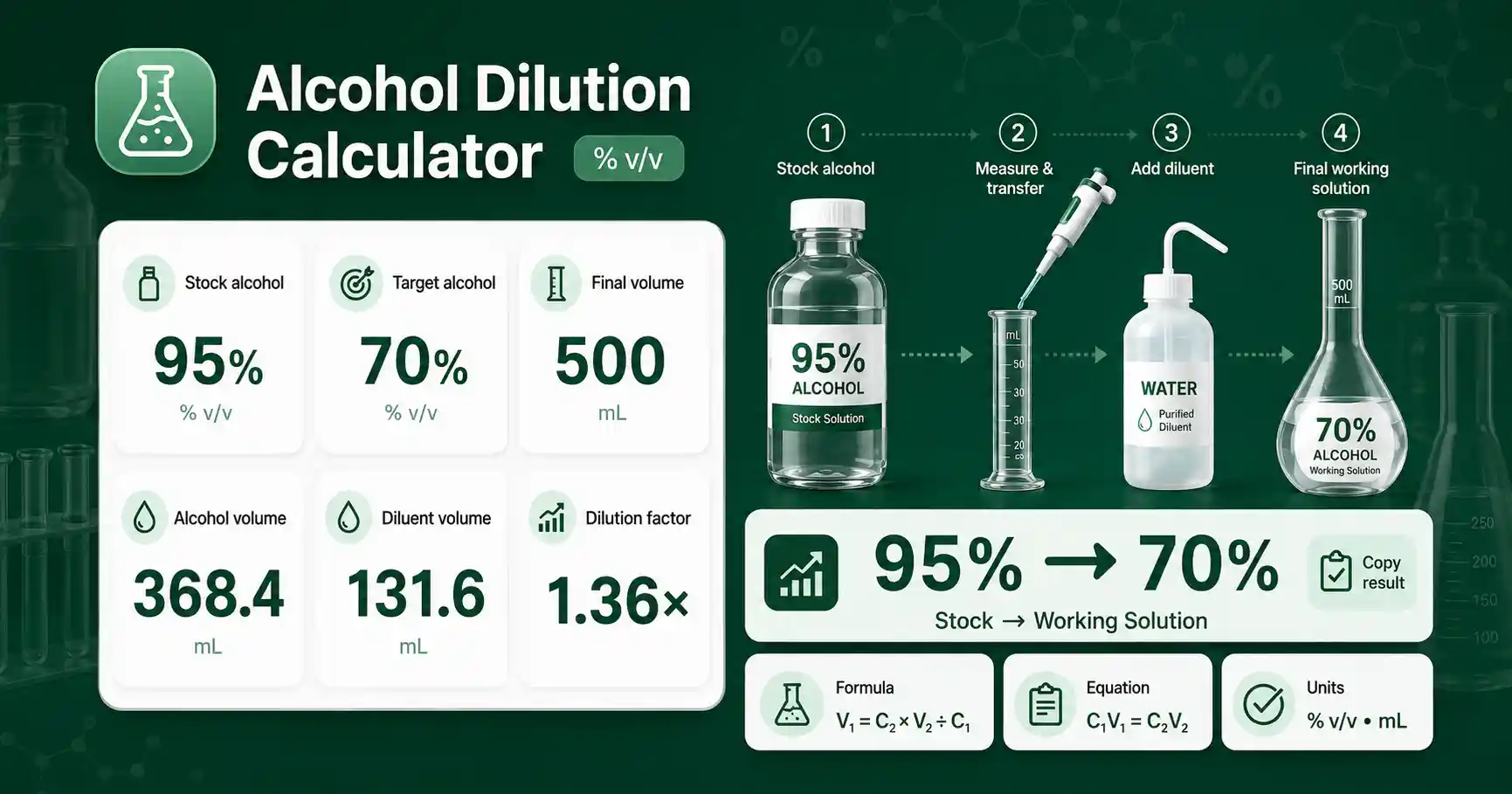
Alcohol Dilution Calculator for ethanol and isopropanol
This Alcohol Dilution Calculator helps you prepare a lower-percent alcohol solution from a stronger stock. It is useful when you need to dilute ethanol, isopropanol, methanol, or another alcohol solution to a working percentage. The tool is designed for percent v/v calculations, which means volume of alcohol per final volume of solution. It gives the volume of alcohol stock to add and the volume of diluent needed.
The calculator is helpful for students learning solution dilution, teachers writing lab examples, and lab workers preparing routine alcohol solutions. It can handle small tube volumes, bench-scale bottles, and liter-scale preparations. It also includes optional overage for workflows where some liquid remains in tips, reservoirs, bottles, or spray containers. The result is a planning aid, not a substitute for your local safety rules or product label.
Alcohol Dilution Calculator formula
The calculator uses C1V1 = C2V2. C1 is the stock alcohol percentage. C2 is the target alcohol percentage. V2 is the final volume you want to prepare. V1 is the volume of stock alcohol that must be added.
The rearranged equation is V1 = C2 × V2 ÷ C1. After the stock volume is calculated, the diluent volume is final volume minus stock volume. The same equation works for 95% ethanol to 70% ethanol, 99% isopropanol to 70% isopropanol, or any other lower target percentage. The target percentage must be lower than or equal to the stock percentage because dilution cannot make a stronger alcohol solution.
Percent values should use the same basis in one calculation. This page assumes volume/volume percent. If a bottle label uses a different basis, such as w/w, convert it first or follow the supplier's preparation instructions.
Alcohol Dilution Calculator worked example
Suppose you need 1,000 mL of 70% ethanol from 95% ethanol stock. The given values are C1 = 95%, C2 = 70%, and V2 = 1,000 mL. Substitute the values into the formula: V1 = 70 × 1,000 ÷ 95. The stock ethanol volume is 736.84 mL.
The diluent volume is final volume minus stock volume. That gives 1,000 mL − 736.84 mL = 263.16 mL. A practical note is to measure 736.84 mL of 95% ethanol and then bring the solution to 1,000 mL total volume with the compatible diluent. This approach is often more accurate than simply adding separately measured volumes when contraction or mixing effects matter.
If you add 10% overage, the calculator prepares 1,100 mL instead of 1,000 mL. The stock ethanol volume becomes 810.53 mL, and the diluent volume becomes 289.47 mL. Overage is useful when a protocol needs extra volume for priming, rinsing, soaking, or transfer loss.
How to interpret alcohol dilution results
The stock volume is the amount of concentrated alcohol solution to use. The diluent volume is the amount of water or compatible diluent needed to reach the final volume. The prepared volume includes overage when you enter an overage percentage. The dilution factor tells you how much weaker the target solution is compared with the stock.
A dilution factor of 1.36 means the stock is diluted about 1.36-fold. The stock fraction shows the percent of the final preparation that comes from the original alcohol stock. The diluent fraction shows the remaining portion of the final preparation. These values help students connect concentration ratios with actual pipetting or measuring steps.
For common alcohol disinfection context, the CDC discusses alcohols among chemical disinfectants and describes uses of ethyl alcohol and isopropyl alcohol in healthcare infection-control settings in its chemical disinfectants guidance. Always follow the product label, institutional biosafety rules, and your protocol. Alcohol concentration alone does not define contact time, surface compatibility, sterility, or safety.
When to use an alcohol dilution calculation
Use this tool when you need to dilute a high-strength alcohol stock to a lower working percent. It helps with ethanol dilution for bench workflows, isopropanol dilution for cleaning-compatible protocols, and chemistry examples that teach percent solutions. It is also useful when a supplier bottle is labeled 95%, 96%, 99%, or 100% and the protocol asks for a lower target percent.
The calculator connects closely to general dilution planning. If your solution is not alcohol based, the Solution Dilution Calculator gives a broader stock-to-working workflow. If you mainly need fold dilution or 1:X notation, the Dilution Factor Calculator can help interpret the ratio.
Students can use the page to practice C1V1 = C2V2 with real wet-lab units. Lab workers can use it to reduce manual arithmetic errors during repetitive preparation. Researchers can use it to scale a small method to a larger bottle while keeping the same target percentage. The copy button makes it easier to paste the result into a notebook or protocol draft.
Common alcohol dilution mistakes to avoid
Do not enter a target percentage higher than the stock percentage. A 70% target can be made from 95% stock, but a 99% target cannot be made from 70% stock by dilution. Do not assume every alcohol bottle is exactly the same percentage. Check the label before calculating.
Do not confuse percent v/v with percent w/w. Density can make these values different. Do not use the calculator to decide whether an alcohol solution is safe for skin, surfaces, instruments, or biological materials. Use the correct approved product and protocol for the specific application.
Alcohols are flammable and can be hazardous. Work away from ignition sources. Use proper ventilation and compatible containers. Label the final solution with alcohol type, target percentage, date, preparer, and any local hazard information. Verify critical lab calculations independently before using them in real experiments.