
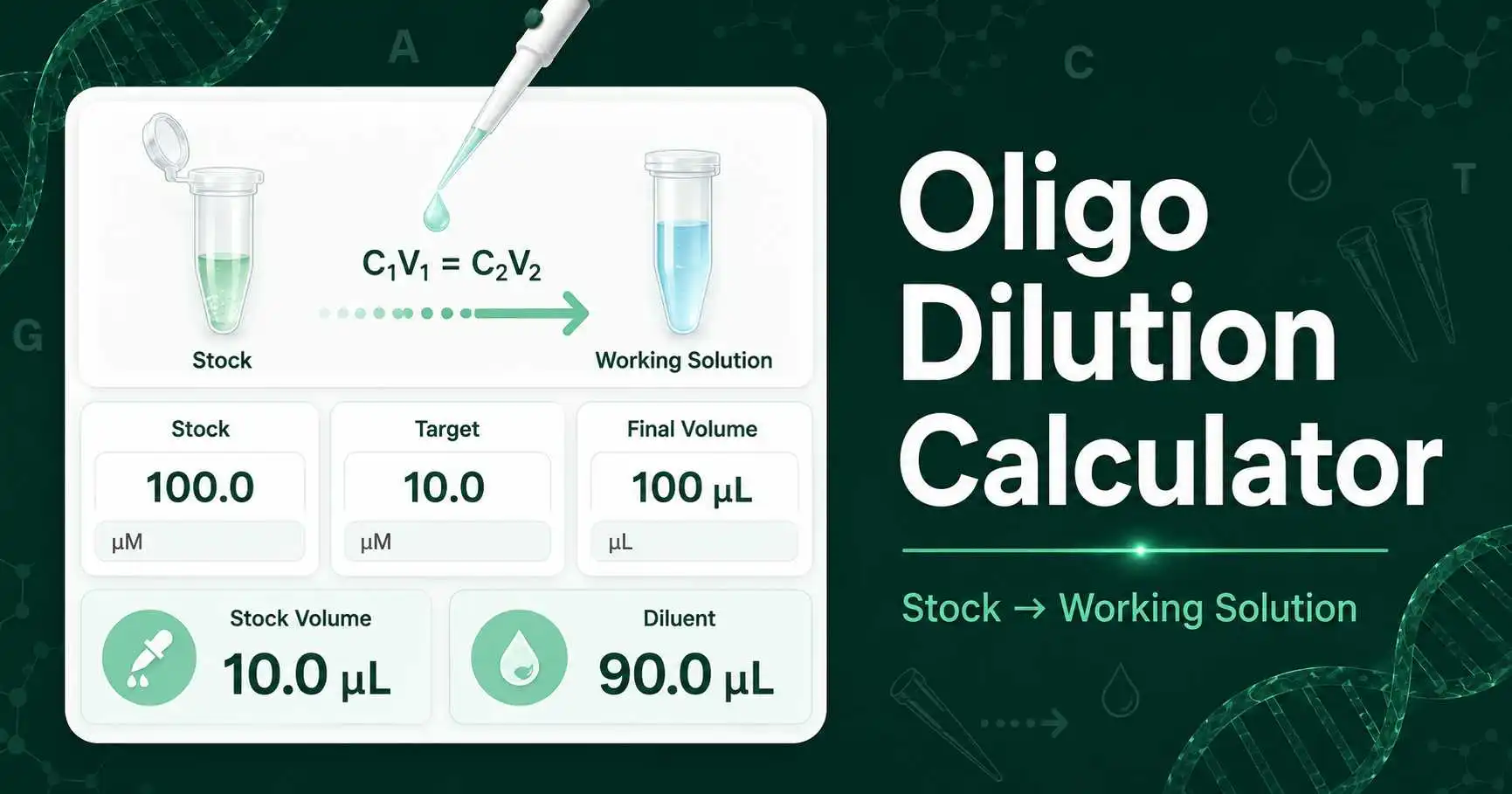
Oligo Dilution Calculator for working stocks
The Oligo Dilution Calculator helps you prepare a lower-concentration oligo solution from a stronger stock. It is commonly used when a dry primer has already been resuspended into a stock solution and you need a working concentration for PCR, qPCR, sequencing, cloning, or routine molecular biology practice.
The tool calculates the volume of stock oligo to add, the volume of diluent to add, the final volume, and the dilution factor. It supports micromolar, nanomolar, and picomolar concentrations, plus microliter and milliliter final volumes.
How to dilute an oligo stock
Enter the stock concentration first. This is the concentration of the oligo solution you already have, such as 100 µM. Then enter the target concentration, such as 10 µM, and the final volume you want to prepare, such as 100 µL. The calculator converts the units internally and returns the amount of stock and diluent to mix.
If you are starting with a dry lyophilized oligo instead of an existing stock, prepare the stock first with the Oligo Resuspension Calculator. If you need to convert between mass, moles, and concentration, use the Oligo Concentration Calculator.
Oligo dilution formula and example
This calculator uses the standard dilution equation C1V1 = C2V2. C1 is the stock concentration. V1 is the stock volume to add. C2 is the target concentration. V2 is the final volume. Rearranged for stock volume, the equation becomes V1 = (C2 × V2) ÷ C1.
Example: to prepare 100 µL of a 10 µM working primer from a 100 µM stock, calculate V1 = (10 × 100) ÷ 100 = 10 µL. Add 10 µL stock oligo and 90 µL nuclease-free water or buffer. The dilution factor is 10×.
The same dilution relationship is part of basic solution chemistry and concentration calculations, as explained in OpenStax Chemistry 2e.OpenStax Chemistry 2e concentration of solutions
Choosing a practical oligo working concentration
Many PCR primer working stocks are prepared at 10 µM, while concentrated primer stocks are often stored around 100 µM. Your lab may use a different value depending on the assay, polymerase, qPCR chemistry, probe format, storage plan, or instrument protocol. Always follow the concentration written in your experiment design or lab SOP.
For routine pipetting, avoid volumes that are too small. If the calculator gives less than 1 µL of stock oligo, prepare a larger final volume or make an intermediate dilution. This reduces pipetting error and makes repeated experiments more consistent.
Common oligo dilution mistakes to avoid
Do not enter a target concentration higher than the stock concentration. Dilution cannot make a solution stronger. Also check that both concentrations are in the correct units. Mixing up µM and nM can produce a 1,000-fold error.
Use the final volume after mixing, not the diluent volume alone. The final volume equals stock volume plus diluent volume. Label the tube with oligo name, concentration, date, and storage condition so the working stock is easy to identify later.
Using oligo dilutions in real lab work
Students can use this calculator to learn how concentration and volume are connected. Lab workers can use it to prepare primer working stocks for PCR setup. Researchers can use it for quick planning before preparing several primers, probes, or short nucleotide sequences.
This calculator provides a planning result, not a guarantee of experimental performance. Verify critical lab calculations independently, use calibrated pipettes, mix the tube well, and confirm that your diluent matches the storage and application requirements of your oligo.