
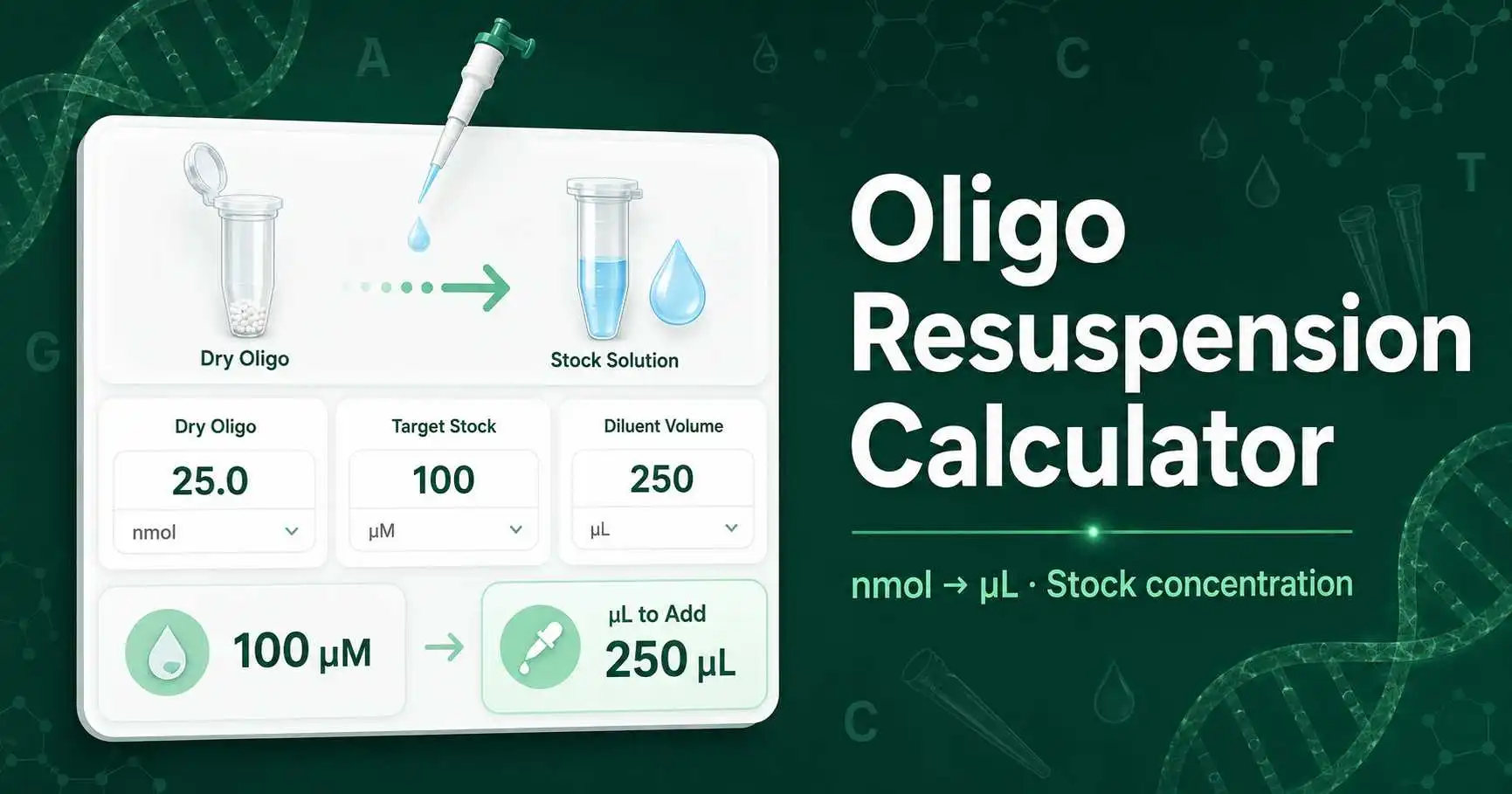
Oligo Resuspension Calculator purpose
The Oligo Resuspension Calculator helps you decide how much liquid to add to a lyophilized DNA or RNA oligonucleotide. It is useful for PCR primers, qPCR primers, sequencing primers, synthetic DNA fragments, short RNA oligos, and routine molecular biology teaching labs.
The tool uses the dry oligo amount and your desired stock concentration to calculate the final resuspension volume. It supports amount units such as pmol, nmol, µmol, µg, and mg. It supports stock concentration units such as nM, µM, and mM.
How to use Oligo Resuspension Calculator
Read the amount printed on the oligo tube or supplier specification sheet. Many primer tubes list the yield in nmol. Enter that value, choose the amount unit, then enter the desired stock concentration. A common primer stock is 100 µM, but your lab may use 10 µM, 50 µM, or another value.
If your supplier gives the oligo amount by mass, select µg or mg and enter the molecular weight in g/mol. Use the molecular weight from the same oligo sheet because sequence length, base composition, and modifications can change mass.
Oligo resuspension formula
The calculator uses the concentration relationship: volume equals amount divided by concentration. When the amount is in nmol and the target concentration is in µM, the direct formula is volume in µL = nmol × 1000 ÷ µM.
For example, a 10 nmol primer resuspended to 100 µM needs 100 µL of diluent. A 20 nmol primer at 100 µM needs 200 µL. This works because 1 µM equals 1 pmol/µL, and 1 nmol equals 1000 pmol.
IDT also describes oligo resuspension and dilution calculators for preparing primers and oligos from supplier values.IDT oligo resuspension guidance
Choosing an oligo stock concentration
A concentrated stock is useful for long-term storage because it takes less tube space and can reduce repeated handling of the original oligo. Many labs prepare a 100 µM stock first, then make a 10 µM working dilution for PCR setup.
For downstream PCR setup, you can pair this calculator with the Oligo Dilution Calculator to prepare a working concentration from your stock. If you need to check the measured or expected concentration, use the Oligo Concentration Calculator.
What the resuspension result means
The main result tells you the volume of diluent to add directly to the dry oligo tube. The calculator also shows the final amount in nmol, the equivalent concentration in pmol/µL, the volume in mL, and an approximate mass concentration when molecular weight is available.
If the result is below 5 µL, pipetting may be inaccurate. If the result is several milliliters, the tube may not hold the calculated volume. In either case, choose a more practical stock concentration or confirm the plan with your lab protocol.
Common oligo resuspension mistakes
The most common mistake is mixing up pmol, nmol, and µmol. Another common error is using a working dilution concentration as if it were the primary stock concentration. Always check whether your number came from the tube label, supplier sheet, or a previous dilution.
Do not enter mass units unless you also enter molecular weight. Do not assume every oligo has the same molecular weight. DNA and RNA oligos differ, and modified bases, labels, linkers, and purification choices can change the final molecular weight.
Lab use notes for oligo resuspension
Use the diluent recommended by your supplier, instructor, or lab protocol. Nuclease-free water is common for many short-term primer uses. TE or Tris-based buffers may be preferred for some storage plans, but EDTA can affect certain downstream enzymatic reactions if carried into the assay at high levels.
Spin the tube briefly before opening it so the dry oligo pellet stays at the bottom. Add the calculated liquid, close the tube, mix gently, and allow enough time for the oligo to dissolve. For valuable oligos, aliquot the stock to reduce freeze-thaw cycles and contamination risk.