
pH Calculator
Use this pH Calculator to calculate pH from hydrogen ion or hydronium ion concentration. It also shows pOH, hydroxide ion concentration, acidity class, and the 25 °C assumption behind the result.
Calculate pH from hydrogen ion concentration
Enter hydrogen ion or hydronium ion concentration. The calculator converts the value to mol/L, applies pH = -log10[H+], and estimates pOH at 25 °C.
Use for direct molar hydrogen ion concentration. Scientific notation such as 2.5e-4 is accepted.
pH result
Near neutralThe value is close to neutral water at 25 °C. Small measurement errors may matter in this range.
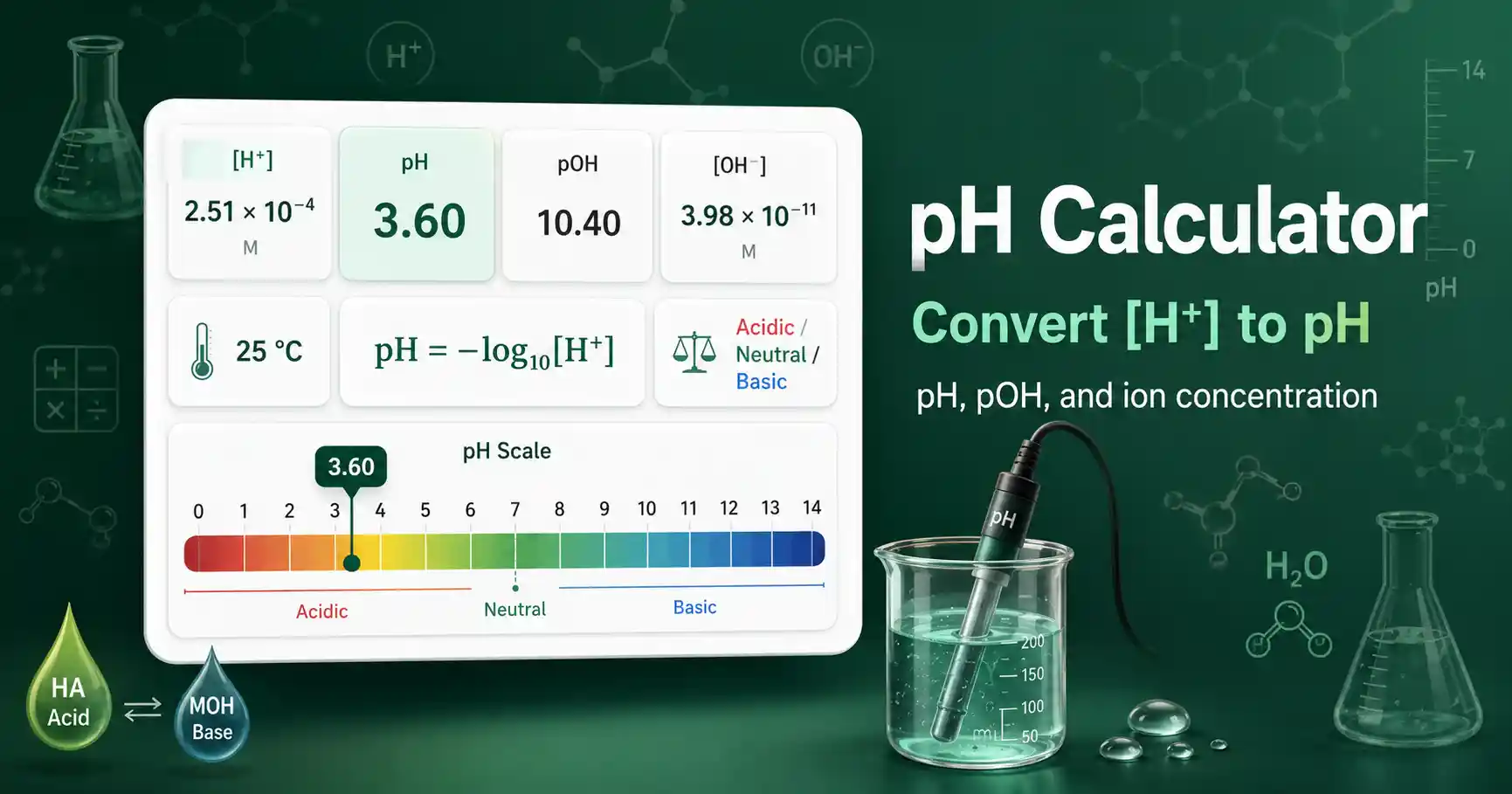
pH Calculator formula and result meaning
This pH Calculator finds the pH of an aqueous solution from hydrogen ion concentration. It uses hydrogen ion concentration as [H+] and treats hydronium ion concentration, [H3O+], as the same practical input. The calculator first converts your selected unit into mol/L. It then applies the logarithmic pH formula. The result helps you describe whether a sample is acidic, near neutral, or basic.
The core equation is simple, but the logarithmic scale can make mental math difficult. A tenfold increase in [H+] lowers pH by one unit. A tenfold decrease in [H+] raises pH by one unit. That is why 0.001 M hydrogen ion concentration has pH 3, while 0.000001 M has pH 6. The number looks small, but the pH change is chemically large.
pH = -log10([H+])
[H+] = 10^(-pH)
pH + pOH = 14 at 25 °C
Students can use the tool to check homework problems about acid concentration and logarithms. Teachers can use it to show how the pH scale compresses concentration values. Lab workers can use it as a quick sanity check before writing a calculation in a notebook. Researchers can use it for non-clinical planning notes when a simple concentration-to-pH conversion is enough.
If you need to compare this result with hydroxide concentration, use the pOH Calculator. If you are estimating a buffer made from a weak acid and conjugate base, the Henderson-Hasselbalch Calculator is usually the better next step.
How to calculate pH from hydrogen ion concentration
Enter the numerical hydrogen ion concentration first. Then choose the matching concentration unit. The calculator accepts mol/L, mmol/L, µmol/L, nmol/L, and pmol/L. Unit choice matters because pH must be calculated from mol/L. Entering 1 as mM gives 0.001 M, not 1 M. This difference changes the pH by three full units.
The pH value tells you the order of magnitude of hydrogen ion concentration. Low pH means more hydrogen ion activity. High pH means less hydrogen ion activity. A pH close to 7 is often described as neutral for dilute water-based solutions at 25 °C. A pH below 7 is acidic. A pH above 7 is basic under the same simple assumption.
The calculator also estimates hydroxide ion concentration from the ion product of water. It uses Kw = 1 × 10^-14 at 25 °C. This assumption is useful for introductory chemistry and many quick checks. It is not a full activity correction model. Temperature, ionic strength, concentrated acid or base, and instrument calibration can all affect real measured pH.
For a concise chemistry reference on the pH and pOH relationship, see the OpenStax Chemistry 2e section on pH and pOH.
pH Calculator worked example
Suppose a solution has hydrogen ion concentration of 2.5 × 10^-4 M. The concentration is already in mol/L, so no unit conversion is needed. The formula is pH = -log10([H+]). Substitution gives pH = -log10(2.5 × 10^-4). The calculated value is pH = 3.602.
[H+] = 2.5 × 10^-4 M
Temperature assumption = 25 °C
pH = -log10([H+])
pH = -log10(2.5 × 10^-4)
pH = 3.602
pOH = 10.398
The solution is acidic because its pH is below 7. The value is reasonable because 2.5 × 10^-4 M lies between 10^-3 M and 10^-4 M, so the pH should fall between 3 and 4.
Rounding matters because pH is logarithmic. Reporting pH as 3.60 is usually clearer than reporting too many decimals for a classroom calculation. For critical lab work, report the precision supported by your measurement method. Verify critical lab calculations independently before using them in real experiments.
pH calculation limits and common mistakes
The most common mistake is using the wrong concentration unit. A value of 10 µM is 1 × 10^-5 M, so the pH is 5. A value of 10 mM is 1 × 10^-2 M, so the pH is 2. Those two entries look similar but differ by three pH units. Always confirm the unit on the tube label, worksheet, or instrument output.
Another common mistake is treating the calculated pH as a measured pH. A calculation from [H+] is not the same as a calibrated pH meter reading. The calculator does not correct for activity coefficients. It does not solve weak acid equilibrium. It does not account for buffer capacity. It does not replace a pH meter when an experiment requires measured pH.
The calculator can produce values below 0 or above 14 for very concentrated solutions. Those values are possible in the mathematical definition, but they need careful interpretation. In concentrated solutions, activity and calibration limits become important. For ordinary dilute educational problems, the 0 to 14 range is the most familiar scale.
Use this tool when the input is hydrogen ion or hydronium concentration. Use a buffer equation when the input is pKa and acid-base ratio. Use an acid-base equilibrium method when the input is weak acid concentration and Ka. The right tool depends on what chemical information you actually have.
Related pH and acid-base tools
User Queries About pH Calculator
- What concentration should I enter in a pH calculator?
- Enter the hydrogen ion or hydronium ion concentration for the solution. Use the unit selector carefully, because pH must be calculated from mol/L.
- Why does the calculator also show pOH?
- At 25 °C, pH and pOH add to 14 for dilute aqueous solutions. Showing pOH helps you compare hydrogen ion and hydroxide ion concentration in the same result.
- Can pH be below 0 or above 14?
- Yes, the equation can return values outside the familiar 0 to 14 range. These results need careful interpretation because concentrated solutions do not behave like ideal dilute solutions.