
PCR Product Size Calculator direct answer
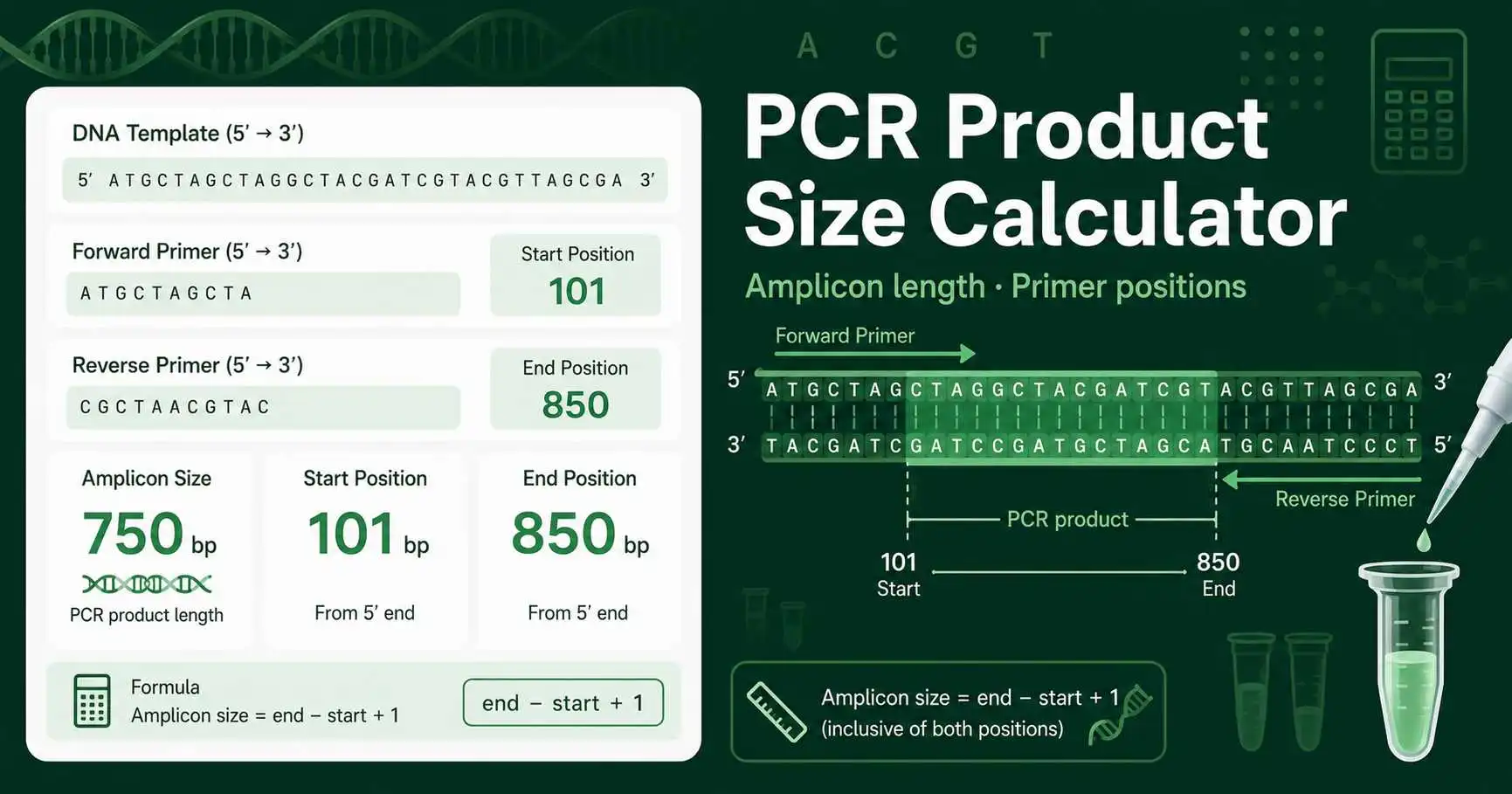
A PCR Product Size Calculator predicts the length of the DNA fragment amplified by a primer pair. It searches the DNA template for the forward primer and the reverse primer binding site. Then it reports the amplicon size in base pairs.
Enter the forward primer and reverse primer exactly as you would order them, both in 5′ to 3′ direction. The calculator reverse-complements the reverse primer internally because the reverse primer binds to the opposite strand of the template.
How to calculate PCR product size from primers
PCR product size depends on the first base of the forward primer site and the last base covered by the reverse primer binding site. For a linear template, the calculation is simple once both binding sites are known.
Formula: PCR product size = reverse primer binding site end position − forward primer start position + 1.
For example, if the forward primer starts at base 120 and the reverse primer binding site ends at base 685, the expected PCR product size is 685 − 120 + 1 = 566 bp. This number is the amplicon length you would compare with a DNA ladder on an agarose gel.
Worked example for expected amplicon length
Suppose a template is 1,200 bp long. The forward primer matches bases 210–229. The reverse primer binding site matches bases 740–759 on the same pasted template strand. The product starts at base 210 and ends at base 759.
The practical calculation is 759 − 210 + 1 = 550 bp. The primer lengths do not need a separate addition because the start and end positions already include the bases covered by both primers.
If the same primer pair gives several products, the template has more than one exact binding site. Review the binding positions and check primer specificity before using the pair in real PCR.
Use case 1: checking a PCR band before gel electrophoresis
Students often know the template sequence and primer sequences but do not know what band size to expect. This calculator gives the expected product size before running the PCR. You can compare the result with the band position on a DNA ladder.
If the calculator predicts a 420 bp product and the gel shows a strong band near 420 bp, the result supports the expected amplification. If the gel shows a band at 900 bp, primer mismatch, off-target amplification, template contamination, or incorrect primer choice may be involved.
Use case 2: checking cloning and colony PCR primers
In cloning, PCR product size helps confirm whether an insert, vector region, or junction is present. Colony PCR primers may sit inside the insert, outside the multiple cloning site, or across a vector-insert boundary.
For plasmids, turn on circular template mode if the expected product crosses the pasted sequence origin. Circular mode is useful when a primer binds near the end of a plasmid sequence and the other primer binds near the beginning.
Primer direction and reverse-complement logic
Primer direction causes many product-size errors. The forward primer is searched directly on the pasted template strand. The reverse primer is entered in 5′ to 3′ order, but its reverse complement is the sequence that appears on the pasted template strand.
NCBI Primer-BLAST uses the same biological idea when it asks for user-provided primers in 5′ to 3′ orientation and reports PCR product size ranges for primer pair design.NCBI Primer-BLAST
What to check when no PCR product appears
First, confirm that the template sequence is complete and written with A, C, G, and T only. Then check whether the forward primer is copied correctly. Next, confirm that the reverse primer is not accidentally pasted as its reverse complement.
If you work with plasmid DNA, try circular mode. If the primers contain designed mismatches, restriction tails, adapters, or barcode overhangs, only the template-matching part may bind. In that case, trim the non-template 5′ tail before searching for exact binding sites.
PCR product size versus PCR success
A correct amplicon size does not guarantee successful amplification. Product size only answers one question: where do the primers bind and how long is the DNA fragment between them?
Before real lab use, also check primer melting temperature with a Primer Tm Calculator, primer concentration, GC content, primer-dimer risk, polymerase instructions, magnesium concentration, and cycling conditions. When preparing reactions, use a PCR Master Mix Calculator to reduce pipetting errors.