
Molecular Lab Tools calculator
BCA Assay Calculator
Calculate BCA protein concentration from A562, blank correction, standard curve, and dilution factor. Use it for classroom work, protocol planning, and quick wet-lab checks before you verify final values independently.
BCA concentration
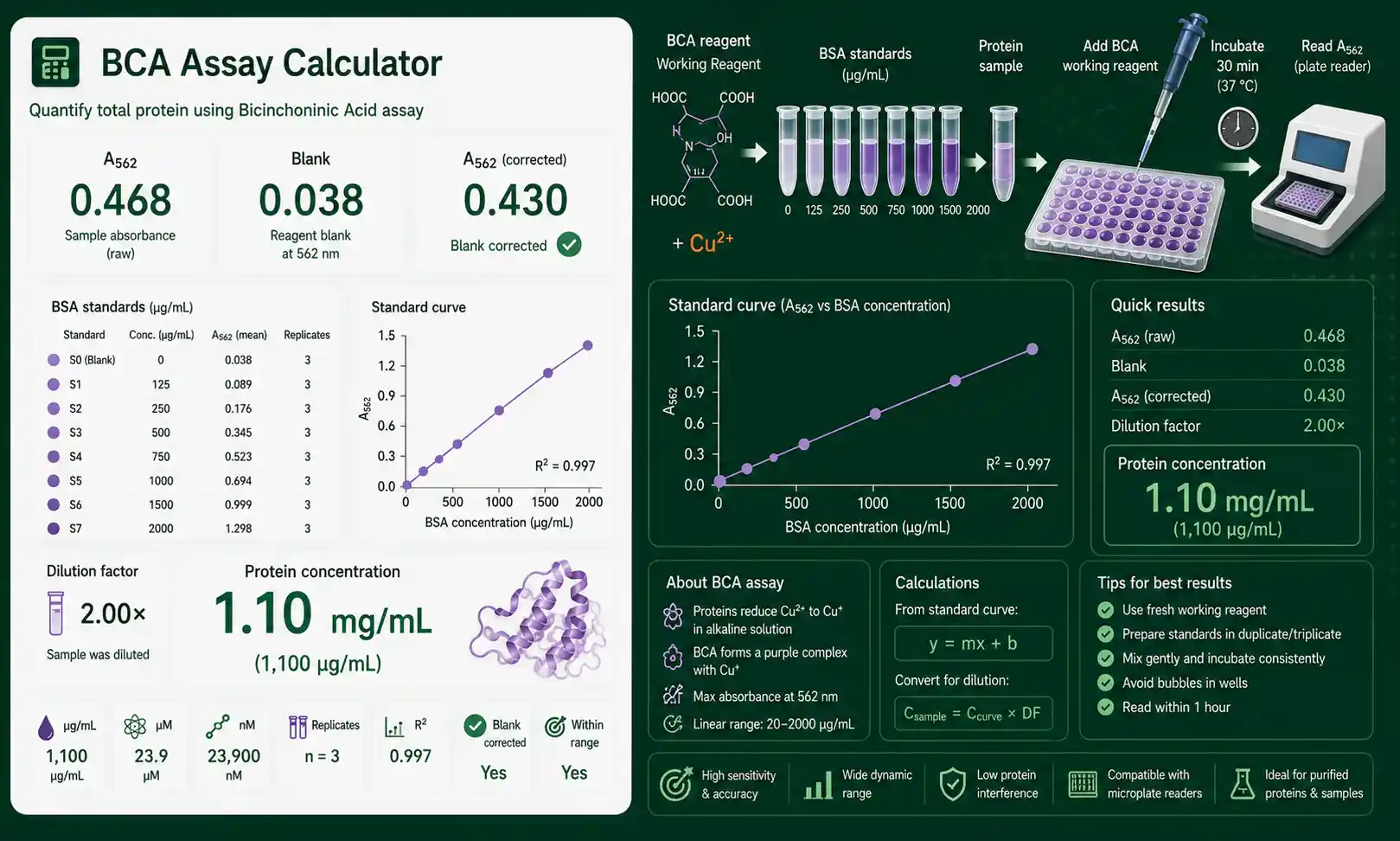
BCA Assay Calculator explained
This BCA assay calculator uses a linear standard curve to convert A562 into protein concentration.
It performs blank correction, slope-intercept calculation, and dilution correction for the original protein sample.
The tool fits common BCA workflows that use BSA standards, microplate wells, and a plate reader.
The calculator handles empty fields, invalid numbers, and common input formatting mistakes. It gives a clear result and a short interpretation so users can decide what to check next. Students can use the page to learn the calculation logic. Lab workers can use it to reduce manual arithmetic errors. Researchers can use it as a first-pass planning aid before confirming the design with the relevant protocol, reagent datasheet, or analysis software.
For background reading, see this trusted reference: supporting educational source.
BCA Assay Calculator worked example
Given A562 0.78, blank 0.05, slope 0.48, intercept 0.02, and dilution factor 5, the calculator reports the original sample concentration.
The result should be treated as a planning estimate. Always verify critical lab calculations independently before using them in real experiments.
For related planning, you may also use the Protein Concentration Calculator or compare the next step with the Bradford Assay Calculator.
Related tools
Practical questions about BCA Assay Calculator
Can I use this result directly in an experiment?
Use the result as a careful planning estimate. Recheck important values with your protocol, instrument settings, and reagent documentation.
Why does the tool show warnings?
The warnings catch common mistakes such as missing required values, impossible negative values, unsuitable sequence characters, or values outside a typical screening range.
Does the tool replace experimental validation?
No. It supports calculation and screening, but final biological performance depends on the sample, assay, protocol, and experimental controls.