
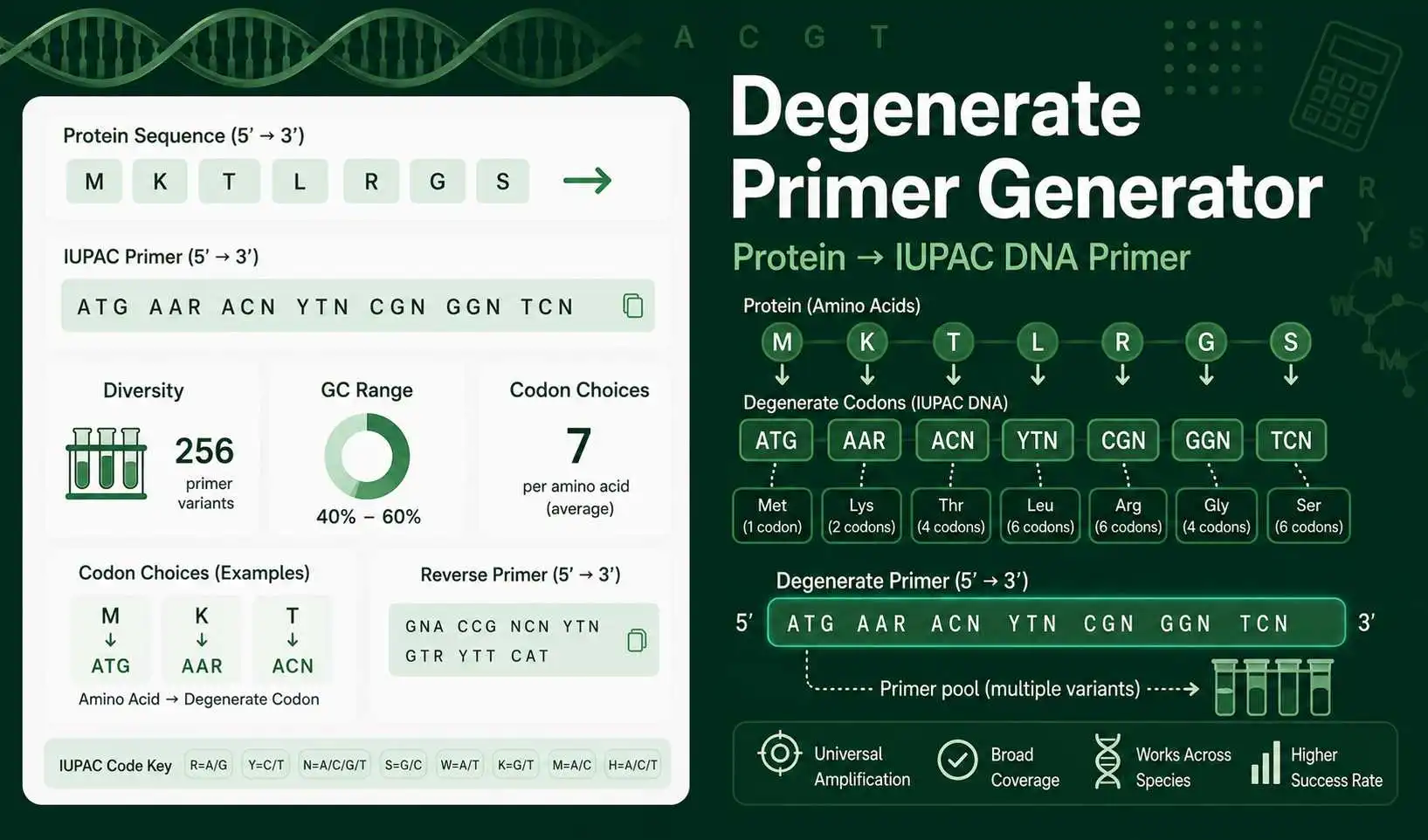
Degenerate Primer Generator for protein to DNA design
A Degenerate Primer Generator converts a protein sequence into DNA primer options that use IUPAC ambiguity symbols. It helps when you know a conserved amino acid sequence but do not know the exact nucleotide sequence in your target organism.
The tool is useful for PCR primer design from conserved proteins, gene family screening, cloning unknown homologs, and teaching the genetic code. It gives direct outputs: primer length, compact degenerate sequence, exact primer diversity, GC range, and codon choices for each amino acid.
How the degenerate primer calculation works
The calculator reads each amino acid and maps it to standard DNA codons. It then compresses compatible bases into IUPAC codes. For example, alanine uses GCT, GCC, GCA, and GCG. These four codons become GCN because N means A, C, G, or T.
Some amino acids need more than one compact group. Leucine can use CTN or TTR. Arginine can use CGN or AGR. Serine can use TCN or AGY. Splitting these families avoids a single broad degenerate codon that would add many unwanted amino acids.
The main practical equation is simple: total primer diversity equals the product of the codon possibilities for every amino acid in the selected peptide region.
Worked example for a degenerate primer
Suppose your conserved peptide is MKT. Methionine uses ATG, lysine uses AAR, and threonine uses ACN. The compact forward degenerate primer becomes ATGAARACN.
The diversity calculation is 1 × 2 × 4 = 8 exact primer molecules. The primer is 9 nucleotides long because three amino acids make three codons. In real PCR primer design, you would usually use a longer peptide region, but this short example shows the logic clearly.
Use case 1: Finding a homolog from a conserved protein
A researcher may align several related proteins and find a conserved peptide region. The generator can convert that protein region into a degenerate DNA primer. This helps when the exact gene sequence is unknown but the amino acid sequence is conserved across species.
In this case, choose a region with low degeneracy, avoid long stretches rich in leucine, arginine, and serine, and check the final primer with a Primer Tm Calculator. Lower diversity often gives a stronger effective primer concentration for the correct target.
Use case 2: Teaching codon degeneracy and IUPAC symbols
Students can use this page to connect the genetic code with primer design. They can enter a short protein sequence, inspect the codon table, and see how symbols such as R, Y, H, and N represent different DNA bases.
This is also a good way to explain why the same amino acid can have several codons. The tool shows both the compact degenerate codon and the exact codons behind it. For a broader symbol lesson, compare the output with the IUPAC DNA Code Converter.
How to choose a better peptide region
A good degenerate primer region is short enough to control diversity but long enough to bind specifically. Regions containing methionine and tryptophan are helpful because they each have one codon. Regions with many leucine, arginine, or serine residues often produce more primer options.
Watch the diversity value. A primer pool with 32 or 64 variants is easier to use than a pool with thousands of variants. Very high diversity can dilute the effective concentration of each exact primer molecule and may increase non-specific amplification.
Practical problem before ordering primers
Compare two candidate peptide regions. Region A has MKTW and region B has LRSV. Region A has low degeneracy because M and W each have one codon. Region B is more complex because L, R, and S each split across multiple codon groups.
In practice, start with the region that gives lower degeneracy, reasonable GC range, and a clean 3′ end. Then check target specificity, primer-dimer risk, and expected amplicon size before ordering.
Important assumptions and lab checks
This tool uses the standard genetic code and DNA primer notation. It does not optimize for a specific organism, codon usage table, inosine placement, modified bases, or primer supplier constraints. It also does not guarantee target specificity.
Review IUPAC mixed-base notation before placing an oligo order. IDT provides practical guidance on entering mixed bases and degenerate bases for oligo ordering. IDT mixed bases and degenerate bases guidance
Verify critical lab calculations independently. Check the primer sequence, orientation, GC content, melting temperature, 3′ end, secondary structure, and expected PCR product before using the result in a real experiment.