
Biochemistry calculator
Inhibitor Dilution Calculator
Calculate inhibitor stock volume, diluent volume, working concentration, serial dilution steps, and final assay solvent percentage from stock and target concentrations.
Inhibitor dilution calculator
Calculate inhibitor stock and diluent volumes
Use C1V1 = C2V2 to prepare inhibitor working solutions and check final solvent percentage for assay wells.
Inputs
Results
The calculated dilution stays within the selected solvent limit. Check pipetting volume before using it in a real assay.
The stock volume is below 1 µL. Make an intermediate dilution for better pipetting accuracy.
Formula used: C1V1 = C2V2. Final solvent percent is based on the fraction of stock carried into the final solution.
Serial dilution helper
Use this table as a planning aid for equal-factor dilution series. Verify the layout and pipetting scheme before lab use.
| Step | Concentration | Transfer | Diluent |
|---|---|---|---|
| 1 | 10 µM | 333.3 µL | 666.7 µL |
| 2 | 3.333 µM | 333.3 µL | 666.7 µL |
| 3 | 1.111 µM | 333.3 µL | 666.7 µL |
| 4 | 0.3704 µM | 333.3 µL | 666.7 µL |
| 5 | 0.1235 µM | 333.3 µL | 666.7 µL |
| 6 | 0.04115 µM | 333.3 µL | 666.7 µL |
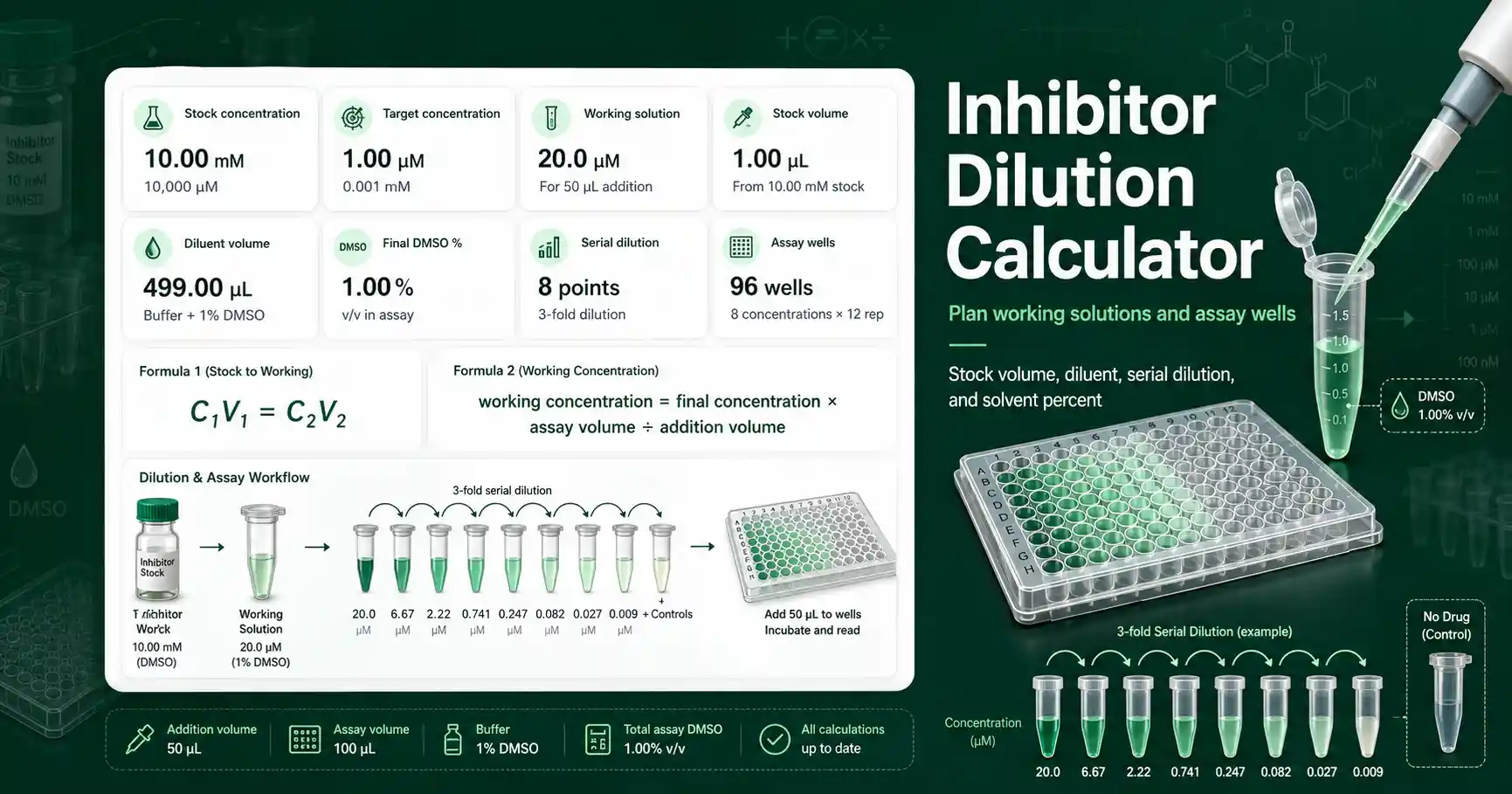
Inhibitor Dilution Calculator for assay setup
The Inhibitor Dilution Calculator helps you turn a concentrated inhibitor stock into a practical working solution. It uses the standard dilution equation C1V1 = C2V2. It calculates how much stock solution to add. It calculates how much diluent to add. It also checks the final solvent percentage carried from the stock. This is useful when an inhibitor is stored in DMSO, ethanol, water, or another compatible solvent. Students can use the calculator to learn dilution logic. Teachers can use it to demonstrate why small stock volumes can create large pipetting errors. Lab workers can use it to plan working solutions before an assay plate. Researchers can use it to keep inhibitor concentration and vehicle concentration consistent across samples.
Direct dilution mode is best when you want to prepare one working solution. You enter the inhibitor stock concentration, target working concentration, and final working volume. Assay wells mode is best when you know the desired final concentration inside each well. The calculator then accounts for well volume, inhibitor addition volume, number of wells, and overage. This makes it easier to prepare enough working solution for a plate or tube set. It also reports the working solution concentration required before it enters the assay.
The calculation assumes complete mixing and no chemical loss during dilution. It does not check compound stability, precipitation, adsorption to plastic, or biological activity. It treats concentration as a simple molar amount per volume. It does not replace a validated protocol or an assay-specific plate map. Verify critical lab calculations independently before using them in real experiments.
Inhibitor dilution formula and solvent check
The main formula is C1V1 = C2V2. C1 is the stock inhibitor concentration. V1 is the stock volume you need. C2 is the target concentration. V2 is the final solution volume. The calculator rearranges the equation to V1 = C2 × V2 ÷ C1. The diluent volume is V2 − V1. The dilution factor is C1 ÷ C2. These values are valid only when the target concentration is lower than the stock concentration.
Solvent percentage matters because inhibitor stocks often contain 100% DMSO. A 10 mM stock diluted to 10 µM gives a 1:1000 dilution. If the stock solvent is 100% DMSO, the final solvent percentage is 0.1%. If the final assay limit is 1%, that result stays below the selected limit. If the target concentration is too high or the stock is too weak, the solvent percentage can rise quickly. The calculator flags this so you can change the stock concentration, target concentration, or addition volume.
Many assay workflows try to keep vehicle concentration consistent across wells. The NCBI Assay Guidance Manual discusses practical assay setup concerns, including solvent and compound-handling considerations, in its assay operations guidance. This calculator supports that planning step by showing both concentration and solvent carryover. It does not decide whether a solvent level is safe for a specific assay. You should use the same vehicle percentage in controls when the assay design requires it.
If you are preparing a dose-response plate, this page can help plan the first working concentration and an equal-factor serial dilution. After the dilution series is prepared, the IC50 Calculator can help analyze response data. For activation or stimulation curves, the EC50 Calculator is the better next tool. Keep the dilution table, plate map, concentration unit, and vehicle control notes together in your lab record.
Inhibitor Dilution Calculator worked example
Given values: Stock inhibitor = 10 mM, final assay target = 10 µM, final well volume = 100 µL, inhibitor addition = 1 µL, wells = 96, and overage = 10%.
Working concentration needed: working concentration = final concentration × final well volume ÷ addition volume.
Substitution: working concentration = 10 µM × 100 µL ÷ 1 µL = 1000 µM, or 1 mM.
Working volume: 1 µL × 96 wells × 1.10 = 105.6 µL.
Stock volume: V1 = C2 × V2 ÷ C1 = 1 mM × 105.6 µL ÷ 10 mM = 10.56 µL.
Diluent volume: 105.6 µL − 10.56 µL = 95.04 µL.
Interpretation: Prepare about 105.6 µL of 1 mM working inhibitor by mixing 10.56 µL stock with 95.04 µL diluent, then add 1 µL per 100 µL well to reach 10 µM.
This example is reasonable because the stock volume is above 1 µL. The working dilution is a clean 1:10 dilution from 10 mM to 1 mM. The final concentration in the assay is another 1:100 dilution from the working solution into the well. If the stock is in 100% DMSO, the working solution is 10% DMSO and the final assay solvent is 0.1% DMSO. That solvent level is below a 1% limit, but the acceptable limit still depends on the assay.
How to interpret inhibitor dilution results
A small stock volume can be mathematically correct but difficult to pipette accurately. If the calculator shows less than 1 µL of stock, prepare a larger volume or make an intermediate dilution. A very large dilution factor can also create avoidable error. Serial dilution can improve practical handling because each step uses a repeatable transfer volume. Equal-factor serial dilution is common for dose-response experiments because each concentration changes by the same fold amount.
The working solution concentration is not always the same as the final assay concentration. If you add 1 µL of inhibitor working solution into a 100 µL well, the working solution is diluted 100-fold in the well. This means a 1 mM working solution becomes 10 µM in the assay. Always confirm whether a concentration label refers to the tube, the working solution, or the final assay mixture. Many mistakes happen when these three contexts are mixed.
Rounding should match the pipettes and volumes you actually use. A result of 10.56 µL may be practical with a P20 pipette. A result of 0.056 µL is not practical for routine manual pipetting. Unit conversion also matters. A 10 mM stock is 10,000 µM, not 10 µM. A final volume of 1 mL is 1000 µL. The calculator handles these unit conversions, but you should still review the setup before preparing the dilution.
Practical Questions About Inhibitor Dilution
What does the Inhibitor Dilution Calculator calculate?
It calculates stock volume, diluent volume, dilution factor, working solution concentration, and final solvent percentage for inhibitor dilution planning.
Why does final solvent percentage matter?
Final solvent percentage matters because solvents such as DMSO can affect enzyme activity, cell response, signal background, or compound solubility in assay systems.
When should I use an intermediate dilution?
Use an intermediate dilution when the calculated stock volume is too small to pipette accurately or when the dilution factor is very large.
Can I use this for IC50 or EC50 plate setup?
Yes, you can use it to plan the first working solution and serial dilution concentrations. You still need a clear plate map and matched vehicle controls for the actual response assay.