
mg/mL to Molarity Calculator
Convert a compound concentration in mg/mL into M, mM, µM, and nM using the molecular weight of the exact chemical form you are working with.
mg/mL to Molarity Calculator explained in one minute
To convert mg/mL to molarity, divide the concentration in mg/mL by molecular weight in g/mol. The shortcut works because 1 mg/mL is numerically equal to 1 g/L, so (g/L) ÷ (g/mol) gives mol/L.
Convert mg/mL to molarity
Convert a mass concentration into mol/L, mM, µM, and nM using the compound molecular weight.
Enter your values
Your result
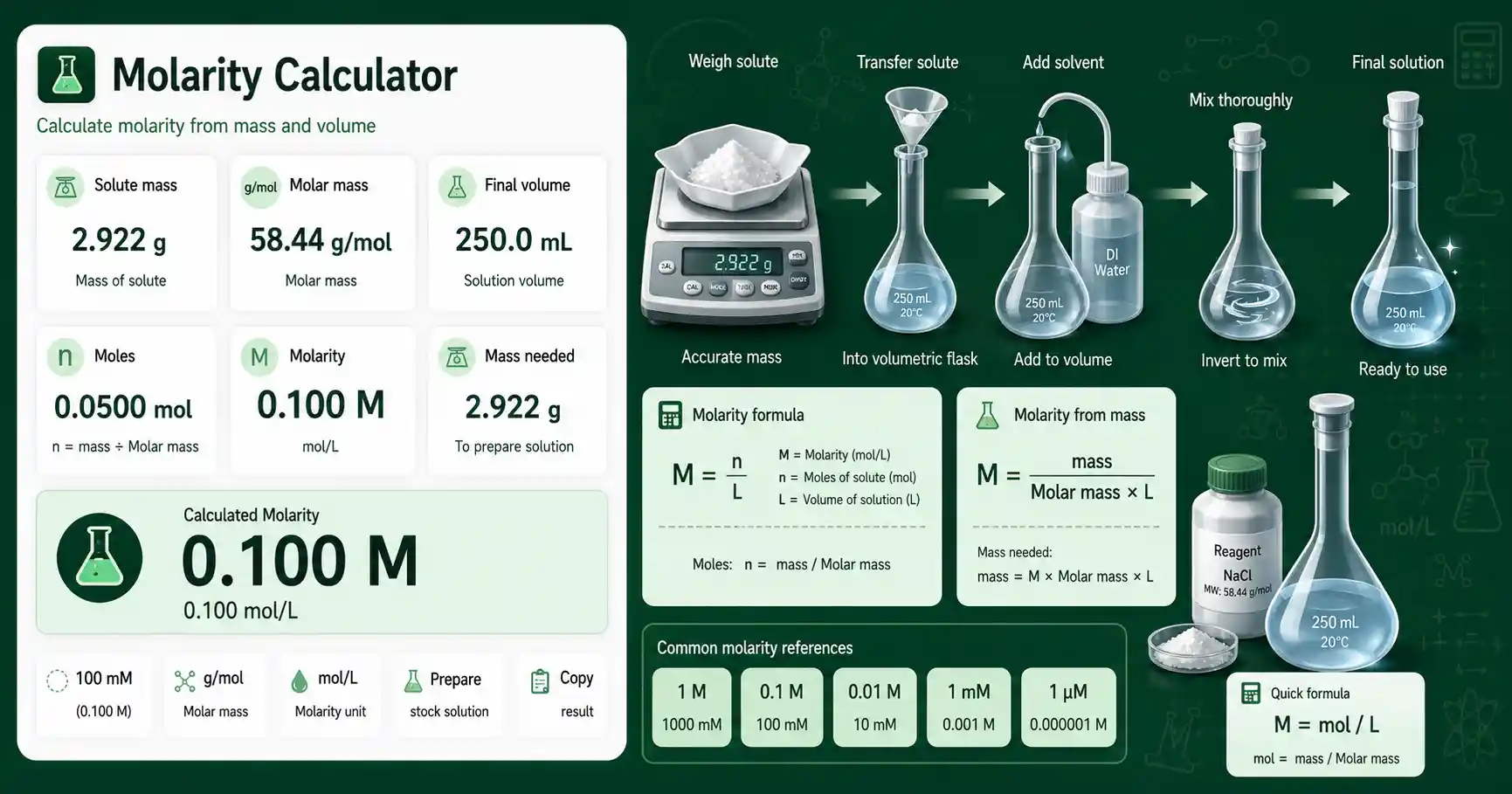
How to use the mg/mL to Molarity Calculator
Enter the values from your protocol, reagent label, spectrophotometer, or experiment, then use the result together with the formula and assumptions shown on this page.
- 1
Enter the measured or stated mass concentration in mg/mL.
- 2
Enter molecular weight in g/mol for the exact compound form on the vial, certificate of analysis, or reagent specification.
- 3
Read the molarity in mol/L (M) and the automatically converted mM, µM, and nM values.
- 4
If the material is a salt, hydrate, or solvated form, confirm whether your concentration and molecular weight refer to that full form or to the active parent compound.
- 5
Use the result as the stock concentration in downstream dilution calculations when the assumptions match your reagent and protocol.
- 6
For critical work, verify batch-specific molecular weight and purity information before preparing or interpreting a stock solution.
How do you convert mg/mL to molarity?
Divide the mass concentration in mg/mL by the molecular weight in g/mol to obtain molarity in mol/L.
The relationship is simple because mg/mL and g/L have the same numerical value. A solution that contains 10 mg/mL also contains 10 g/L. Dividing 10 g/L by a molecular weight of 180.16 g/mol gives about 0.0555 mol/L, or 55.5 mM.
This conversion is especially useful when a supplier reports solubility or stock concentration in mg/mL but an assay protocol specifies the working concentration in mM or µM.
| Quantity | Relation | Meaning |
|---|---|---|
| Mass concentration | 1 mg/mL = 1 g/L | Mass of solute per solution volume |
| Molarity | M = g/L ÷ g/mol | Moles of solute per liter |
| Millimolar | mM = M × 1,000 | 10⁻³ mol/L |
| Micromolar | µM = M × 1,000,000 | 10⁻⁶ mol/L |
| Nanomolar | nM = M × 1,000,000,000 | 10⁻⁹ mol/L |
Why molecular weight changes the molarity of the same mg/mL concentration
At the same mass concentration, a lower-molecular-weight compound contains more molecules and therefore has a higher molarity than a higher-molecular-weight compound.
For example, 1 mg/mL of a 100 g/mol compound is 10 mM, while 1 mg/mL of a 500 g/mol compound is only 2 mM. The mass concentration is identical, but each mole of the heavier compound contains five times more mass.
This is why you cannot convert mg/mL to mM without molecular weight. A concentration such as 5 mg/mL does not have one universal molar value; the answer depends on what chemical is dissolved.
Which molecular weight should you use for salts, hydrates, and solvates?
Use the molecular weight that matches the exact chemical form represented by your weighed mass or stated stock concentration unless your protocol explicitly defines concentration as parent-compound equivalents.
A free base, hydrochloride salt, sodium salt, hydrate, and solvate can all have different formula weights. If the bottle contains a salt but you divide by the molecular weight of the free compound, the calculated molarity of the material actually weighed will be wrong.
Batch-specific water content or solvation can also matter for some reagents. Supplier tools and certificates of analysis may list a batch-specific molecular weight or correction. Follow that information when accurate stock preparation is important.
- Read the full reagent name, not only the parent molecule name.
- Check the molecular weight on the vial or certificate of analysis.
- Distinguish chemical-form molarity from active-moiety or parent-compound equivalents when a protocol makes that distinction.
- Account for purity or potency separately if the protocol requires an effective rather than nominal concentration.
Using mg/mL to mM conversion for stock solutions
Once mg/mL has been converted to mM, that molar concentration can be used as C1 in standard dilution calculations such as C1V1 = C2V2.
Suppose a compound stock is 25 mg/mL and its molecular weight is 250 g/mol. The stock is 0.100 M, or 100 mM. If you need a 10 µM working solution, you can then calculate the required dilution from a 100 mM stock.
Large dilution factors are often more accurate when prepared through an intermediate stock rather than by pipetting a very small volume directly into the final assay. Use your laboratory's validated dilution practice and pipette range.
Common mg/mL to molarity conversion mistakes
Most errors come from incorrect molecular weight, unit confusion, or forgetting that salts and hydrates may have a different formula weight from the parent compound.
- Do not multiply by 1,000 before dividing by molecular weight when your starting unit is already mg/mL; the mg/mL to g/L numerical conversion is 1:1.
- Do not enter molecular weight in kDa or mg/mmol without converting it to g/mol first.
- Do not use the parent drug or free-base molecular weight when the weighed material is a salt unless your method explicitly uses parent equivalents.
- Do not confuse mM with µM: 1 mM equals 1,000 µM.
- Do not infer solubility from molarity alone; a mathematically possible concentration may exceed the compound's physical solubility in the chosen solvent.
- For experimental stocks, confirm solvent compatibility, stability, and storage conditions in the reagent documentation.
Convert 10 mg/mL to mM: worked example
Assume a compound concentration of 10 mg/mL and a molecular weight of 180.16 g/mol. This is close to the molecular weight of glucose and provides a simple unit demonstration.
10 mg/mL is numerically equal to 10 g/L.
M = 10 g/L ÷ 180.16 g/mol.
M ≈ 0.0555 mol/L.
0.0555 M × 1,000 ≈ 55.5 mM.
55.5 mM × 1,000 ≈ 55,500 µM.
g/L divided by g/mol leaves mol/L, confirming the dimensional conversion.
Interpretation: A 10 mg/mL solution of a 180.16 g/mol compound is about 55.5 mM. The same 10 mg/mL would give a different molarity for any compound with a different molecular weight.
Calculations and terms covered on this page
These are the closely related lab calculations and concepts this tool is designed to answer without forcing you to translate between several separate calculators.
Scientific references and source checks
The equations, constants, and interpretation notes on this page are checked against established chemistry or molecular-biology references. Always follow your own validated protocol when exact experimental conditions matter.
- Tocris Bioscience: Molarity calculator relationshipShows the standard mass = concentration × volume × molecular-weight relationship and advises use of batch-specific molecular weight.
- IUPAC Gold Book: amount concentrationReference terminology for amount-of-substance concentration, commonly called molarity.
mg/mL to Molarity Calculator FAQs
What is the formula for mg/mL to molarity?
Molarity in mol/L equals concentration in mg/mL divided by molecular weight in g/mol because 1 mg/mL is numerically equal to 1 g/L.
How do I convert mg/mL to mM?
First calculate M = mg/mL ÷ molecular weight, then multiply M by 1,000 to obtain mM. Equivalently, mM = mg/mL × 1,000 ÷ molecular weight.
Can I convert mg/mL to molarity without molecular weight?
No. Molarity depends on the number of moles, so molecular weight is required to convert a mass concentration into an amount-of-substance concentration.
Is 1 mg/mL equal to 1 g/L?
Yes. Both describe the same mass concentration because 1 mg per mL scales to 1,000 mg per liter, which is 1 g/L.
Which molecular weight should I use for a hydrochloride salt?
Use the molecular weight of the exact hydrochloride form represented by the weighed mass unless your protocol explicitly defines concentration as free-base or parent-compound equivalents.
How do I convert the result from M to µM?
Multiply molarity in M by 1,000,000. The calculator reports M, mM, µM, and nM automatically.
Does purity affect the calculated molarity?
The calculator reports nominal molarity from stated mass concentration and molecular weight. If the material is less than 100% pure and your protocol requires corrected active concentration, apply the appropriate purity or potency correction separately.
Can I use this for proteins?
Yes if you have a meaningful molecular weight in g/mol and a mass concentration in mg/mL. For heterogeneous proteins or mixtures, the interpretation may require an average or experimentally defined molecular weight.