
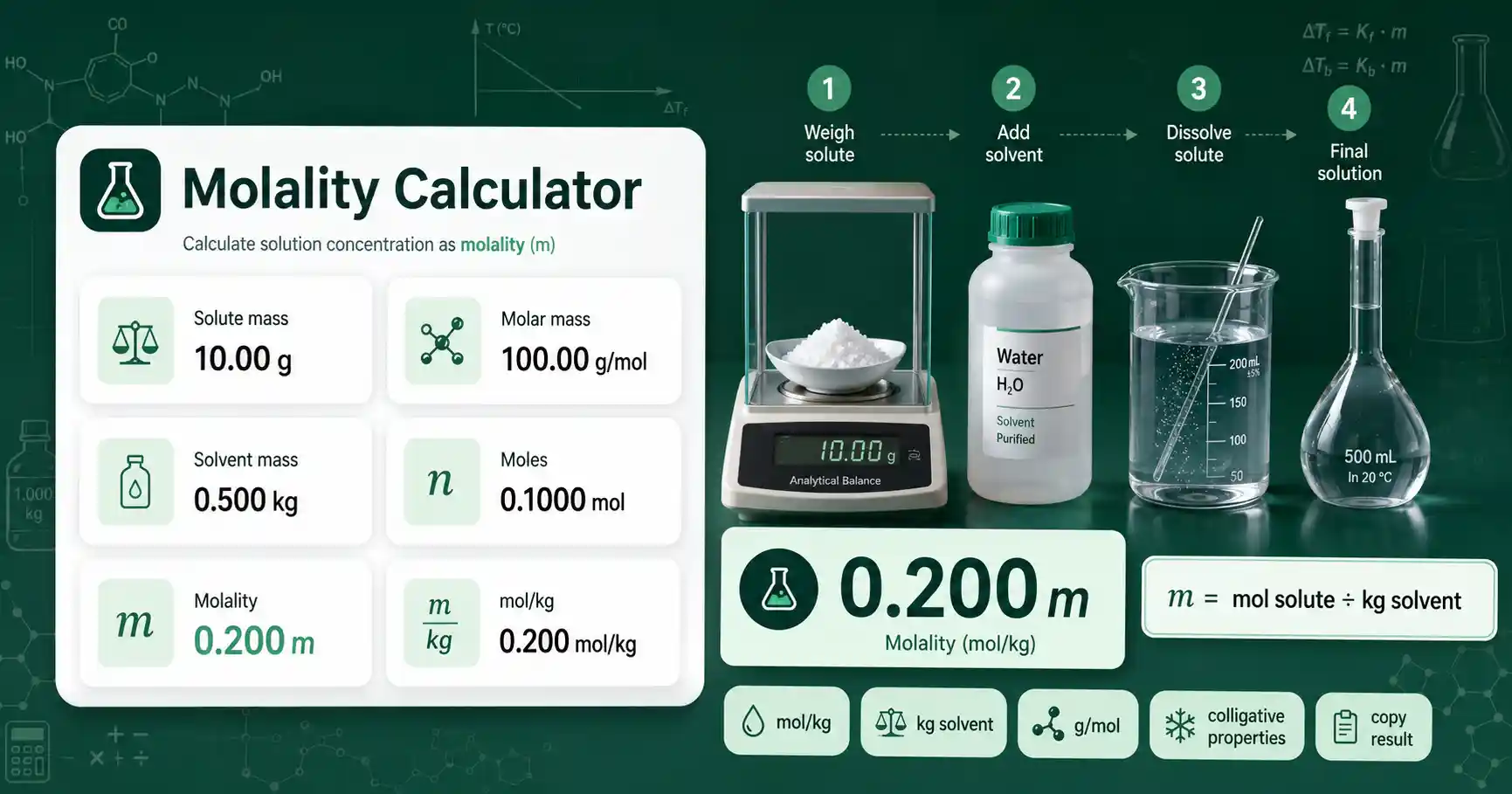
Molality Calculator formula for solution chemistry
The Molality Calculator uses the definition of molality as moles of solute per kilogram of solvent. The formula is molality = n ÷ kg solvent. Here, n is the amount of solute in moles. The solvent mass is the mass of the liquid or medium before the solute is added. A result of 0.200 m means the solution contains 0.200 mol of solute for every 1 kg of solvent. The lowercase m means molal, while uppercase M means molar. This difference matters because molarity uses liters of solution, but molality uses kilograms of solvent. OpenStax also defines molality as the ratio of moles of solute to solvent mass in kilograms in its chemistry discussion of colligative properties. OpenStax Chemistry 2e
This tool accepts solute mass, molar mass, and solvent mass. It converts milligrams, grams, and kilograms into the correct base units. It then converts solute mass into moles using molar mass. Finally, it divides moles by kilograms of solvent. The calculator also reports mmol/kg because many student problems and lab notes use millimolal values. The result card shows moles of solute, grams of solute, solvent mass in kilograms, and approximate percent by mass. Percent by mass is included as a helper value only. It is not part of the molality formula.
Calculate molality from mass and molar mass
Use the calculate mode when you already know how much solute was weighed. This is common in general chemistry problems, freezing point depression calculations, boiling point elevation calculations, and solution preparation checks. Enter the solute mass in mg, g, or kg. Enter the molar mass in g/mol. Enter the solvent mass in mg, g, or kg. The calculator rejects zero, negative, missing, and non-numeric values because those inputs do not describe a valid solution. It also protects against NaN and infinity results.
A student can use the tool to check homework where 5.844 g of sodium chloride is dissolved in 500 g of water. A lab worker can use it to record a molal solution made by weighing solvent directly on a balance. A researcher can use it when temperature changes make a volume-based concentration less convenient. The tool does not know whether the solute fully dissolves. It also does not correct for hydrate water, purity, density, or ion association. Always check the reagent label and the experimental protocol before preparing real solutions.
Molality Calculator worked example
Suppose you dissolve 5.844 g of NaCl in 500 g of water. The molar mass of NaCl is 58.44 g/mol. First, convert solute mass to moles: 5.844 g ÷ 58.44 g/mol = 0.1000 mol. Next, convert solvent mass to kilograms: 500 g = 0.500 kg. Then divide moles by kilograms of solvent: 0.1000 mol ÷ 0.500 kg = 0.200 mol/kg. The solution is therefore 0.200 m. This means each kilogram of water would contain 0.200 mol of NaCl if the same ratio were scaled up.
The prepare mode works in the opposite direction. If you want 0.150 m NaCl using 500 g of water, convert the solvent to 0.500 kg. Multiply 0.150 mol/kg by 0.500 kg to get 0.0750 mol. Multiply 0.0750 mol by 58.44 g/mol to get 4.38 g NaCl. You would weigh 4.38 g of NaCl and dissolve it in 500 g of water. This type of mass-based setup is useful when the final volume is not the main control variable.
Molality versus molarity in lab calculations
Molality and molarity are related, but they are not the same unit. Molarity measures moles of solute per liter of final solution. Molality measures moles of solute per kilogram of solvent. Molarity is common for everyday buffer and reagent recipes because volumetric flasks make final volume easy to control. Molality is common in colligative property calculations because those effects depend on the number of solute particles relative to solvent amount. Molality also avoids the direct volume change problem caused by temperature expansion or contraction. When your protocol asks for molar concentration, use a Molarity Calculator instead of this page. When your protocol asks for molal concentration or uses the symbol m, this tool is the correct starting point.
The calculator helps avoid common manual mistakes. Many errors happen when grams of solvent are used directly instead of kilograms. Other errors happen when users divide by final solution mass instead of solvent mass. Some users also confuse molar mass with solute mass. The input labels separate those values to reduce that risk. If you need to move between percent solution units and concentration units, a concentration unit converter may be more useful.
Practical notes for preparing molal solutions
Molal solution preparation starts with weighing the solvent. Do not assume that 500 mL of solvent always equals 500 g unless the density supports that assumption. Water is often close enough for simple teaching examples, but other solvents can differ strongly. After weighing the solvent, weigh the calculated solute mass on a suitable balance. Add the solute to the solvent and mix until the solid or liquid solute dissolves evenly. Label the solution with the molality, solute name, solvent name, date, and any safety notes. If the solute is hygroscopic or supplied as a hydrate, use the correct formula weight for the actual material. If the reagent purity is less than 100%, apply a purity correction outside the calculator.
This page is useful for students learning concentration units, teachers preparing examples, lab workers checking recipes, and researchers planning mass-based solution conditions. It is not a substitute for safety review or method validation. Very concentrated solutions may be limited by solubility. Strong acids, strong bases, and volatile solvents require extra handling controls. Verify critical lab calculations independently before using them in real experiments.