
Buffer and pH calculator
PBS Preparation Calculator
Calculate phosphate buffered saline component masses or stock volumes from final volume, PBS strength, and buffer composition. The tool is designed for educational lab math, homework checks, and non-clinical solution planning.
PBS recipe calculator
Calculate PBS salts for your final volume
Enter the final volume and PBS strength. The calculator returns dry salt masses, stock-solution volumes, phosphate ratio, osmolarity estimate, and ionic strength estimate for a calcium-free and magnesium-free PBS recipe.
Preparation summary
| Component | Target | Dry mass | Stock volume |
|---|---|---|---|
| NaClSodium chloride | 137 mM | 8.0063 g | 27.4 mL |
| KClPotassium chloride | 2.7 mM | 201.285 mg | 2.7 mL |
| Na₂HPO₄Disodium phosphate | 10 mM | 1.4196 g | 20 mL |
| KH₂PO₄Monopotassium phosphate | 1.8 mM | 244.962 mg | 3.6 mL |
Dissolve the listed salts in less than the final volume, check the pH near 7.4, then bring the solution to the exact final volume. Verify critical lab calculations independently before using them in real experiments.
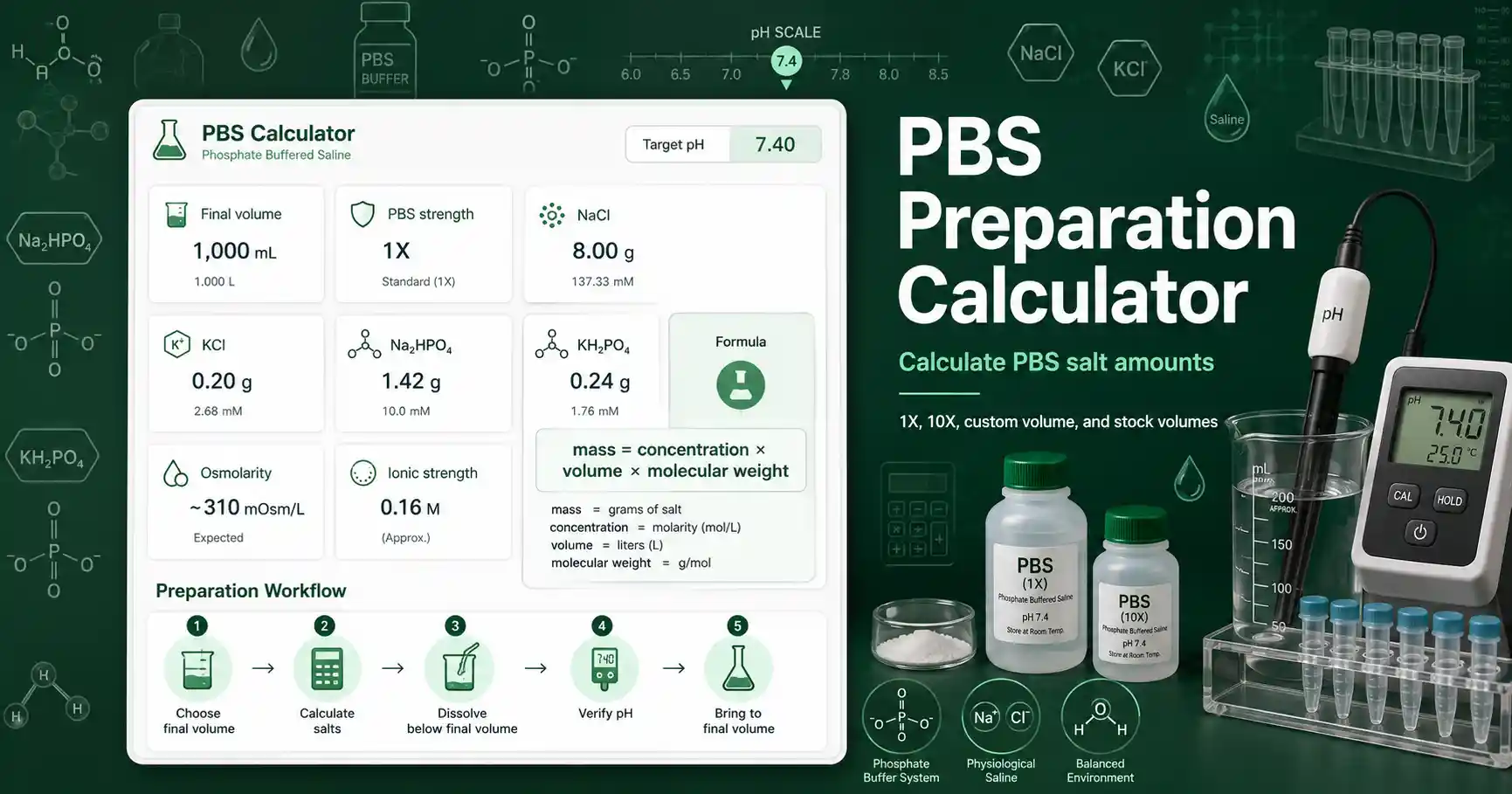
PBS Preparation Calculator for phosphate buffered saline
The PBS Preparation Calculator estimates the amount of sodium chloride, potassium chloride, disodium phosphate, and monopotassium phosphate for a selected final volume. It uses a common calcium-free and magnesium-free PBS composition with 137 mM NaCl, 2.7 mM KCl, 10 mM Na₂HPO₄, and 1.8 mM KH₂PO₄ at 1X strength. The calculator scales those values when you enter 10X PBS or another custom strength. It also returns an approximate osmolarity and an approximate ionic strength so users can understand how the ions affect the solution. Students can use the result to check a lab manual recipe before writing a solution-preparation calculation. Teachers can use the result to demonstrate how molarity, formula mass, and volume connect in buffer preparation. Lab workers can use the result as a planning aid before checking an approved recipe or standard operating procedure. Researchers can use the advanced fields to test a modified PBS composition for a specific educational calculation.
PBS contains both saline ions and phosphate buffer ions. Sodium chloride and potassium chloride supply most of the ionic strength. The phosphate pair supplies buffering capacity near neutral pH. If you need a focused phosphate acid-base ratio from target pH and pKa, use the Phosphate Buffer Calculator next. If you need a broader particle-count estimate for a mixed solution, compare the value with an Osmolarity Calculator. PBS recipes can vary by lab, supplier, hydrate form, pH target, and whether calcium or magnesium is included. For background on PBS as a common balanced salt solution, Thermo Fisher provides a concise overview of phosphate buffered saline and related cell-culture formulations.
PBS Preparation Calculator formula
The core calculation uses moles equal to molarity times volume. The calculator first converts the target millimolar concentration to mol/L. It then multiplies by final volume in liters. The dry mass equals moles multiplied by molecular weight. For a stock solution, the stock volume equals required moles divided by stock molarity. The result uses anhydrous molecular weights for the displayed dry salt masses. Hydrated salts have different molecular weights, so you should change the formula mass manually if your lab recipe uses a hydrate form. The calculator does not replace a calibrated pH meter. It helps estimate component amounts before final pH adjustment and volume make-up.
moles = concentration × volume
mass = moles × molecular weight
stock volume = moles ÷ stock concentration
PBS Preparation Calculator worked example
Given values: Final volume = 500 mL, PBS strength = 1X, NaCl concentration = 137 mM, NaCl molecular weight = 58.44 g/mol.
Formula: mass = concentration × volume × molecular weight.
Substitution: NaCl mass = 0.137 mol/L × 0.500 L × 58.44 g/mol.
Result: NaCl mass = 4.00 g for 500 mL of 1X PBS.
Interpretation: A 500 mL 1X PBS preparation needs about half of the NaCl used in a 1 L recipe.
The same volume scaling applies to KCl, Na₂HPO₄, and KH₂PO₄. For 10X PBS, each target concentration is ten times higher. A 10X recipe therefore requires ten times the dry mass for the same final volume. Rounding matters because small phosphate masses can change noticeably when you prepare small volumes. A student report should state the final volume, PBS strength, salt form, molecular weight, and any pH adjustment assumption.
Practical Questions About PBS Preparation
What does the PBS Preparation Calculator calculate?
It calculates the mass of NaCl, KCl, Na2HPO4, and KH2PO4 needed for a selected PBS strength and final volume.
Can I use the calculator for 10X PBS?
Yes. Enter 10 as the PBS strength, and the calculator scales each component concentration and mass by a factor of ten.
Does the calculator adjust pH automatically?
No. It estimates component amounts from a common phosphate buffered saline recipe, but you should measure and adjust pH with a calibrated pH meter when the final pH matters.
Why does the calculator show osmolarity?
The osmolarity estimate helps users see how salt ions contribute to the total number of dissolved particles in PBS.
What should I verify before using a PBS calculation?
Verify the exact recipe, hydrate form, final pH, final volume, and lab-approved preparation method. A calculated mass is only as reliable as the concentration values and molecular weights entered. Filter sterilization, autoclaving, storage, and clinical suitability are outside the scope of this educational calculator.