
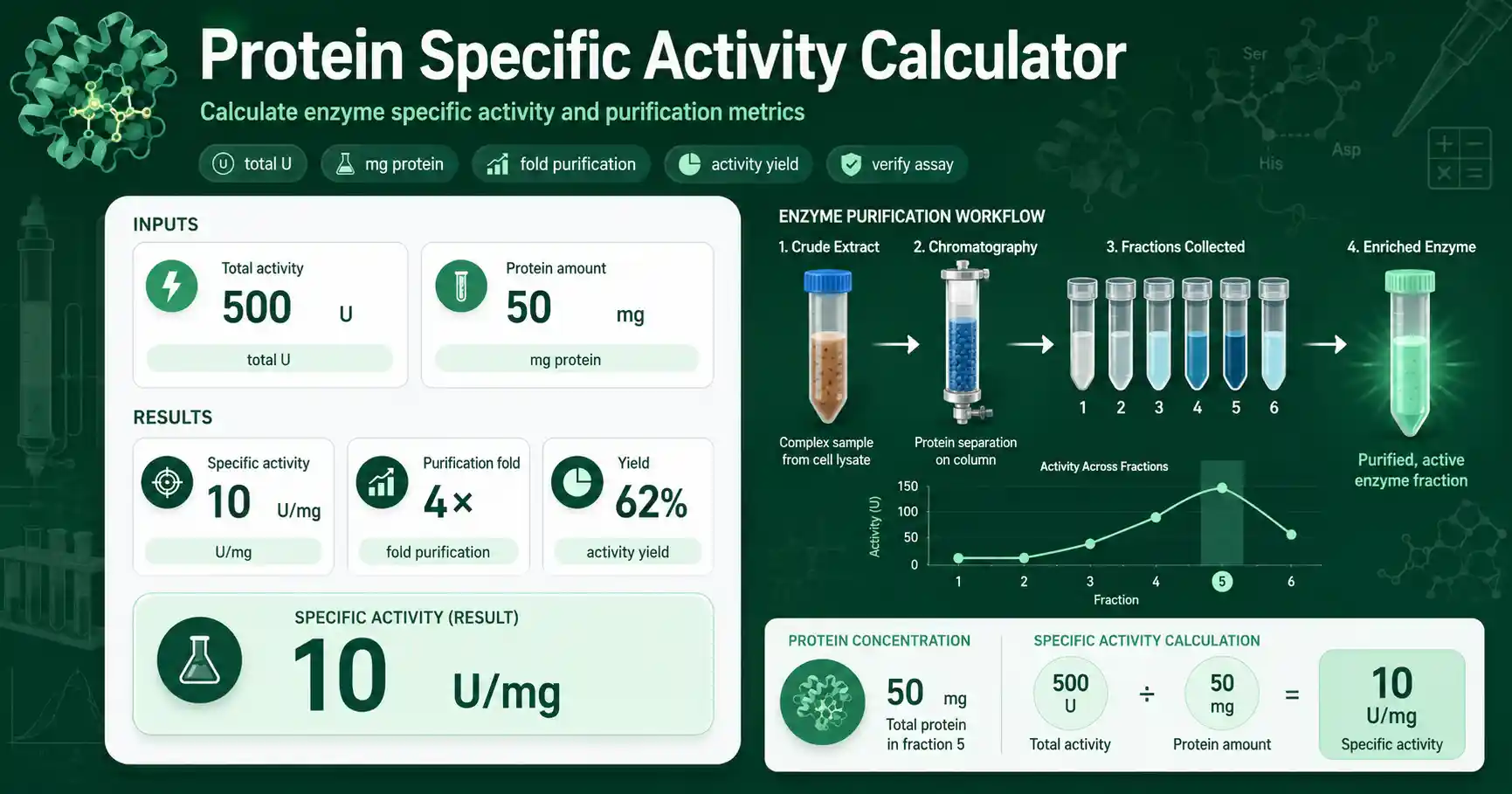
Specific Activity Calculator for enzyme purification
This Specific Activity Calculator converts enzyme activity and protein amount into U/mg protein.
Specific activity is one of the most useful numbers in enzyme purification.
It tells you how much catalytic activity exists per milligram of total protein.
A purified enzyme fraction usually has a higher specific activity than a crude lysate.
The tool works for students, teachers, biochemistry labs, molecular biology labs, and protein purification workflows.
You can enter total enzyme activity and total protein directly.
You can also enter activity concentration, protein concentration, and fraction volume.
The calculator then reports total activity, total protein, specific activity, purification fold, and activity yield.
Specific activity formula used by the calculator
The core formula is specific activity = total enzyme activity ÷ total protein amount.
When total activity is entered in U and total protein is entered in mg, the result is U/mg.
If activity is entered in mU, the calculator converts mU to U before calculation.
If protein is entered in µg, the calculator converts µg to mg before calculation.
In fraction mode, total activity equals activity concentration in U/mL multiplied by fraction volume in mL.
In the same mode, total protein equals protein concentration in mg/mL multiplied by fraction volume in mL.
The formal enzyme unit concept is based on catalytic conversion under stated assay conditions, as defined in the IUPAC Gold Book.
The assay conditions matter because pH, temperature, substrate concentration, cofactors, and inhibitors change enzyme rate.
Compare specific activity values only when the enzyme assay and protein assay were performed under compatible conditions.
Specific Activity Calculator worked example
Suppose a purified fraction has 25 U of enzyme activity.
The same fraction contains 2.5 mg of total protein.
The formula is specific activity = total activity ÷ total protein.
Substitution gives 25 U ÷ 2.5 mg = 10 U/mg.
This means each milligram of protein in that fraction provides 10 enzyme units under the assay conditions.
If the crude extract started at 2.5 U/mg, the purification fold is 10 ÷ 2.5 = 4-fold.
If the crude extract started with 60 U total activity and the purified fraction has 25 U, the activity yield is 25 ÷ 60 × 100 = 41.7%.
The fraction is more enriched than the starting sample, but it has lost some total activity during purification.
How to interpret U/mg protein results
A higher U/mg value usually means the enzyme is more enriched relative to other proteins.
A low U/mg value can mean the sample is crude, the enzyme is weak, the assay is not optimized, or the protein concentration is overestimated.
A zero result means no measurable enzyme activity was entered or detected.
Specific activity does not prove that the protein is pure by itself.
A contaminated sample can still show activity if the target enzyme is active.
A pure sample can show low activity if it is denatured, inhibited, missing cofactors, or measured outside its optimal pH.
Use the Enzyme Activity Calculator before this tool when you first need to convert product formation or absorbance slope into enzyme units.
Use the Protein Concentration Calculator when you need to estimate mg/mL from A280, standard curve data, or dilution-corrected readings.
Protein purification fold and yield explained
Purification fold compares the current specific activity with the starting specific activity.
A 4-fold purification means the activity per milligram is four times higher than the starting material.
Activity yield compares the current total activity with the starting total activity.
A 42% yield means 42% of the starting enzyme activity remains after the purification step.
Good purification often increases specific activity while decreasing total protein.
Total activity can decrease because enzymes are lost, diluted, denatured, or separated into different fractions.
Tracking both fold and yield helps you decide whether a purification step is worth keeping.
A step with high fold but very poor yield may not be useful for preparative work.
Common mistakes in specific activity calculations
Do not divide activity concentration by total protein mass.
Use total activity with total protein, or use concentration values from the same fraction.
Do not mix mU and U without converting units.
Do not mix µg and mg without converting protein mass.
Do not compare samples measured with different enzyme assay times, temperatures, or substrate concentrations.
Do not use protein concentration from a different fraction or a different dilution.
Blank correction is important for both activity assays and protein assays.
Replicates help reveal pipetting error, nonlinear enzyme reactions, and unreliable standard curves.
Verify critical lab calculations independently before using them in real experiments.
Lab uses for specific activity calculation
Students can use this calculator to learn why U/mg is different from U/mL.
Teaching labs can use it to check purification tables from enzyme practicals.
Research labs can use it to compare lysate, ammonium sulfate precipitate, chromatography flow-through, wash, and elution fractions.
Protein engineers can use it to compare variants when protein expression level differs between samples.
Quality-control workflows can use it to check whether an enzyme preparation keeps activity during storage.
The calculator helps avoid manual conversion mistakes when activity is reported in mU and protein is reported in µg.
It also keeps the interpretation close to the result so users can understand what the number means.
The result is only as reliable as the enzyme assay, protein assay, and dilution records used to calculate it.
Related tools for enzyme and protein analysis
Practical Questions About Specific Activity
What does specific activity mean?
Specific activity means enzyme activity divided by protein amount, usually reported as U/mg protein.
Is U/mg the same as U/mL?
No. U/mL describes activity per sample volume, while U/mg describes activity per protein mass.
Why does purification increase specific activity?
Purification removes unrelated proteins, so the same target activity is spread across less total protein.
Can I calculate specific activity from a protein assay?
Yes, but you also need enzyme activity from a matching activity assay.
Does high specific activity guarantee a pure enzyme?
No. High specific activity supports enrichment, but purity should be checked with independent evidence such as SDS-PAGE or chromatography.