
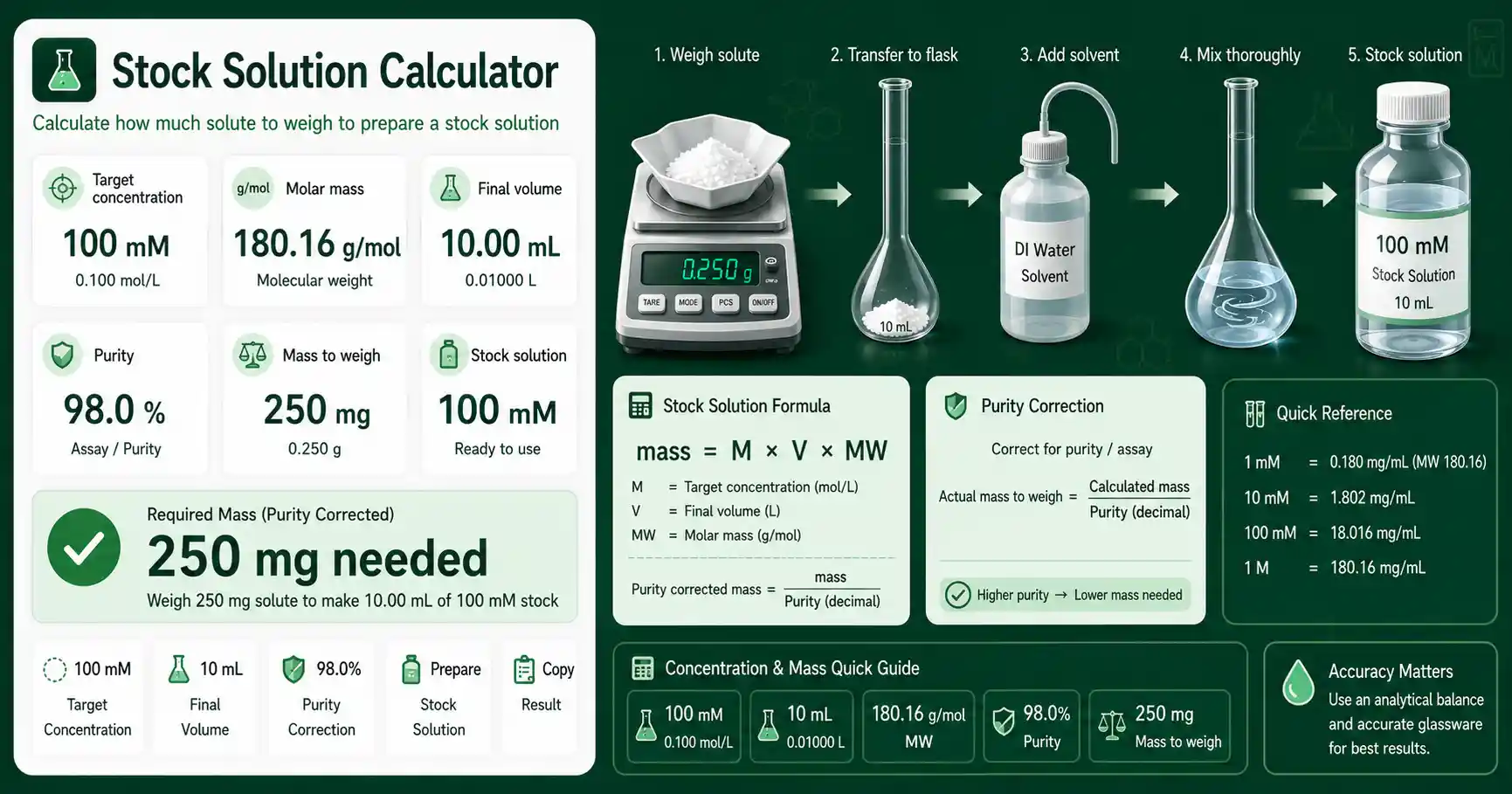
Stock Solution Calculator formula for reagent prep
A stock solution is a concentrated reagent solution that you dilute later into working concentrations. This calculator helps you prepare a stock solution from a target concentration, final volume, and molar mass. It also checks the concentration of a stock when you already know how much compound you weighed. The core formula is moles = molarity × volume in liters. The mass needed is moles × molar mass. If purity is less than 100%, the tool corrects the weighed mass by dividing by the purity fraction.
The calculator accepts target concentration in M, mM, µM, or nM. It accepts final volume in L, mL, or µL. It reports mass in the most readable unit, such as grams, milligrams, or micrograms. It also reports the uncorrected theoretical mass, the purity-corrected mass, the final moles, and practical dilution hints. This makes it useful for salts, buffers, inhibitors, dyes, standards, and small-molecule reagents. The tool does not judge solubility, chemical stability, storage temperature, or reagent compatibility.
Prepare a stock solution from target molarity
Use the prepare mode when you know the desired stock concentration and final stock volume. Enter the molar mass from the bottle label, certificate of analysis, or supplier page. Enter the final volume you want in the finished stock tube or flask. Enter purity as 100% for a pure compound, or use the actual assay value when a certificate gives one. The tool calculates the amount of compound to weigh before you add solvent and bring the solution to volume.
The most common mistake is using the volume of solvent added instead of the final solution volume. A 10 mL stock means the finished liquid volume is 10 mL after the solute dissolves. Another common mistake is using the wrong molar mass for a hydrate or salt form. For example, a free acid, sodium salt, and hydrate may have different formula weights. If the reagent is supplied as a hydrate, use the molar mass of the hydrate you actually weigh. OpenStax explains the relationship between moles, solution volume, and molarity in its molarity and dilution overview.
Stock Solution Calculator worked example
Suppose you need 10 mL of a 100 mM stock solution of a compound with a molar mass of 250.00 g/mol. First convert 100 mM to 0.100 M. Then convert 10 mL to 0.010 L. Calculate moles as 0.100 mol/L × 0.010 L = 0.00100 mol. Multiply by molar mass: 0.00100 mol × 250.00 g/mol = 0.250 g. You would weigh 250 mg and bring the final solution to 10 mL.
If the compound is 95% pure, the required weighed mass changes. The corrected mass is 0.250 g ÷ 0.95 = 0.263 g. That equals about 263 mg. This correction matters for quantitative standards, enzyme inhibitors, antibiotics, dyes, and calibration reagents. It does not solve solubility problems, so you should still confirm the compound can dissolve at the planned stock concentration. Verify critical lab calculations independently before using them in real experiments.
Calculate stock concentration from weighed mass
Use the check concentration mode when you already prepared a stock and want to calculate its molarity. Enter the actual weighed mass, mass unit, molar mass, final volume, and purity. The calculator converts mass to grams, adjusts for purity, converts volume to liters, and divides moles by liters. This is helpful when your notebook records a mass but you need the stock concentration for a protocol. It is also useful when a stock was prepared at a non-round concentration because the weighed mass did not exactly match the target.
A calculated stock concentration can feed into downstream dilution planning. After you prepare or check a stock, the Working Solution Calculator can help you plan the final assay concentration. For direct stock-to-working dilution, the C1V1 C2V2 Calculator uses the same concentration relationship in a dilution-focused format. These workflows connect the initial reagent stock to practical bench volumes.
Stock solution units and lab interpretation
A 1 M stock contains one mole of solute per liter of final solution. A 100 mM stock contains 0.100 mole per liter. A 10 mM stock contains 0.010 mole per liter. Molecular biology stocks often use mM or µM because many reagents are active at low concentrations. Chemistry teaching labs often use M or mM because the examples focus on solution stoichiometry. A concentrated stock saves storage space and reduces repeated weighing.
Good stock preparation also depends on practical details. Use the correct solvent, pH, sterile filtration requirement, storage temperature, and light protection when the protocol specifies them. Label the stock with compound name, concentration, solvent, date, preparer, and storage condition. Record the actual weighed mass instead of only the target mass. If the solution is viscous or volatile, volume handling can introduce extra error. If the compound absorbs water, dries poorly, or degrades quickly, the arithmetic result may not reflect the true active concentration.
When students and lab workers use stock solutions
Students use stock solution calculations to learn how grams, moles, liters, and molarity connect. Teachers use them to build solution-preparation exercises with realistic lab values. Lab workers use them to prepare buffers, antibiotics, stains, inhibitors, standards, and concentrated reagent stocks. Researchers use stock concentration records when reporting final assay concentrations. A clear calculator reduces unit mistakes and makes notebook entries easier to audit.
The tool is most reliable when the input values are accurate. Use a calibrated balance for mass. Use a volumetric flask or suitable calibrated tube for final volume when accuracy matters. Use the exact molar mass for the chemical form in hand. Apply purity correction only when the purity value is known and relevant to the active compound amount. Treat the result as a preparation guide, not as a replacement for your lab protocol or safety data sheet.