
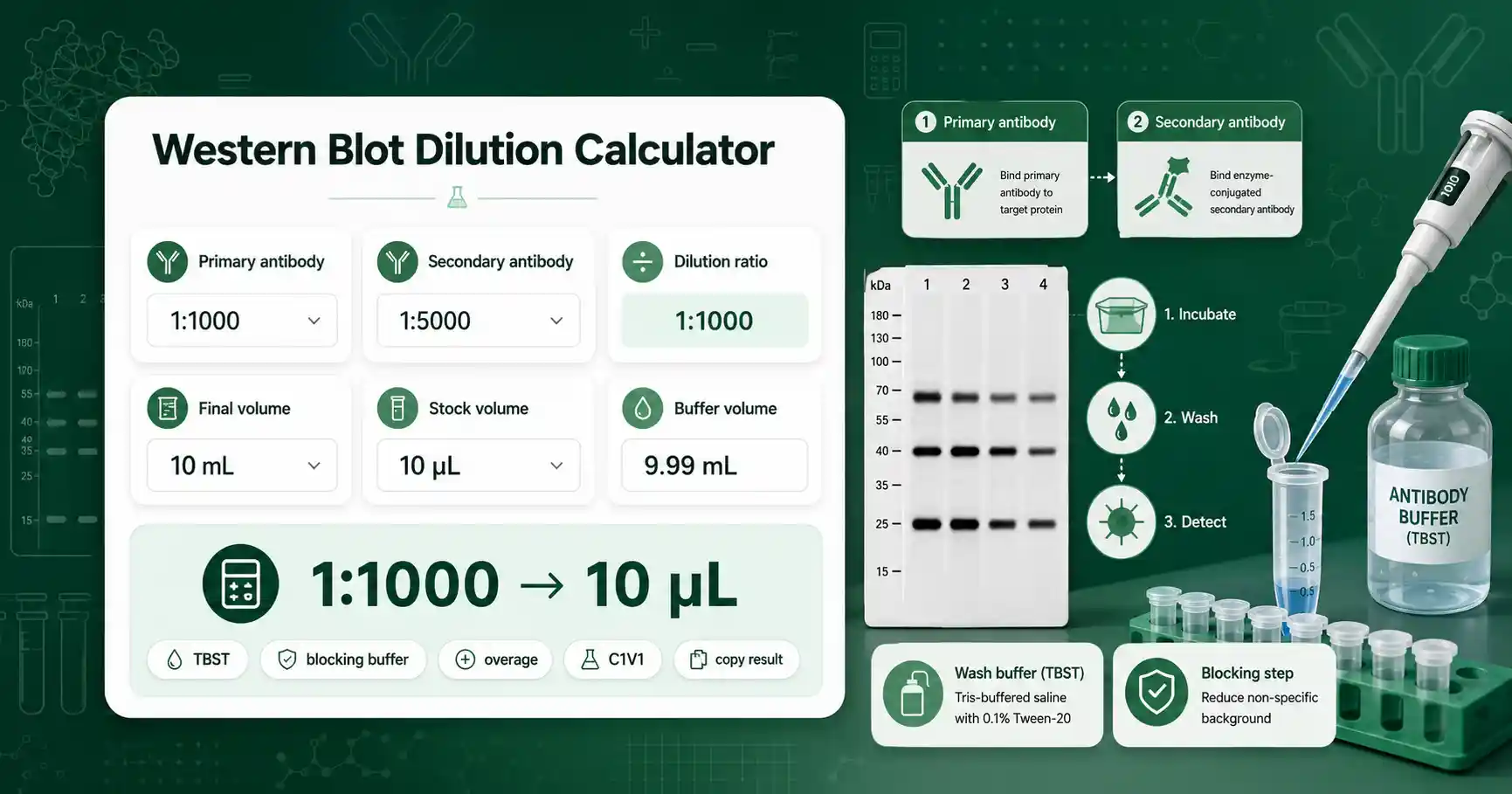
Western Blot Dilution Calculator for antibodies
This Western Blot Dilution Calculator converts common antibody dilution ratios into exact pipetting volumes. It is useful when a protocol says to prepare a primary antibody at 1:1000 or a secondary antibody at 1:5000. You enter the final working volume, the dilution denominator, and any extra overage you want to prepare. The tool then reports the stock antibody volume and the antibody buffer volume. This reduces manual arithmetic during membrane incubation setup. It also helps students understand what a 1:N dilution actually means in a lab protocol.
Western blot antibody solutions are usually prepared in blocking buffer, antibody diluent, TBST with milk, TBST with BSA, or another validated buffer. The calculator does not choose the best antibody or buffer for a target protein. It only calculates volumes from values you provide. You should still follow the antibody datasheet, your lab protocol, and your optimized dilution range. The result is a preparation guide, not a guarantee of signal quality.
Ratio mode is the common workflow for western blot primary and secondary antibodies. A 1:1000 dilution means one part antibody stock in 1000 total parts of working solution. If you prepare 10 mL at 1:1000, the antibody stock volume is 10 µL before any overage. The remaining volume is diluent. The calculator keeps the final volume as the total prepared solution, so the stock volume is included inside the total.
Western blot dilution formula
The ratio dilution formula is simple: stock volume equals final volume divided by the dilution denominator. The final volume must be in the same unit before division. This page converts milliliters into microliters because antibody pipetting is usually done in microliters. The diluent volume equals the final prepared volume minus the stock volume. If you enter an overage, the calculator first increases the final volume and then applies the dilution. This keeps the final 1:N dilution correct after scaling.
The concentration dilution mode uses C1V1 = C2V2. This mode helps when you need to dilute a 10X wash buffer to 1X, a concentrated blocking reagent to a working percentage, or any reagent with a known stock and target concentration. Stock and target concentrations must use the same unit. You can use X, mg/mL, µM, %, or another unit as long as stock and target match. The target concentration cannot be higher than the stock concentration because dilution can only lower concentration.
This calculator accepts positive numeric values only. It blocks zero volumes, negative values, missing inputs, impossible concentration dilutions, and very large overage values. This makes the output safer for routine calculations. You should still check the result before preparing expensive antibodies or limited samples. Critical western blot calculations should be independently verified before real experiments.
Western Blot Dilution Calculator worked example
Suppose you need 10 mL of primary antibody solution at 1:1000. You want 10% extra volume so the membrane remains fully covered during incubation. The adjusted final volume is 10 mL × 1.10 = 11 mL. Convert 11 mL to 11,000 µL. The antibody volume is 11,000 µL ÷ 1000 = 11 µL. The diluent volume is 11,000 µL − 11 µL = 10,989 µL. This means you add 11 µL of antibody stock to 10,989 µL of antibody buffer.
The same logic works for secondary antibody. If a secondary antibody is recommended at 1:5000 and you need 20 mL, the stock volume is 20,000 µL ÷ 5000 = 4 µL before overage. Small antibody volumes can be hard to pipette accurately. In those cases, you can prepare a larger working volume or create an intermediate dilution if your protocol allows it. This tool makes the small volume visible before you start pipetting.
When to use antibody dilution calculations
Use this tool before primary antibody incubation when the membrane tray requires a defined volume. Use it again before secondary antibody incubation when the dilution is usually higher. It also helps when you compare several antibody dilutions during optimization. A student can use it to learn why 1:500 needs twice as much antibody stock as 1:1000 at the same final volume. A lab worker can use it to scale one protocol from a mini blot to a larger membrane. A researcher can use it to prepare enough solution for multiple membranes while keeping the same dilution factor.
Volume matters in western blotting because membranes must remain wet and evenly covered. Too little antibody solution can expose parts of a membrane and cause uneven signal. Too much solution can waste expensive antibody. Adding 5-15% overage is common when trays, tubes, and pipette tips retain liquid. The best overage depends on your container size and handling style.
If you need a more general antibody calculation outside blotting, the Antibody Dilution Calculator can be useful. If you are still preparing protein samples before the blot, you may also need to estimate loading concentration with a protein concentration tool. These calculations connect because accurate loading, transfer, blocking, and antibody dilution all affect final western blot interpretation.
Western blot dilution mistakes to avoid
Do not add the antibody volume on top of the final volume unless your protocol explicitly says so. For a 10 mL final solution, the antibody stock is part of the 10 mL total. Do not enter the numerator of a ratio as the dilution denominator. For a 1:1000 dilution, enter 1000. Do not confuse 1:1000 with 1000 µL of antibody. The denominator describes the total dilution factor, not a fixed pipetting volume.
Do not mix concentration units in C1V1 mode. A stock entered in mg/mL and a target entered in µg/mL will give a wrong result unless you first convert units. Do not assume every antibody works at the same dilution. Primary antibody concentration, affinity, target abundance, blocking chemistry, membrane type, and detection method all affect the useful range. Manufacturer guidance and protocol optimization remain important. Thermo Fisher provides a broad overview of western blot workflow steps and troubleshooting in its western blot protocol guide.