Bacterial Growth Rate Calculator for culture readings
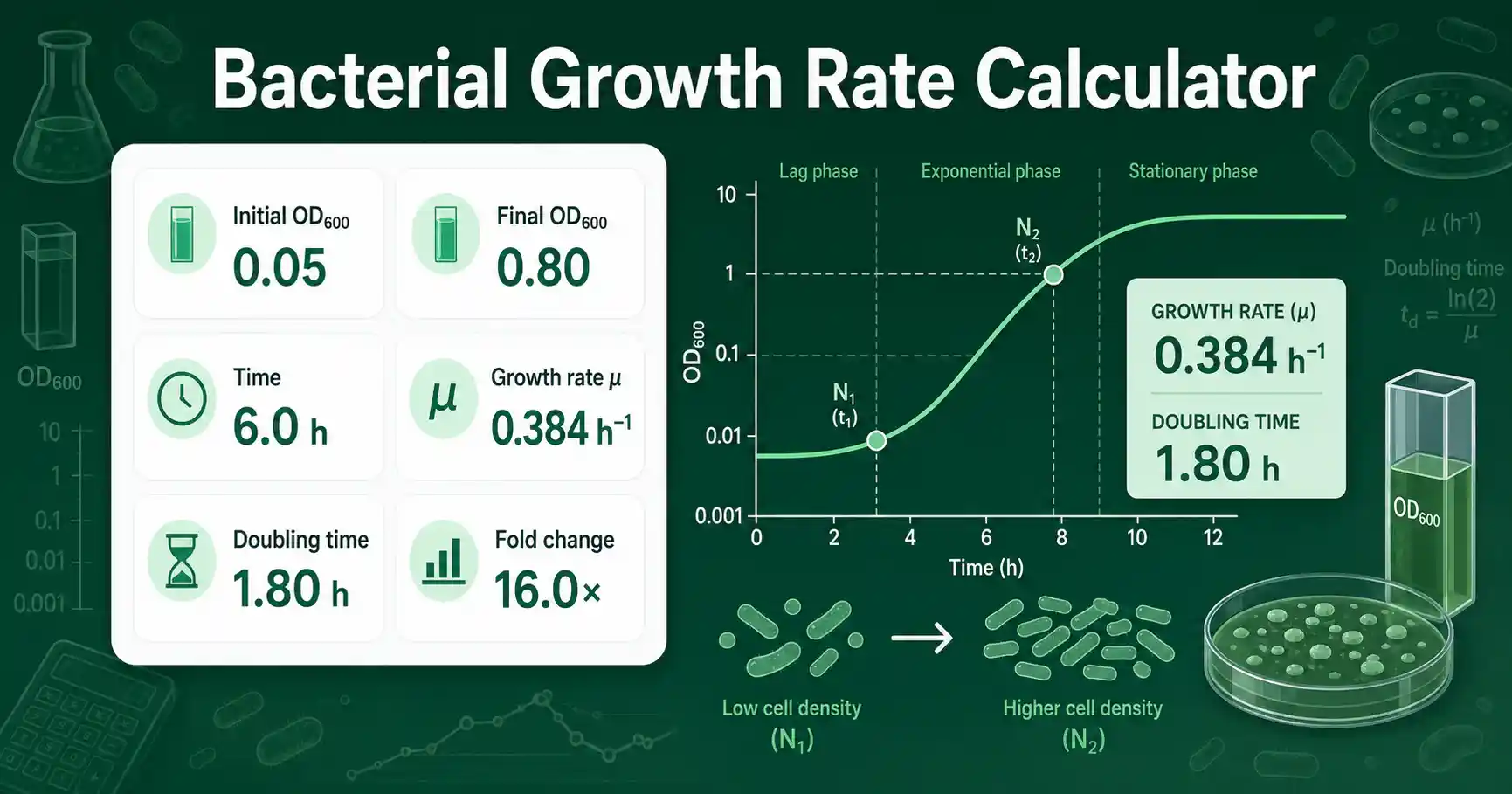
This Bacterial Growth Rate Calculator estimates how quickly a bacterial culture increases between two measurements. It works with OD600 readings, CFU/mL counts, cells/mL estimates, or any relative signal that stays proportional to bacterial abundance.
The calculator is useful when a student needs to analyze a growth curve, when a teacher wants a clear exponential-growth example, or when a lab worker wants a fast check of culture behavior. It does not identify a bacterial species, diagnose contamination, or replace a full growth-curve experiment.
The key result is the specific growth rate, usually written as μ. A higher positive μ means the culture increased faster during the measured interval. The tool also reports doubling time, which is often easier to understand because it tells you how long the population would take to double at the calculated rate.
If you are estimating cell density from optical density before comparing growth, an OD600 Cell Density Calculator can help organize the upstream conversion. If you mainly need the time for one doubling from a known rate, the Doubling Time Calculator is the more direct tool.
How to use Bacterial Growth Rate Calculator correctly
Enter the first measurement as N₁ and the later measurement as N₂. These two values must use the same measurement method and the same units. For example, do not mix an OD600 value for N₁ with a CFU/mL value for N₂.
Enter the elapsed time between the two readings. The calculator accepts hours or minutes, but it reports specific growth rate in h⁻¹. A 180-minute interval is therefore treated as 3 hours.
Use the advanced options when you want to label the measurement type or subtract a blank value from OD-style readings. Blank correction matters when the medium, cuvette, plate, or background absorbance contributes to the raw reading.
The two readings should come from a phase where the measurement is reasonably proportional to cell amount. For OD600, very dense cultures can leave the linear range of the instrument. For plated counts, plates with very low or overcrowded colony numbers can distort the calculated rate.
Bacterial Growth Rate Calculator formula and assumptions
The calculator uses the standard exponential growth relationship between two population measurements. It assumes that N₁ and N₂ represent the same culture type and that the interval is short enough to describe with one average growth rate.
μ = ln(N₂ ÷ N₁) ÷ Δt
generations = log₂(N₂ ÷ N₁)
doubling time = ln(2) ÷ μ
Here, N₁ is the initial reading, N₂ is the final reading, and Δt is the time interval in hours. The natural logarithm is used for μ because exponential growth is continuous in this model.
A positive μ means the population increased. A value near zero means the measurement showed little net change. A negative μ means the later reading was lower, which may indicate decline, dilution, sampling error, or a phase outside active exponential growth.
OpenStax gives a helpful overview of microbial growth phases and population increase in its microbiology chapter on how microbes grow. That background helps users understand why a single growth-rate estimate should be interpreted within the full growth curve.
Bacterial Growth Rate Calculator worked example
Suppose a bacterial culture has an initial OD600 of 0.08 and a later OD600 of 0.64 after 3 hours. Both readings use the same blanking method and the same spectrophotometer settings.
- Given values: N₁ = 0.08, N₂ = 0.64, and Δt = 3 hours.
- Formula: μ = ln(N₂ ÷ N₁) ÷ Δt.
- Substitution: μ = ln(0.64 ÷ 0.08) ÷ 3 = ln(8) ÷ 3.
- Result: μ ≈ 0.693 h⁻¹. The culture increased by 8-fold and completed 3 generations.
- Interpretation: doubling time = ln(2) ÷ 0.693 ≈ 1 hour, so the culture doubled about once per hour during this interval.
This result is easy to check mentally because an 8-fold increase equals three doublings. Three doublings in three hours means about one hour per doubling.
Bacterial Growth Rate Calculator results explained
Specific growth rate is best for comparing growth under different temperatures, media, strains, or treatment conditions. It expresses growth per hour, so two cultures measured over different time intervals can still be compared more fairly.
Doubling time is best for plain-language reporting. A doubling time of 45 minutes means the population would double every 45 minutes if the same average growth rate continued.
Generation count tells you how many doublings occurred between the two readings. A generation count of 2 means a 4-fold increase. A generation count of 3 means an 8-fold increase.
Fold change compares the final reading with the initial reading. A fold change of 1 means no net increase. A fold change below 1 means the final reading is lower than the first reading.
Bacterial Growth Rate Calculator mistakes to avoid
Do not enter a zero or negative value for N₁ or N₂. Logarithmic growth formulas need positive measurements, and zero cannot be used in a logarithm.
Do not use readings from different instruments or different calibration settings without checking comparability. A plate-reader OD600 value and a cuvette OD600 value may not match perfectly.
Do not assume that every part of a growth curve is exponential. Lag phase, stationary phase, nutrient limitation, and measurement saturation can all make a two-point growth rate misleading.
Do not over-round early. Keep enough digits in intermediate values and round the final growth rate or doubling time to a sensible number of significant figures for your report.
Verify critical lab calculations independently before using them in real experiments. This tool supports educational calculation and planning, but it cannot evaluate experimental quality, culture purity, or instrument calibration.
Bacterial Growth Rate Calculator use cases in lab work
Students can use the calculator to analyze textbook growth-curve data and understand the connection between exponential growth, generations, and doubling time. It also helps show why logarithms appear in microbiology growth equations.
Teachers can use the worked result to build classroom problems from OD600 values or viable count values. The same example can be adapted for different time intervals to test whether students understand units.
Lab workers can use the tool as a quick check when comparing culture behavior across media or time points. A sudden change in growth rate may point to a sampling problem, measurement range issue, or a culture condition that needs review.
Researchers can use the calculation for preliminary summaries before fitting a full growth model. For publication-quality analysis, a multi-point growth curve usually gives a more reliable estimate than two points alone.
Related bacterial culture calculators
Practical questions about Bacterial Growth Rate Calculator
Can I use OD600 values in a bacterial growth rate calculator?
Yes. You can use OD600 values when both readings come from the same method and remain in a range where OD is proportional to cell density. If OD readings are too high, dilute and measure again according to your lab method.
Why does the calculator report no positive doubling time?
It reports no positive doubling time when the final measurement is equal to or lower than the first measurement. The culture did not show a net increase over the selected interval, so a positive doubling time does not apply.
What time unit does the specific growth rate use?
The calculator reports μ in h⁻¹. If you enter minutes, the tool converts the interval to hours before applying the formula.