
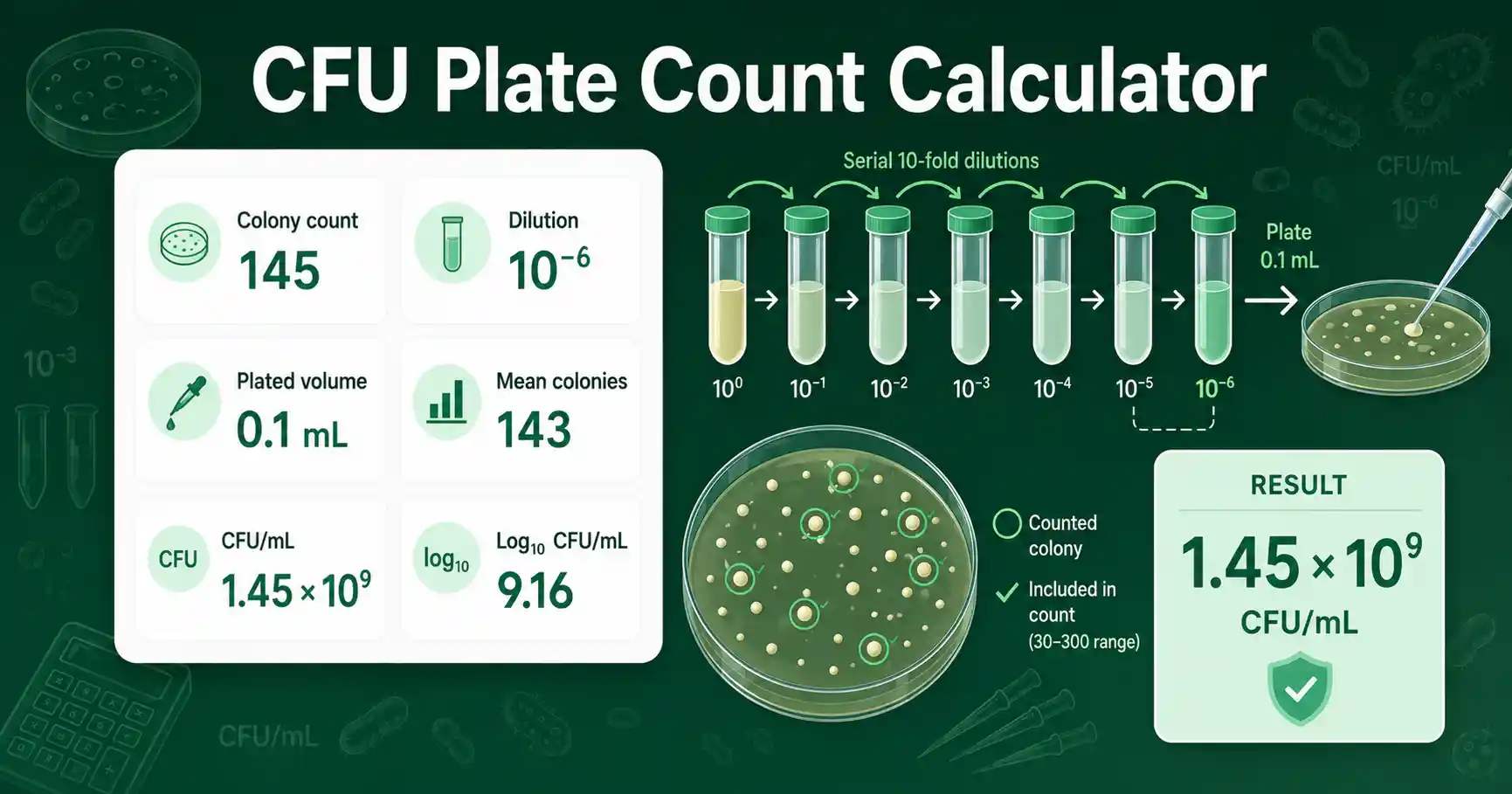
CFU Plate Count Calculator for plated colony results
The CFU Plate Count Calculator estimates colony forming units per milliliter from a visible colony count. It uses the colony count, the dilution fraction, and the plated volume. The result is reported as CFU/mL, which is a common way to express viable microorganisms in a liquid sample.
A CFU result is not the same as a direct cell number. One colony may start from one cell, a pair of cells, or a small clump. That is why the result is called colony forming units instead of cells per mL. This distinction matters when students compare microscopic cell counts with plate-count results.
Use this calculator when you already have a plate count from a dilution series. It is useful after spread plating, drop plating, or other educational colony-count exercises where the plated volume is known. For general concentration calculations after the plate result, the CFU/mL Calculator may also be useful.
How to use CFU Plate Count Calculator correctly
Enter the colony count from the plate you want to analyze. In basic mode, use one count. In replicate mode, enter several colony counts and let the calculator average them.
Enter the dilution exponent as a positive number. If the plate came from a 10^-6 dilution, enter 6. If the sample was not diluted, enter 0. The calculator converts this exponent into the dilution fraction used in the equation.
Enter the plated volume and choose microliters or milliliters. The formula always uses milliliters, so 100 µL becomes 0.1 mL. A wrong volume unit changes the answer by a factor of 1,000.
The countable range note helps you judge the plate, but it does not replace your class or laboratory rule. Many teaching examples use 30 to 300 colonies as a common range. Some labs use a different range depending on the organism, plate format, or counting method.
CFU Plate Count Calculator formula and assumptions
The calculation uses this method: CFU/mL = colonies ÷ (dilution fraction × plated volume in mL). If replicate counts are entered, the calculator first finds the mean colony count. It then applies the same CFU/mL formula to that mean.
For a 10^-6 plate with 0.1 mL plated, the denominator is 10^-6 × 0.1 mL. Dividing by a very small denominator gives the estimated concentration in the original sample. This is why small mistakes in dilution or volume produce large differences in the final result.
The calculator assumes that the counted colonies came from the stated dilution and volume. It also assumes colonies were counted consistently. It does not correct for merged colonies, uneven spreading, clumping, incubation differences, or selective media effects.
For background on microbial growth and how viable counts relate to growth measurements, see the OpenStax Microbiology discussion of microbial growth.
CFU Plate Count Calculator worked example
Given values: a plate has 145 colonies, the dilution is 10^-6, and the plated volume is 100 µL. First convert the plated volume into milliliters. A volume of 100 µL equals 0.1 mL.
Formula: CFU/mL = colonies ÷ (dilution fraction × plated volume in mL). Substitution: CFU/mL = 145 ÷ (10^-6 × 0.1). The denominator is 0.0000001.
Result: 145 ÷ 0.0000001 = 1.45 × 10^9 CFU/mL. The interpretation is that the original sample is estimated to contain about 1.45 billion colony forming units per milliliter under the counting method used.
If three replicate plates gave 132, 145, and 151 colonies at the same dilution and volume, the mean count is 142.67. The result becomes 1.43 × 10^9 CFU/mL. Replicate averaging can make the estimate more stable when counts vary slightly.
CFU Plate Count Calculator results explained
A high CFU/mL value means the original sample had many viable colony-forming units. A low CFU/mL value means fewer colonies were recovered from the plated amount and dilution. A zero-count plate should be interpreted carefully because no colonies on one plate does not prove that no viable organisms existed in the full sample.
The log10 CFU/mL result helps compare large values. For example, 1.0 × 10^6 CFU/mL has a log10 value of 6. A change from 10^6 to 10^7 CFU/mL is a tenfold change, not a small linear increase.
The countable-range message helps students check whether a plate is likely to be useful. Too few colonies increase sampling error. Too many colonies can overlap, merge, or become hard to distinguish.
If your plate count is part of a growth experiment, you may compare results across time points with a Bacterial Growth Rate Calculator. That type of tool uses starting and ending values to estimate growth rate and doubling time.
CFU Plate Count Calculator mistakes to avoid
Do not enter the dilution factor when the field asks for the dilution exponent. For a 10^-5 dilution, enter 5, not 100000. The calculator handles the exponent conversion for you.
Do not forget to convert plated volume correctly. A 100 µL plated volume is 0.1 mL, while a 10 µL drop is 0.01 mL. The same colony count gives a higher CFU/mL when the plated volume is smaller.
Do not combine plates from different dilutions unless your instructor or protocol tells you how to weight them. This calculator averages replicate counts only when they represent the same dilution and plated volume. Mixing unlike plates can create a misleading estimate.
Do not report too many digits. Plate counts have practical uncertainty, so a result such as 1.45 × 10^9 CFU/mL is usually more sensible than 1,450,000,000.000 CFU/mL. Verify critical lab calculations independently before using them in real experiments.
CFU Plate Count Calculator use cases in lab work
Students can use the calculator to check microbiology homework involving serial dilutions and colony plates. It shows how dilution fraction and plated volume control the final CFU/mL value. It also helps students explain why a 10^-6 plate can represent a much more concentrated original sample.
Teachers can use the calculator during lessons on viable counts, logarithmic growth, and dilution math. It gives a quick way to test whether students understand the difference between colony count, dilution factor, and original concentration.
Lab workers can use it as a quick educational check for non-clinical plate-count calculations. Researchers can use it for transparent notebook math when recording dilution, plated volume, colony count, and concentration estimate. The tool keeps the calculation visible so assumptions are easier to review.
Practical questions about CFU plate counts
What colony count should I use?
Use the plate that falls inside the acceptable countable range for your class or laboratory method. If several replicate plates at the same dilution are countable, average them.
How do I enter a 10^-6 dilution?
Enter 6 as the dilution exponent. The calculator treats the dilution fraction as 0.000001 and uses it in the denominator of the CFU/mL equation.
Why is CFU/mL not exactly cells/mL?
A colony forming unit is based on colony formation, not direct visualization of every cell. One colony may come from a single cell or from a small cluster, so the value is an estimate of viable colony-forming units.