
Buffer Capacity Calculator
Calculate theoretical buffer capacity from pH, pKa, and total buffer concentration. The tool reports the Van Slyke buffer-pair contribution, optional water contribution, base-to-acid ratio, and the maximum capacity possible for that concentration.
Buffer Capacity Calculator explained in one minute
Buffer capacity, written as β, measures how strongly a solution resists a pH change when strong acid or base is added. For a simple monoprotic weak-acid/conjugate-base pair, capacity increases with total buffer concentration and reaches its maximum when pH equals pKa.
Calculate buffer capacity (β)
Estimate the Van Slyke buffer-pair contribution from pH, pKa, and total buffer concentration. You can also include the water contribution.
Enter your values
Your result
Water contribution: 6.702e-7 mol/(L·pH), using Kw = 1.0 × 10⁻¹⁴ at about 25 °C.
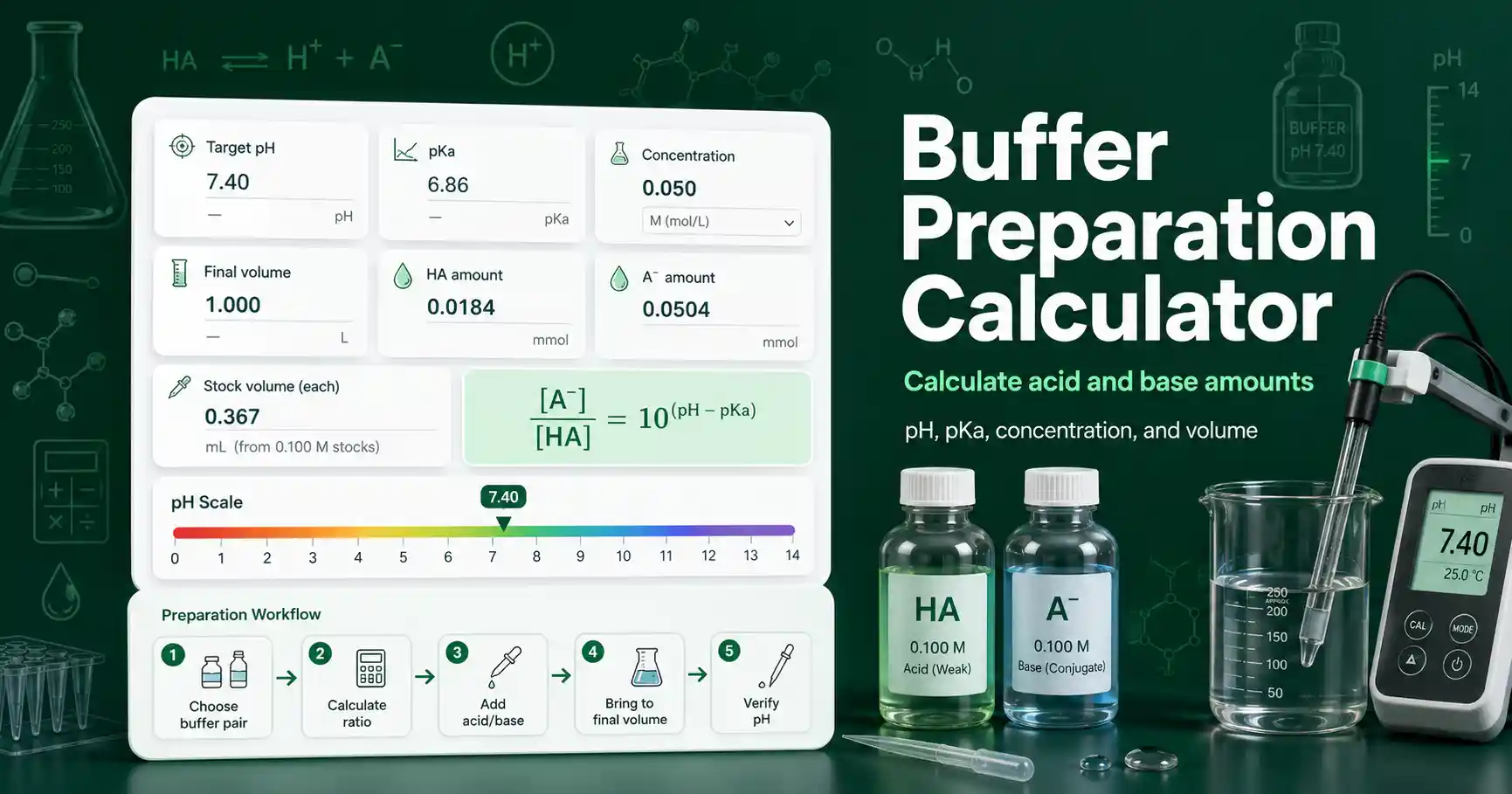
How to use the Buffer Capacity Calculator
Enter the values from your protocol, reagent label, spectrophotometer, or experiment, then use the result together with the formula and assumptions shown on this page.
- 1
Enter the target or measured pH of the buffer solution.
- 2
Enter the pKa of the weak-acid/conjugate-base pair that operates near that pH.
- 3
Enter the final total buffer concentration in mol/L, where C = [HA] + [A⁻].
- 4
Leave the water contribution enabled for an approximate total β, or turn it off to see only the buffer-pair contribution.
- 5
Compare the reported β with the theoretical maximum for the same concentration and check how far the target pH lies from pKa.
- 6
Use the value for comparison and planning, then verify critical formulations experimentally because activity, ionic strength, and temperature affect real solutions.
What is buffer capacity and what does β mean?
Buffer capacity is the amount of strong acid or strong base required per liter to change a solution by one pH unit, expressed as an incremental or differential quantity.
A buffer with a larger β can absorb more added H⁺ or OH⁻ before its pH moves by the same amount. This is why two buffers at the same pH can behave very differently if one is much more concentrated or if one operates closer to its pKa.
The result is most useful for comparing candidate buffer systems, concentrations, or operating pH values. It should not be read as a promise that a real preparation will change by exactly one pH unit after a finite addition of titrant, because the equation describes local differential behavior around the entered pH.
- Higher total buffer concentration generally gives higher buffer capacity at the same pH and pKa.
- Capacity from the conjugate pair is strongest at pH = pKa because acid and base forms are present in equal amounts.
- Moving one or more pH units away from pKa shifts most material into one protonation state and lowers the pair contribution.
- Very acidic or very basic solutions can have a noticeable H⁺/OH⁻ contribution even when the weak buffer pair is ineffective.
Buffer capacity formula: Van Slyke equation
For a simple monoprotic buffer pair, this calculator uses βpair = 2.303 × C × Ka[H⁺] / (Ka + [H⁺])², with Ka = 10⁻pKa and [H⁺] = 10⁻pH.
C is the final analytical concentration of the conjugate pair, not the concentration of only the acid form or only the base form. The factor 2.303 appears because pH is defined with a base-10 logarithm.
When the optional water term is enabled, the calculator also adds βwater = 2.303 × ([H⁺] + [OH⁻]). At about 25 °C, [OH⁻] is estimated from Kw = 1.0 × 10⁻¹⁴ divided by [H⁺]. Near neutral pH in a normally concentrated buffer, this water term is usually very small compared with the buffer-pair term.
| Symbol | Meaning | Unit or relation |
|---|---|---|
| β | Buffer capacity | mol/(L·pH) |
| C | Total buffer-pair concentration | mol/L |
| Ka | Acid dissociation constant | 10⁻pKa |
| [H⁺] | Hydrogen-ion concentration approximation | 10⁻pH mol/L |
| [OH⁻] | Hydroxide concentration approximation | Kw/[H⁺] |
| [A⁻]/[HA] | Conjugate base-to-acid ratio | 10^(pH − pKa) |
Why is maximum buffer capacity at pH = pKa?
At pH = pKa, the acid and conjugate-base forms are present at a 1:1 ratio, and the Van Slyke pair term reaches its mathematical maximum for a fixed total concentration.
Substituting [H⁺] = Ka into the Van Slyke expression gives βpair,max = 2.303 × C / 4, or about 0.5758 × C. A 0.050 M simple buffer therefore has a theoretical pair maximum near 0.0288 mol/(L·pH).
A buffer does not suddenly stop working outside pKa ± 1, but the pair becomes progressively less balanced. The calculator reports the percentage of the theoretical pair maximum so you can see the loss in capacity directly rather than relying only on the common ±1 pH rule of thumb.
How concentration, pH, pKa, and temperature affect buffer strength
Buffer capacity depends mainly on how much buffer pair is present and how closely the working pH matches the relevant pKa, while real experimental behavior also depends on temperature, ionic strength, solvent, and activity coefficients.
- Doubling total buffer concentration approximately doubles the Van Slyke pair capacity at the same pH and pKa.
- Choosing a buffer with pKa closer to the desired pH usually improves capacity without changing concentration.
- Temperature can shift pKa, so the same nominal recipe may have a different pH and capacity at 4 °C, room temperature, and 37 °C.
- High ionic strength and concentrated additives can make activity-based behavior differ from a simple concentration model.
- Polyprotic systems such as phosphate and citrate can have contributions from more than one dissociation step; a single-pKa calculation is then an approximation unless one transition clearly dominates.
Common buffer-capacity calculation mistakes
The most common errors are using the wrong pKa, entering one component concentration instead of total buffer concentration, and treating theoretical β as a complete experimental titration result.
- Do not enter millimolar values as molar values: 50 mM must be entered as 0.050 M.
- Use the pKa of the conjugate pair relevant to the working pH, especially for polyprotic acids.
- Do not confuse buffer capacity with buffer concentration; they are related but not the same quantity.
- Do not assume pH = pKa for every recipe. The Henderson–Hasselbalch ratio determines the actual acid/base balance.
- For precision work, confirm pH and buffering performance by titration under the same temperature, solvent, salt, and concentration conditions used in the experiment.
Buffer capacity worked example for 50 mM phosphate near pH 7.4
Suppose a simple buffer pair has pKa 7.21, total concentration 0.050 M, and working pH 7.40. The calculator evaluates the local buffering strength at that pH.
pH = 7.40, pKa = 7.21, C = 0.050 M.
[A⁻]/[HA] = 10^(7.40 − 7.21) ≈ 1.55.
βpair ≈ 0.02745 mol/(L·pH).
βpair,max = 0.5758 × 0.050 ≈ 0.0288 mol/(L·pH).
The pair is operating at roughly 95.4% of its theoretical maximum because pH is close to pKa.
Near pH 7.4, the H⁺/OH⁻ contribution is tiny compared with a 50 mM buffer pair.
Interpretation: This is a strong operating point for that conjugate pair. The result is useful for comparing buffer choices, but the prepared solution should still be checked with a calibrated pH meter and, when capacity matters quantitatively, by experimental titration.
Calculations and terms covered on this page
These are the closely related lab calculations and concepts this tool is designed to answer without forcing you to translate between several separate calculators.
Scientific references and source checks
The equations, constants, and interpretation notes on this page are checked against established chemistry or molecular-biology references. Always follow your own validated protocol when exact experimental conditions matter.
- IUPAC Gold Book: buffer capacityTerminology and definition of buffer capacity.
- Chemistry LibreTexts: Buffer SolutionsBackground on buffer equilibria and Henderson–Hasselbalch behavior.
- Pearson: Buffer Capacity CalculatorVan Slyke pair term, optional water contribution, and reverse-capacity relationships.
Buffer Capacity Calculator FAQs
What is buffer capacity?
Buffer capacity is a measure of resistance to pH change. Differential buffer capacity β describes the amount of strong acid or base per liter needed for an incremental change in pH.
When is buffer capacity highest?
For a simple monoprotic weak-acid/conjugate-base pair at fixed concentration, the pair contribution is highest when pH equals pKa.
Does a higher buffer concentration increase capacity?
Yes. In the Van Slyke pair term, capacity is directly proportional to total buffer concentration at a fixed pH and pKa.
What unit does buffer capacity use?
A common unit is mol/(L·pH), meaning moles of strong acid or base per liter per pH unit for the differential definition.
Should I include the water contribution?
Near neutral pH in a normal laboratory buffer, the water contribution is usually very small. It becomes more important at very low or very high pH or when the buffer itself is extremely dilute.
Can I use this calculator for phosphate or citrate?
You can use one pKa as a local approximation when one dissociation step dominates. Polyprotic systems can require multiple equilibrium contributions for high-accuracy capacity calculations.
Is buffer capacity the same as buffer range?
No. Buffer range describes a pH interval where both conjugate forms are useful, while buffer capacity quantifies resistance to pH change at a particular composition and concentration.
Why can experimental buffer capacity differ from the calculation?
Real measurements can differ because of ionic strength, activity coefficients, temperature, finite titrant additions, dilution, other acid-base species, and measurement uncertainty.