
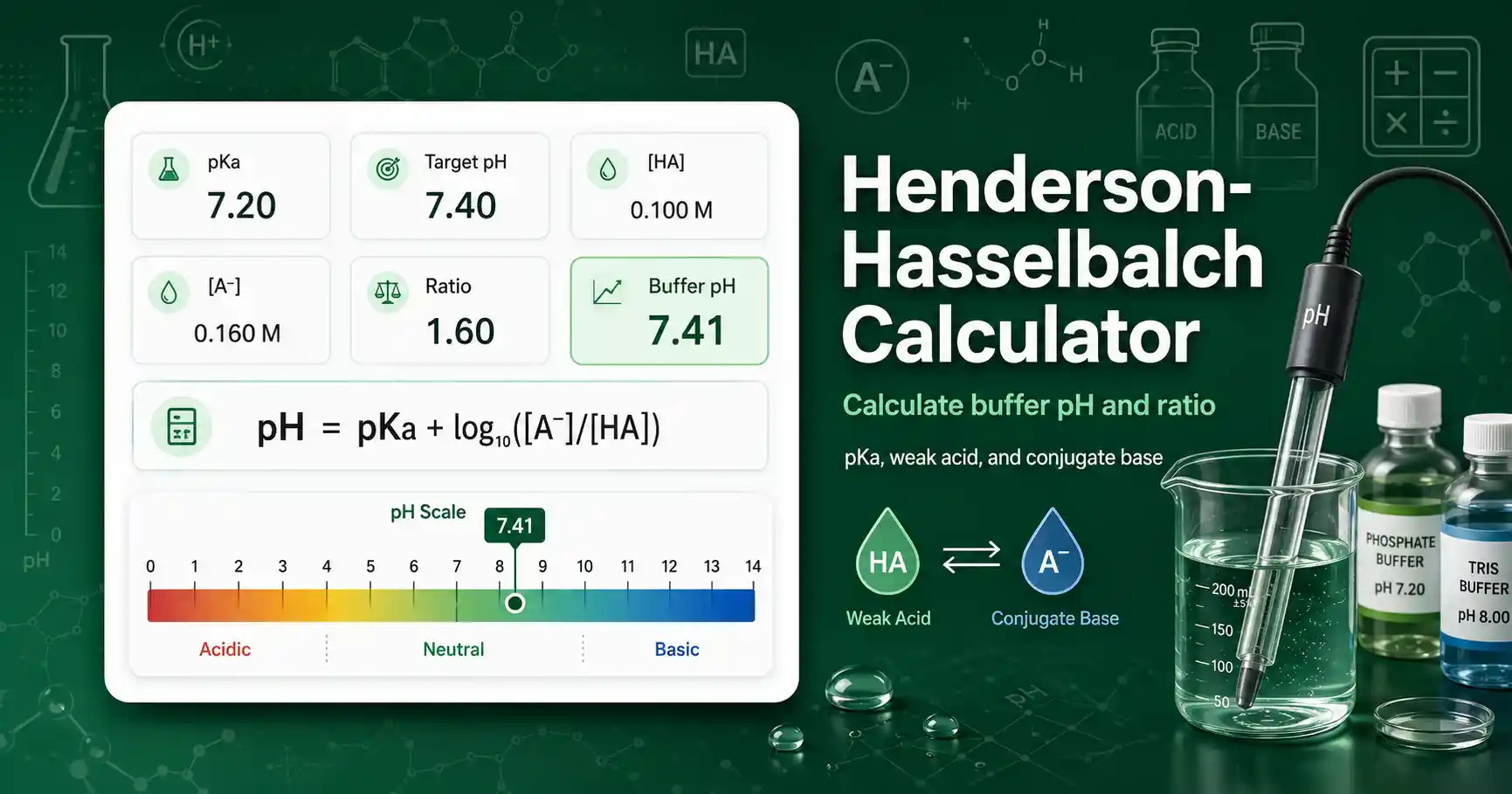
Henderson-Hasselbalch Calculator for buffer pH
The Henderson-Hasselbalch Calculator estimates the pH of a buffer from the acid dissociation constant and the ratio of conjugate base to weak acid.
It uses the equation pH = pKa + log10([A−]/[HA]).
In this equation, HA is the weak acid form and A− is the conjugate base form.
The calculator can also rearrange the equation to find the acid-base ratio needed for a target pH.
Students can use it to check acid-base homework and learn why pH changes when the ratio of A− to HA changes.
Teachers can use it to demonstrate the connection between pKa, pH, and buffer composition during classroom examples.
Lab workers can use it as a quick educational check before moving to a more detailed buffer preparation calculation.
Researchers can use it to compare candidate buffer systems when a protocol needs a pH near 6.8, 7.4, or 8.0.
Henderson-Hasselbalch equation inputs
The main input is pKa, which describes the acid strength of the buffer pair.
A phosphate buffer often uses a pKa near 7.21 for the H2PO4− and HPO4²− pair at room temperature.
The weak acid concentration can be entered in M, mM, or µM.
The conjugate base concentration can also be entered in M, mM, or µM.
Unit conversion matters when acid and base values are entered in different units.
The equation depends on a ratio, so equal units cancel when both components use the same unit.
The calculator validates empty, negative, zero, and unrealistic values so the result does not show NaN or Infinity.
Use the pH Calculator if you already know hydrogen ion concentration instead of buffer composition.
For a deeper chemistry explanation of this equation, Chemistry LibreTexts provides a helpful overview of the Henderson-Hasselbalch approximation.
Henderson-Hasselbalch Calculator result interpretation
A calculated pH equal to pKa means the weak acid and conjugate base amounts are equal.
A pH above pKa means the conjugate base form is higher than the weak acid form.
A pH below pKa means the weak acid form is higher than the conjugate base form.
Buffer capacity is usually strongest when the target pH is within about one pH unit of the pKa.
A ratio such as 1.6 means the conjugate base amount is 1.6 times the weak acid amount.
A ratio such as 0.25 means the weak acid amount is four times higher than the conjugate base amount.
Rounding should match the precision of your input data because pKa values can shift with temperature and ionic strength.
The result is an estimate, not a substitute for measuring final pH with a calibrated pH meter.
Verify critical lab calculations independently before using them in real experiments.