
Citrate Buffer Calculator
Estimate citrate conjugate-pair amounts from target pH, citric-acid pKa, total citrate concentration, and final volume. The calculator labels the actual protonation pair selected for pKa1, pKa2, or pKa3.
Citrate Buffer Calculator explained in one minute
Citric acid is triprotic, so citrate buffering cannot be represented by one pKa across the whole pH range. Choose the citric-acid pKa closest to your target pH, then use the calculator as a local Henderson–Hasselbalch approximation for the adjacent conjugate pair.
Calculate citrate conjugate-pair amounts
Estimate the distribution between one adjacent citric-acid protonation pair using the pKa closest to your target pH.
Enter your values
Your result
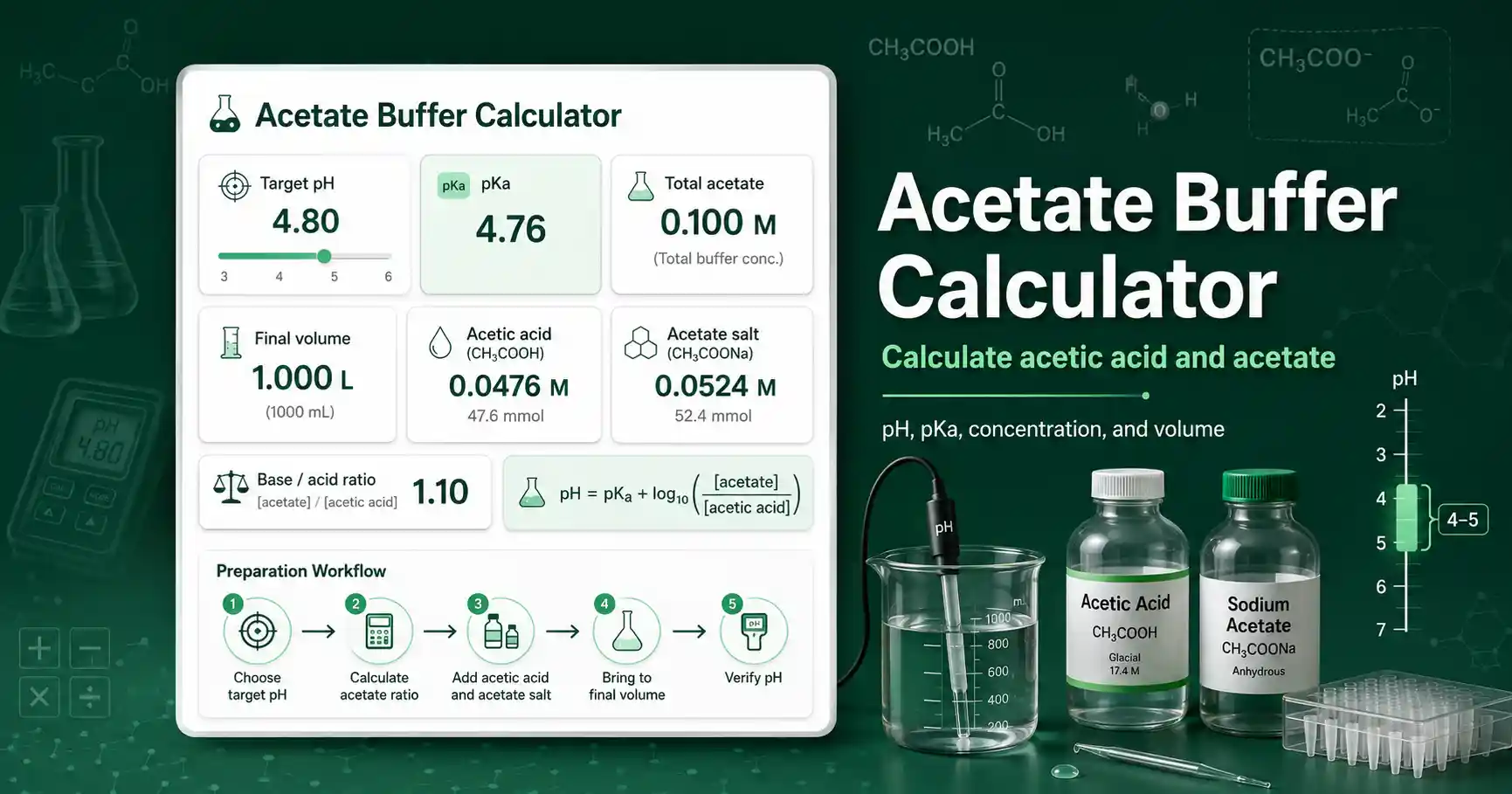
How to use the Citrate Buffer Calculator
Enter the values from your protocol, reagent label, spectrophotometer, or experiment, then use the result together with the formula and assumptions shown on this page.
- 1
Enter the target pH for the citrate buffer.
- 2
Choose the citric-acid pKa closest to that pH: about 3.13, 4.76, or 6.40 at 25 °C.
- 3
Enter the total citrate concentration in mM.
- 4
Enter the intended final volume in mL.
- 5
Read the calculated mmol of the selected acid and conjugate-base species, plus the base-to-acid ratio.
- 6
Use the result as a speciation and planning aid. If you need exact grams of citric acid and a particular citrate salt, account for the exact salt form, hydration state, and full polyprotic equilibrium or use a validated formulation table.
Why citrate buffer needs three pKa values
Citric acid can lose three protons, so it has three acid-dissociation steps and three nearby conjugate pairs rather than one universal citrate-buffer pKa.
The approximate pKa values at 25 °C are 3.13, 4.76, and 6.40. Each value describes equilibrium between two adjacent protonation states. Around pH 4.5, for example, pKa2 is usually the most relevant local transition, while around pH 6 the pKa3 pair becomes more important.
This page therefore asks you to choose the pKa instead of silently applying one number to every citrate buffer. That makes the approximation more transparent and helps prevent a common error in citric-acid buffer calculations.
| Citric-acid transition | Approx. pKa at 25 °C | Adjacent pair |
|---|---|---|
| First dissociation | 3.13 | H₃Cit / H₂Cit⁻ |
| Second dissociation | 4.76 | H₂Cit⁻ / HCit²⁻ |
| Third dissociation | 6.40 | HCit²⁻ / Cit³⁻ |
Citrate buffer formula and Henderson–Hasselbalch ratio
For the selected adjacent pair, the calculator uses [base]/[acid] = 10^(pH − pKa) and then divides the entered total citrate amount between those two species.
Total citrate moles are estimated from concentration × volume. The acid-form amount is total pair moles ÷ (1 + ratio), and the conjugate-base amount is the remaining fraction.
Because citrate is polyprotic, real solutions contain more than two protonation states to some degree. A full speciation calculation solves all acid dissociation equilibria simultaneously. The single-pKa Henderson–Hasselbalch model is most useful when the target pH lies reasonably close to one pKa and one adjacent pair dominates the buffering behavior.
Which citrate pKa should you choose?
Choose the pKa closest to the target pH because that adjacent conjugate pair will usually make the most useful local contribution to buffering.
If the target pH is more than about one pH unit from the selected pKa, the chosen pair becomes strongly unbalanced and a different transition may be more representative. The calculator flags this situation in the result panel.
Published citrate-buffer recipes sometimes use citric acid and trisodium citrate directly. Those starting reagents do not correspond one-to-one with a single adjacent protonation pair after equilibrium, so a simple pair calculation should not be interpreted as exact gram instructions for those two bottles.
| Target pH region | Useful starting pKa | Pair emphasized |
|---|---|---|
| Around pH 3 | pKa1 ≈ 3.13 | H₃Cit / H₂Cit⁻ |
| Around pH 4–5 | pKa2 ≈ 4.76 | H₂Cit⁻ / HCit²⁻ |
| Around pH 6 | pKa3 ≈ 6.40 | HCit²⁻ / Cit³⁻ |
Citric acid and sodium citrate buffer preparation
For practical citric-acid/sodium-citrate preparation, use the calculator to understand pH-dependent speciation, then use the exact reagent forms and a validated recipe or full equilibrium calculation for final gram amounts.
Citric acid may be supplied as anhydrous material or a monohydrate, while sodium citrate is commonly encountered in different hydration states. These forms have different molecular weights, so an exact mass recipe must match the actual reagent labels.
A prepared citrate buffer should be dissolved below final volume, checked with a calibrated pH meter, adjusted only as permitted by the protocol, and brought to final volume at the end. Temperature and ionic strength can shift the observed pH relative to ideal pKa-based calculations.
- Check whether citric acid is anhydrous or monohydrate.
- Check the exact sodium citrate formula and hydration state before weighing.
- Do not assume a 1:1 mass mixture corresponds to pH = pKa; pH relationships are molar, not mass-based.
- Use the pKa closest to target pH for a local pair estimate.
- Verify final pH experimentally after all components are dissolved.
Common uses and limitations of citrate buffer
Citrate buffers are useful across acidic-to-mildly acidic laboratory pH ranges, but citrate can chelate metal ions and its polyprotic chemistry makes exact speciation more complex than a simple monoprotic buffer.
Citrate is used in biochemical, histological, analytical, and formulation workflows. A common example is citrate buffer used in heat-induced antigen retrieval, although exact composition and pH depend on the validated method.
Because citrate coordinates many metal ions, it can alter metal availability or interfere with assays where free metal concentration is important. Buffer choice should therefore consider not only target pH but also chemical compatibility with proteins, enzymes, metal-dependent reactions, and analytical methods.
- Do not use citrate automatically in metal-sensitive assays without checking compatibility.
- Do not treat the single-pKa output as a full distribution of all citrate species.
- Do not convert the reported species mmol directly into citric-acid/sodium-citrate grams without specifying reagent forms and equilibrium assumptions.
- For a published protocol, follow its exact reagent composition and use this calculator mainly to understand the acid-base logic or scale a validated molar formulation carefully.
50 mM citrate buffer at pH 4.5: worked example
A 100 mL citrate solution at 50 mM contains 5.00 mmol total citrate. At pH 4.50, pKa2 = 4.76 is the closest citric-acid transition, so the H₂Cit⁻/HCit²⁻ pair is a useful local approximation.
H₂Cit⁻ as acid form and HCit²⁻ as conjugate base.
0.050 mol/L × 0.100 L = 5.00 mmol.
10^(4.50 − 4.76) ≈ 0.55.
5.00 ÷ (1 + 0.55) ≈ 3.23 mmol H₂Cit⁻.
5.00 − 3.23 ≈ 1.77 mmol HCit²⁻.
Because pH is below pKa2, the more protonated H₂Cit⁻ form is favored.
Interpretation: The pair estimate explains the acid/base balance near pH 4.5, but it is not an exact dry-mass recipe for citric acid plus sodium citrate. Use the exact reagent forms and a validated formulation for final preparation.
Calculations and terms covered on this page
These are the closely related lab calculations and concepts this tool is designed to answer without forcing you to translate between several separate calculators.
Scientific references and source checks
The equations, constants, and interpretation notes on this page are checked against established chemistry or molecular-biology references. Always follow your own validated protocol when exact experimental conditions matter.
- Sigma-Aldrich: Citric acidLists citric-acid pKa values near 3.13, 4.76, and 6.40 at 25 °C.
- PubChem: Citric acidChemical identity, formula, molecular weight, and physicochemical reference data.
- Chemistry LibreTexts: Buffer SolutionsBackground on conjugate acid-base equilibria and buffer calculations.
Citrate Buffer Calculator FAQs
Which pKa should I use for citrate buffer?
Use the citric-acid pKa closest to the target pH: approximately 3.13, 4.76, or 6.40 at 25 °C.
Why does citrate have three pKa values?
Citric acid is triprotic and can lose three protons in separate equilibrium steps, so three adjacent conjugate pairs contribute across different pH ranges.
Can this calculator give exact grams of citric acid and sodium citrate?
No. It reports a local conjugate-pair distribution. Exact gram recipes require the specific citric-acid and citrate-salt forms, hydration states, and ideally a validated formulation or full polyprotic equilibrium treatment.
What pKa should I use for citrate buffer at pH 4.5?
pKa2, approximately 4.76, is the closest transition and is usually a useful local starting approximation around pH 4.5.
What pKa should I use near pH 6?
pKa3, approximately 6.40, is the closest citric-acid transition near pH 6.
Is citric acid/sodium citrate a simple one-pKa buffer?
No. Citric acid is polyprotic, and mixing fully protonated citric acid with trisodium citrate produces an equilibrium distribution that can include several citrate protonation states.
Why should I verify citrate buffer pH after mixing?
Temperature, ionic strength, reagent form, additional salts, and activity effects can shift measured pH away from the ideal pKa-based calculation.
Can citrate affect metal-dependent experiments?
Yes. Citrate can bind or chelate metal ions, so check compatibility when free metal concentration matters in the assay or protocol.