
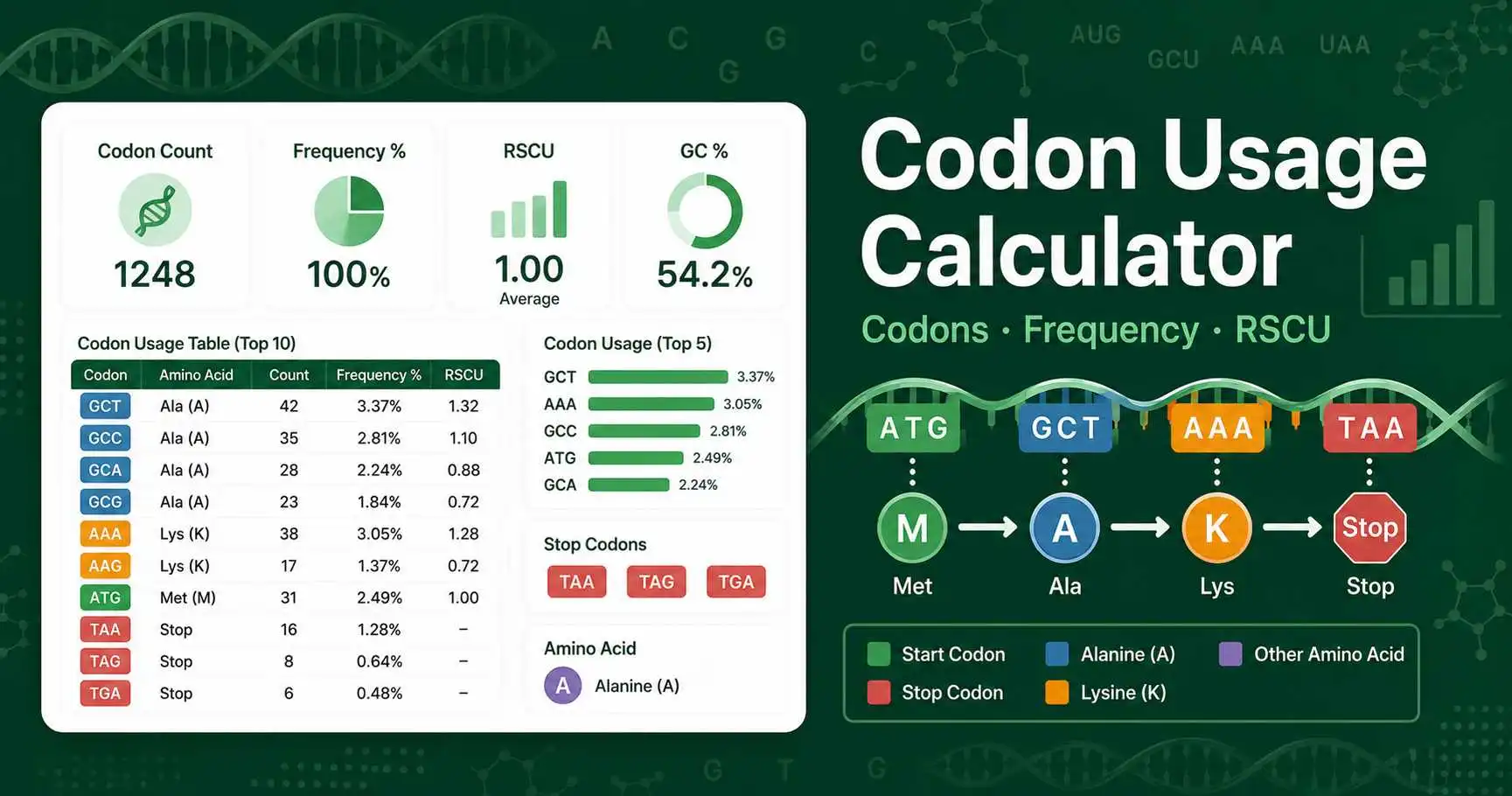
Codon Usage Calculator for coding sequences
A Codon Usage Calculator measures how often each codon appears in a coding DNA or RNA sequence. It helps students and lab workers connect nucleotide triplets with amino acids, protein translation, reading frames, GC content, and stop codons.
This calculator is useful when you want to inspect a coding sequence before cloning, expression planning, sequence annotation, or homework analysis. It shows codon count, total codon frequency, amino acid assignment, frequency within synonymous codons, and RSCU.
How to use Codon Usage Calculator
Paste a DNA or RNA coding sequence, choose the correct sequence type, and select the reading frame. Frame 1 starts at the first base. Frame 2 starts at the second base. Frame 3 starts at the third base. The tool ignores FASTA headers, spaces, line breaks, and numbers.
Use a sequence length that matches a complete coding region whenever possible. If the last one or two bases do not form a complete codon, the calculator leaves them out and shows a review note. For sequence translation, you can also compare the output with the DNA to Protein Translator.
Codon usage results explained
The codon count tells you how many times each triplet appears. Total percentage shows how much of the whole codon set uses that codon. Amino acid percentage shows how strongly that codon is used among synonymous codons for the same amino acid.
RSCU means relative synonymous codon usage. A value near 1 suggests that a codon is used close to equal expectation among its synonyms. A value above 1 means that codon appears more often than equal synonymous use. A value below 1 means it appears less often.
Codon bias, GC content, and expression planning
Codon usage can differ between organisms. Bacteria, yeast, plants, animals, and viruses may prefer different synonymous codons. This is called codon bias. A coding sequence that works well in one host may not express as efficiently in another host if its codon usage does not match the host translation system.
GC content also matters because GC-rich and AT-rich sequences can behave differently during PCR, cloning, synthesis, and expression. For a broader nucleotide composition check, use the GC Content Calculator with the same sequence.
The standard genetic code used by this calculator follows the common codon table used for most nuclear genes. Organelles and some organisms can use alternative genetic codes, so verify unusual systems with a trusted reference such as the NCBI genetic code tables.
Common mistakes in codon usage analysis
The most common mistake is choosing the wrong reading frame. A one-base shift changes every codon after the start point. Another common mistake is using a partial sequence and expecting it to behave like a full coding sequence with a start codon and one final stop codon.
Do not mix DNA and RNA symbols in one mode. DNA mode uses T. RNA mode uses U. Also avoid ambiguity codes if you need exact codon counts, because ambiguous bases cannot map to one specific amino acid codon without extra assumptions.
When to verify codon usage manually
Verify the reading frame, organism, genetic code, start codon, final stop codon, and any intended sequence modifications before using codon usage results for real lab work. If you plan expression in a specific host, compare the sequence with a host-specific codon usage table and check whether codon optimization is needed.