
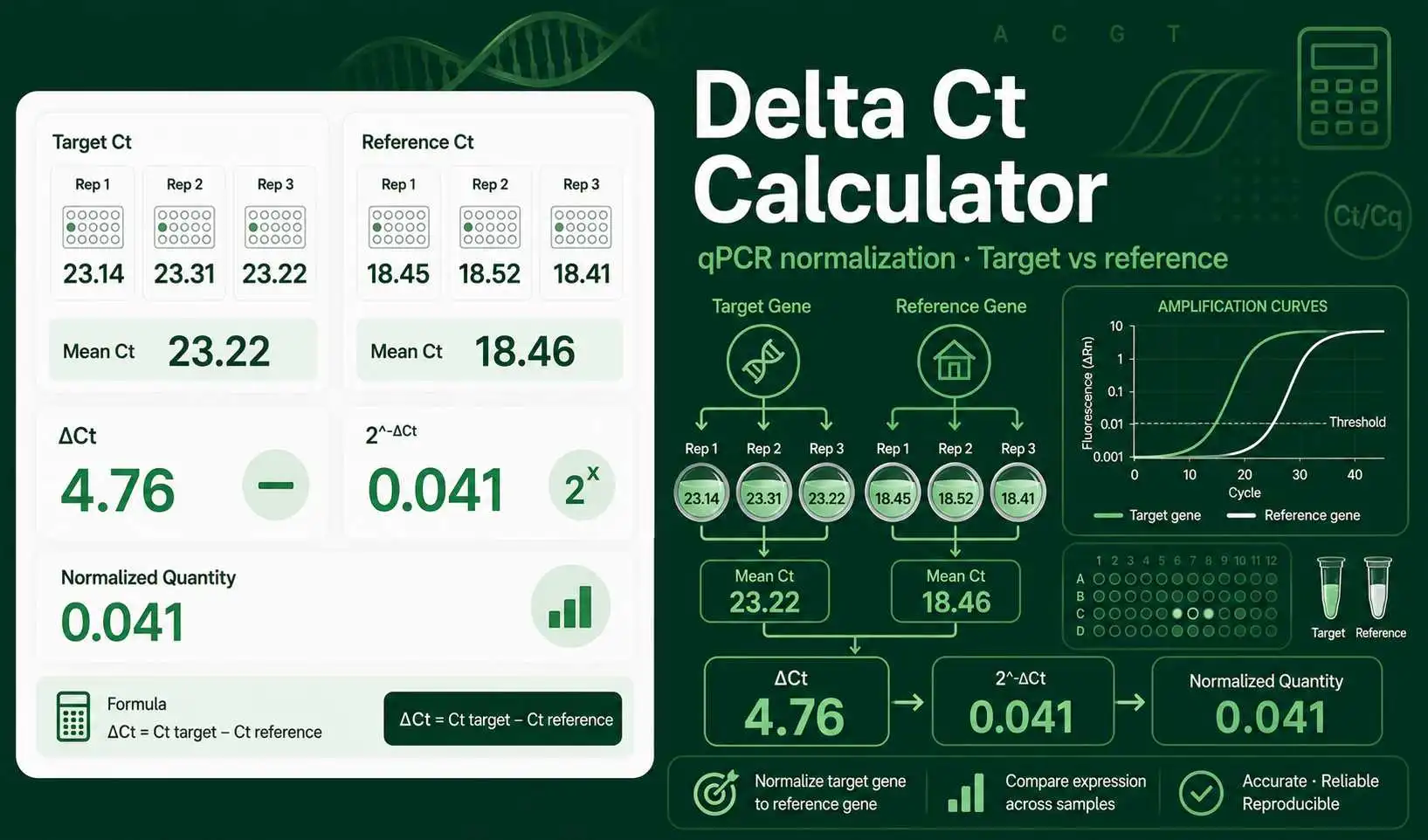
Delta Ct Calculator for qPCR normalization
This Delta Ct Calculator helps you normalize a qPCR target gene to a reference gene in the same sample. It works with single Ct values or technical replicate Ct values. It then reports mean Ct, standard deviation, range, ΔCt, and normalized quantity.
Use it when you have Ct or Cq values from a real-time PCR run and want a quick, transparent calculation. The tool is useful for students, teachers, lab workers, and researchers who need to understand the first normalization step before relative expression comparison.
What Delta Ct means in real-time PCR
Ct means threshold cycle. It is the PCR cycle where fluorescence crosses a defined threshold. A lower Ct often means the starting template was more abundant. A higher Ct often means the starting template was less abundant.
ΔCt compares two Ct values from the same sample. The target gene is the gene of interest. The reference gene is the internal control, such as a stable housekeeping gene. Normalization helps reduce variation caused by RNA input, reverse transcription yield, and sample loading.
Delta Ct formula and normalized quantity
The main equation is simple:
ΔCt = mean Ct target − mean Ct reference
If PCR efficiency is 100%, the common normalized quantity estimate is:
Normalized quantity = 2^-ΔCt
If you know the assay efficiency, the calculator can use a more general expression:
Normalized quantity = (1 + efficiency)^(-ΔCt)
For example, 100% efficiency gives an amplification factor of 2. A 95% efficiency gives an amplification factor of 1.95. This matters when you compare assays with different standard-curve efficiencies.
Worked example using Delta Ct Calculator
Imagine a qPCR sample has three target gene Ct values: 24.18, 24.31, and 24.25. The mean target Ct is 24.25. The same sample has reference gene Ct values of 20.92, 21.05, and 20.98. The mean reference Ct is 20.98.
The calculation is:
ΔCt = 24.25 − 20.98 = 3.27
With 100% PCR efficiency, the normalized quantity is 2^-3.27, which is about 0.104. This means the target signal is lower than the reference signal after normalization. It does not yet compare treated and control samples. For that step, use a ΔΔCt calculation.
How to enter qPCR Ct replicates correctly
Paste target gene Ct values into the target field. Paste reference gene Ct values into the reference field. You can separate values with commas, spaces, semicolons, or line breaks. The calculator removes empty entries and uses only valid numeric values.
Keep target and reference Ct values from the same biological sample. Do not mix treatment groups in one ΔCt calculation. If you have control and treated samples, calculate ΔCt for each sample first. Then compare them with the Delta Delta Ct Calculator.
Use case 1: checking one sample before ΔΔCt
A student may receive qPCR Ct values for a treated sample and a control sample. The first task is not fold change. The first task is to normalize each sample separately. This page calculates that first step.
Calculate ΔCt for the control sample. Then calculate ΔCt for the treated sample. After both values are ready, subtract control ΔCt from treated ΔCt to get ΔΔCt. This workflow keeps the math clear and helps prevent common reporting mistakes.
Use case 2: reviewing replicate quality
Lab workers often run qPCR reactions in duplicate or triplicate. Close technical replicates give more confidence in the mean Ct. Wide replicate spread can point to pipetting error, bubbles, poor mixing, threshold problems, or weak amplification.
This tool reports standard deviation and range for target and reference replicates. If the replicate range is large, review the raw qPCR curves before using the number in a lab report or publication. You can also use the Ct Mean Calculator when you only need replicate averaging and spread checks.
Practical problem: interpreting positive and negative ΔCt
Suppose target mean Ct is 28 and reference mean Ct is 23. The ΔCt is 5. The target appears less abundant than the reference because it needs more cycles to cross the threshold.
Now suppose target mean Ct is 20 and reference mean Ct is 24. The ΔCt is -4. The target appears more abundant than the reference because it crosses the threshold earlier. Negative ΔCt is not an error. It simply shows that the target Ct is lower than the reference Ct.
What to verify before using Delta Ct results
Verify the reference gene first. A reference gene should stay stable across the samples and conditions you compare. If the reference gene changes with treatment, tissue type, time point, or extraction method, the normalized result can mislead you.
Also review primer specificity, melt curve shape, no-template control, reverse-transcription controls, and qPCR efficiency. The MIQE guidelines emphasize transparent reporting of real-time PCR assay conditions, validation, and data analysis details. MIQE guidelines