
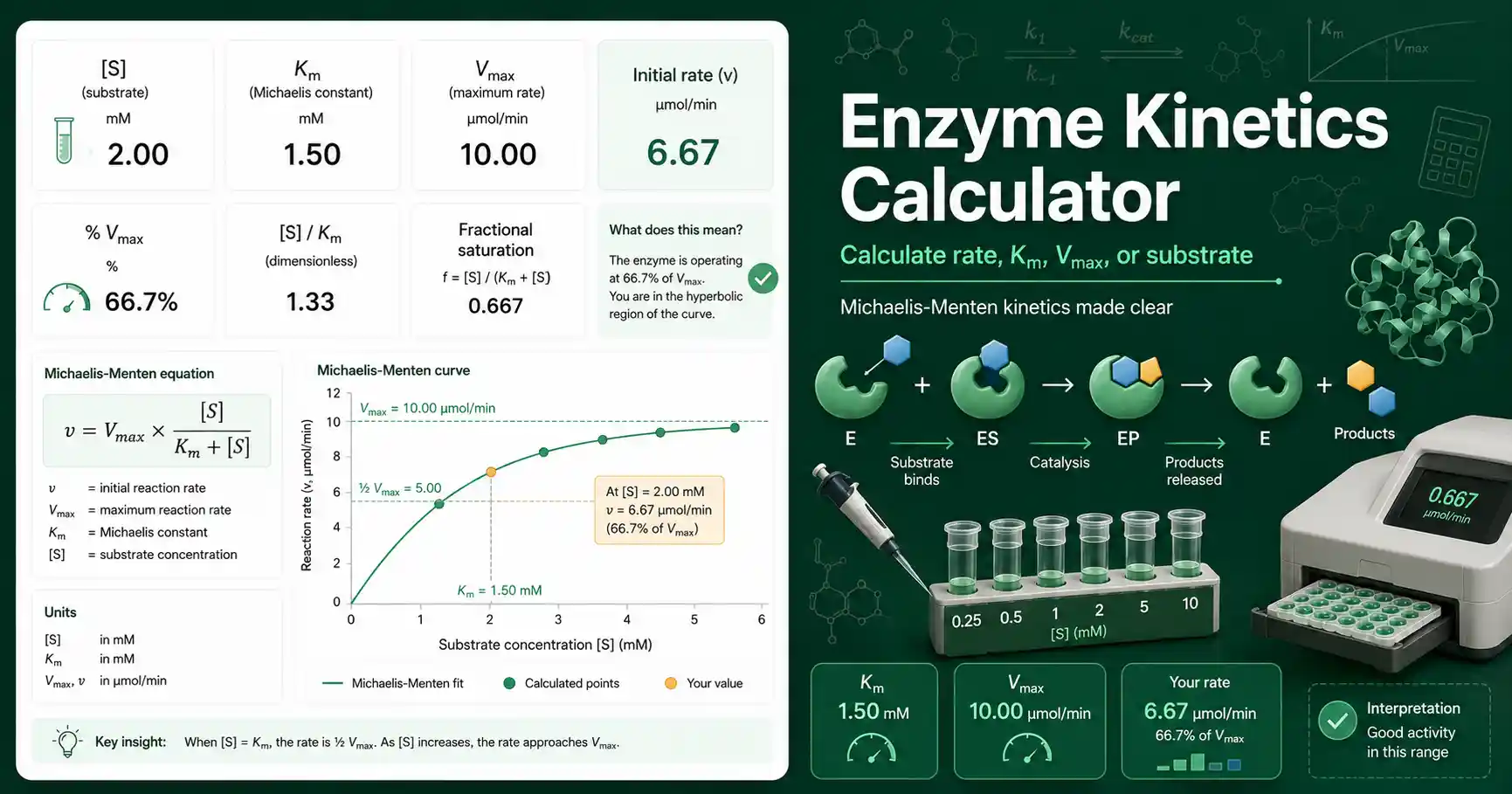
Enzyme Kinetics Calculator for Michaelis-Menten rate
This Enzyme Kinetics Calculator estimates reaction behavior using the Michaelis-Menten equation. It can calculate initial rate when substrate concentration, Km, and Vmax are known. It can also rearrange the same equation to solve for substrate concentration, Km, or Vmax. The calculator is useful for biochemistry homework, enzyme assay planning, lab report checks, and quick interpretation of substrate-rate relationships.
The tool assumes simple steady-state enzyme kinetics. It treats the rate as an initial velocity measured before substantial substrate depletion occurs. It expects Km and substrate concentration to use the same unit. It expects initial rate and Vmax to use the same rate unit. It does not convert between mM and µM automatically because the safest calculator result comes from matching units before calculation.
Students can use this page to understand why rate rises quickly at low substrate and then levels off near Vmax. Teachers can use it to show that Km is the substrate concentration where rate equals half of Vmax. Lab workers can use it to check whether an assay uses enough substrate to approach saturation. Researchers can use it for a fast sanity check before fitting full kinetic data in a dedicated curve-fitting workflow.
Enzyme Kinetics Calculator formula and assumptions
The main equation is v = Vmax × [S] / (Km + [S]). The value v is the initial reaction rate. The value [S] is substrate concentration. The value Km is the Michaelis constant. The value Vmax is the theoretical maximum rate under the selected enzyme amount and assay conditions. The calculator also reports percent of Vmax, fractional saturation, and the [S]/Km ratio so the result is easier to interpret.
When [S] equals Km, the predicted rate is one half of Vmax. When [S] is much lower than Km, the reaction often behaves almost linearly with substrate concentration. When [S] is much higher than Km, the rate approaches Vmax and adding more substrate gives a smaller change in rate. A lower Km often suggests that half-maximal rate occurs at a lower substrate concentration, but Km should not be treated as a universal binding constant without checking the mechanism.
The calculator is not a replacement for full kinetic curve fitting. Use the Km and Vmax Calculator when you have several substrate concentrations and several measured rates. Use the Reaction Rate Calculator when you need to compute rate from product amount and reaction time. For a compact educational overview of Michaelis-Menten kinetics, Chemistry LibreTexts explains the Michaelis-Menten model.
How to interpret enzyme kinetics results
A calculated rate of 91 µmol/min does not mean every future assay will give exactly that value. It means the selected Michaelis-Menten inputs predict that initial velocity under the stated conditions. Enzyme concentration, temperature, pH, buffer composition, ionic strength, substrate purity, inhibitor contamination, and instrument timing can all change real assay data. The calculator does not judge whether a published Km value applies to a new buffer or a different enzyme preparation.
The percent Vmax result helps users see how close the reaction is to saturation. A value near 50% means [S] is close to Km. A value near 90% means substrate is high compared with Km. A value below 10% means the reaction is in a low-substrate region. The [S]/Km ratio is often a useful quick check because it places the substrate concentration on the same scale as the enzyme's kinetic constant.
Rounding matters because kinetic parameters often come from fitted data. Reporting too many digits can imply accuracy that the experiment does not support. Use a reasonable number of significant figures in a lab report. Keep original raw data in your notebook. Verify critical lab calculations independently before using them in real experiments.
Enzyme Kinetics Calculator worked example
Given values: substrate concentration [S] = 2.5 mM, Km = 0.8 mM, and Vmax = 120 µmol/min. Formula: v = Vmax × [S] / (Km + [S]). Substitution: v = 120 × 2.5 / (0.8 + 2.5). Result: v = 90.91 µmol/min. Interpretation: the enzyme is operating at about 75.8% of Vmax because the substrate concentration is above Km but not infinitely saturating.
This worked example also shows why unit matching matters. The calculation is valid because [S] and Km both use mM. If [S] were entered as 2500 µM while Km stayed as 0.8 mM, the result would be wrong. Convert both values to mM or both values to µM before entering them. The same rule applies to rate and Vmax.