
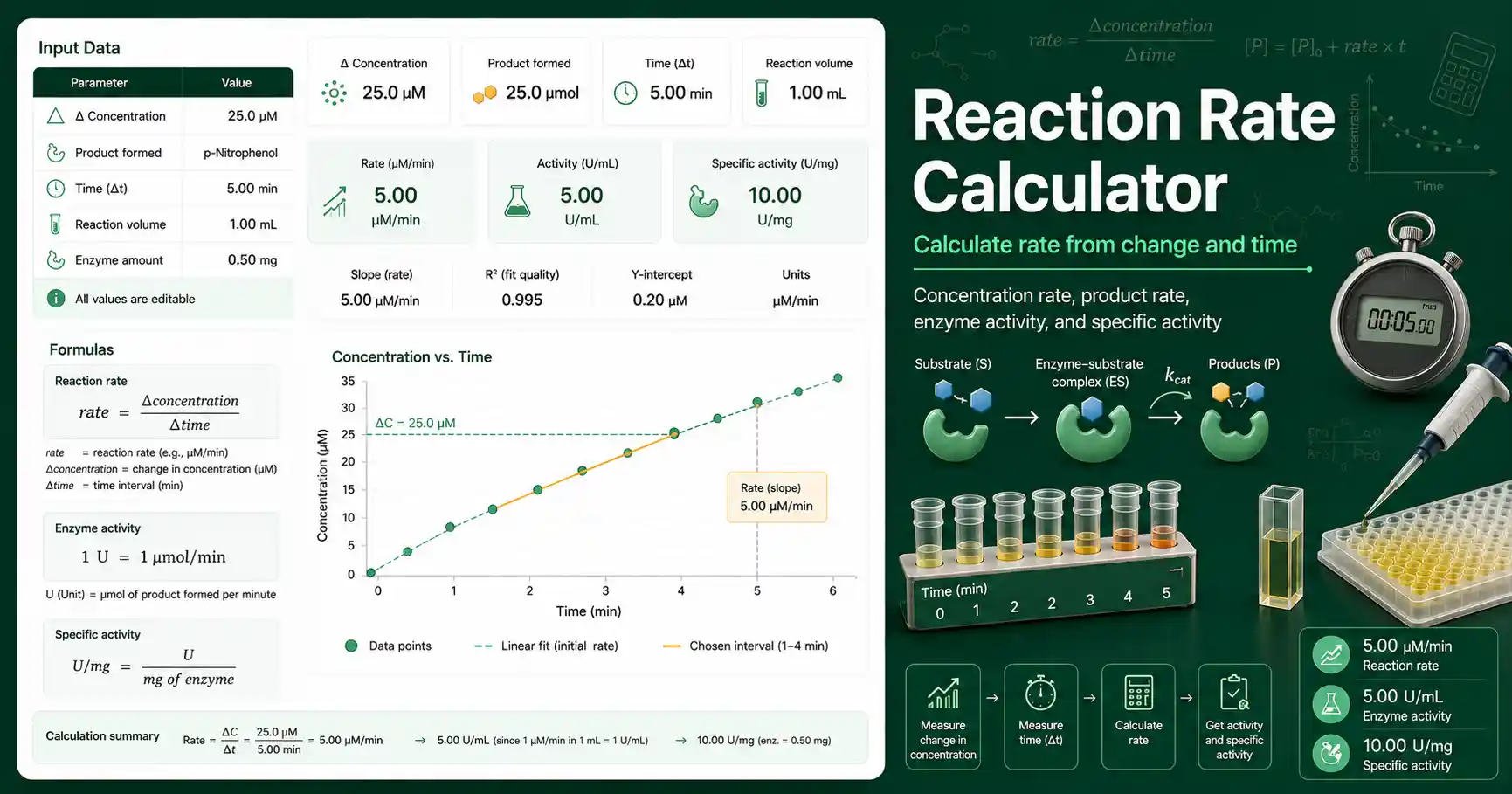
Reaction Rate Calculator for lab measurements
This Reaction Rate Calculator converts a measured change into a rate. It supports concentration change over time, product amount over time, and enzyme activity from product formation. The tool is useful when your notebook records a signal that has already been converted into concentration. It is also useful when an assay reports micromoles of product formed during a fixed incubation. Students can use it to check unit conversions in kinetics homework. Teachers can use it to build examples that connect concentration, time, volume, and enzyme units. Lab workers can use it to summarize routine assay data before transferring results into a worksheet.
A reaction rate describes how quickly a reactant is consumed or a product is formed. In chemistry and biochemistry, rate is often written as change in concentration divided by change in time. The concentration can be reported as M, mM, µM, or nM. Time can be reported in seconds, minutes, or hours. The calculator converts these values so the same result can be read in practical lab units and SI-style units. The Enzyme Kinetics Calculator is better when you already have Km, Vmax, and substrate concentration. This page is better when you need a direct rate from measured change and time.
Reaction Rate Calculator formula
For a direct concentration measurement, the calculator uses rate equals concentration change divided by elapsed time. If the concentration change is 0.24 mM over 5 minutes, the rate is 0.048 mM/min. The same value equals 48 µM/min. It also equals 8.0 × 10⁻⁷ M/s after converting minutes to seconds and millimolar to molar. A positive concentration change usually means product formation. A reactant disappearance can also be reported as a positive rate when you use the absolute value and apply the correct reaction sign convention.
For product formation, the calculator first divides amount by time. It then uses the reaction volume to convert amount rate into concentration rate. This matters because 12 µmol formed in 2 mL is a larger concentration change than 12 µmol formed in 20 mL. The amount-rate result is helpful for enzyme assays. The concentration-rate result is helpful for kinetic comparisons across different reaction volumes. For a deeper background on rate definitions, see the Chemistry LibreTexts explanation of reaction rates and rate laws.
Calculate enzyme activity from product formed
Enzyme activity is commonly expressed in units. One enzyme unit means one micromole of product formed per minute under the stated assay conditions. If an assay forms 8 µmol of product in 4 minutes, the total activity is 2 U. If that activity came from 0.25 mL of enzyme preparation, the activity concentration is 8 U/mL. If the same sample contains 0.4 mg of protein, the specific activity is 5 U/mg. These normalized values help compare enzyme preparations, purification fractions, or assay conditions. The Km and Vmax Calculator is a better next step when you have rates measured at several substrate concentrations.
Reaction rate result interpretation
The main result shows the rate in the unit style that matches your inputs. The secondary result shows a converted rate that helps with comparison. A high rate means the concentration or product amount changed quickly during the measured interval. A low rate may be real, but it may also reflect a short signal window, weak assay response, poor blank correction, or low enzyme concentration. Rate values are only meaningful when the input signal is inside the reliable range of the assay. Early linear time points usually give better initial rates than late time points where substrate depletion or product inhibition may occur. Rounding matters because very small rates can look like zero if too few significant figures are shown. This calculator keeps enough precision for lab interpretation without pretending that the input data are more accurate than the assay. Verify critical lab calculations independently before using them in real experiments.