
Acid chemistry calculator
Ka pKa Converter
Convert Ka to pKa or pKa to Ka with a clear formula, substitution step, and acid strength interpretation for chemistry, buffer, and biochemistry work.
Acid dissociation converter
Convert Ka and pKa instantly
Enter an acid dissociation constant or a pKa value. The calculator converts the value, shows the formula, and explains the acid strength range.
Ka must be positive. Use decimal notation or scientific notation such as 1.8e-5.
Formula used
pKa = −log10(Ka)
pKa = −log10(1.800 × 10^-5)
This pKa sits in a common buffer-study range. The acid/base pair buffers best near this pKa value.
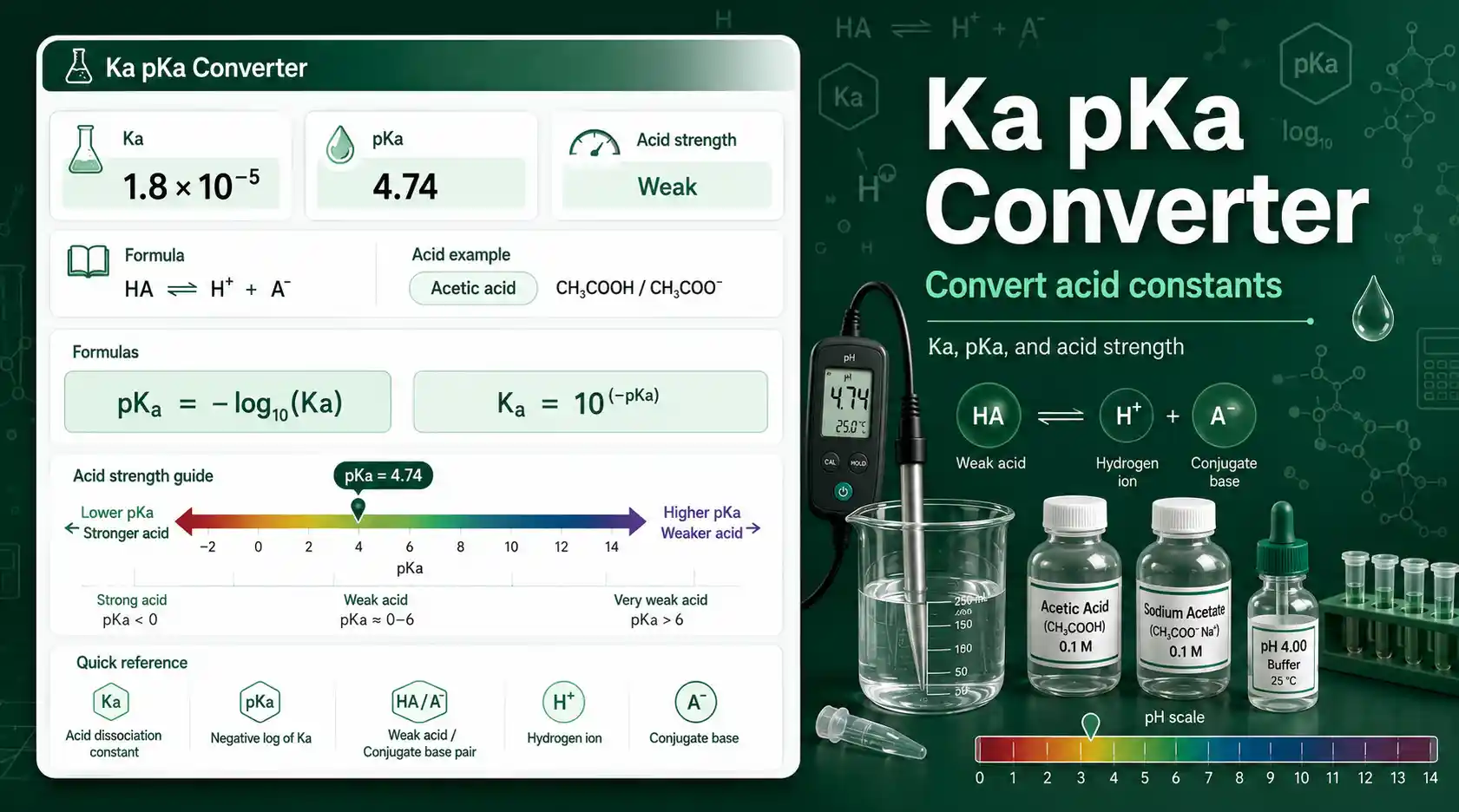
Ka pKa Converter for acid dissociation constants
The Ka pKa Converter changes an acid dissociation constant into a pKa value and changes a pKa value back into Ka. It helps students, teachers, and lab workers move between the two common ways of reporting acid strength.
Ka describes how much an acid dissociates into hydrogen ion and conjugate base at equilibrium. pKa is the negative base-10 logarithm of Ka, so it compresses very small equilibrium constants into values that are easier to compare.
A larger Ka means stronger acid dissociation. A smaller pKa means a stronger acid. These two statements describe the same chemical behavior from opposite numerical directions.
This converter accepts ordinary decimal values such as 0.000018 and scientific notation such as 1.8e-5. It also accepts negative pKa values, which may occur for very strong acids in reference tables.
The result is most useful when the Ka and pKa values come from the same temperature, solvent, and reference convention. Many educational examples assume dilute aqueous solution near room temperature, but real systems can shift with ionic strength and solvent composition.
Ka to pKa formula and pKa to Ka formula
The Ka to pKa formula is pKa = −log10(Ka). This formula means the calculator takes the base-10 logarithm of Ka and changes the sign.
The pKa to Ka formula is Ka = 10^(−pKa). This reverse formula expands the compact pKa value back into the acid dissociation constant.
The converter keeps enough significant digits for homework, lab reports, and buffer calculations. It does not claim more accuracy than the source value provides.
Rounding matters because a small pKa change can represent a meaningful fold change in Ka. A difference of 1 pKa unit equals a tenfold difference in Ka.
The Henderson-Hasselbalch Calculator uses pKa directly to estimate buffer pH from the acid and conjugate base ratio. The Kb pKb Converter performs the matching calculation for base dissociation constants.
Ka pKa Converter result interpretation
A pKa below 0 usually places an acid in a very strong acid range for many educational comparisons. A pKa near 4 to 5 is common for weak organic acids such as acetic acid.
A pKa near 7 is important in many biological and buffer examples because it sits close to neutral pH. A pKa above 10 usually describes a much weaker acid.
The pKa value also tells you where a buffer pair works best. A weak acid and conjugate base pair usually buffers most effectively when the solution pH is within about one unit of the pKa.
Students can use this calculator to check textbook problems, acid strength rankings, and equilibrium worksheets. Teachers can use it to generate examples that show the logarithmic connection between Ka and pKa.
Lab workers can use it when a reagent datasheet gives Ka but a buffer equation needs pKa. Researchers can use it as a quick consistency check before comparing acid-base values from different sources.
A trusted educational discussion of acid dissociation constants and pKa is available from Chemistry LibreTexts.
Ka pKa Converter worked example
Given values: Ka = 1.8 × 10^-5 for a weak acid example.
Formula: pKa = −log10(Ka).
Substitution: pKa = −log10(1.8 × 10^-5).
Result: pKa = 4.74.
Interpretation: A pKa near 4.74 describes a weak acid that is useful in acidic buffer problems near pH 4 to 5.
The reverse check uses Ka = 10^(−4.74), which gives about 1.82 × 10^-5. This close match confirms that the conversion direction and logarithm base are correct.
When you place this value in a lab report, use the same rounding style as the source data. A pKa written as 4.74 should not be treated as if it were known to six decimal places.
Student Questions About Ka and pKa
How do I convert Ka to pKa?
Use pKa = −log10(Ka). Enter a positive Ka value, and the converter returns the matching pKa value.
How do I convert pKa to Ka?
Use Ka = 10^(−pKa). Enter the pKa value, and the converter returns the acid dissociation constant.
What does a lower pKa mean?
A lower pKa means the acid is stronger because its Ka value is larger and dissociation is more favorable.
Why can Ka be hard to compare directly?
Ka values often span many powers of ten. pKa makes comparison easier because it turns those large scale differences into smaller logarithmic numbers.