
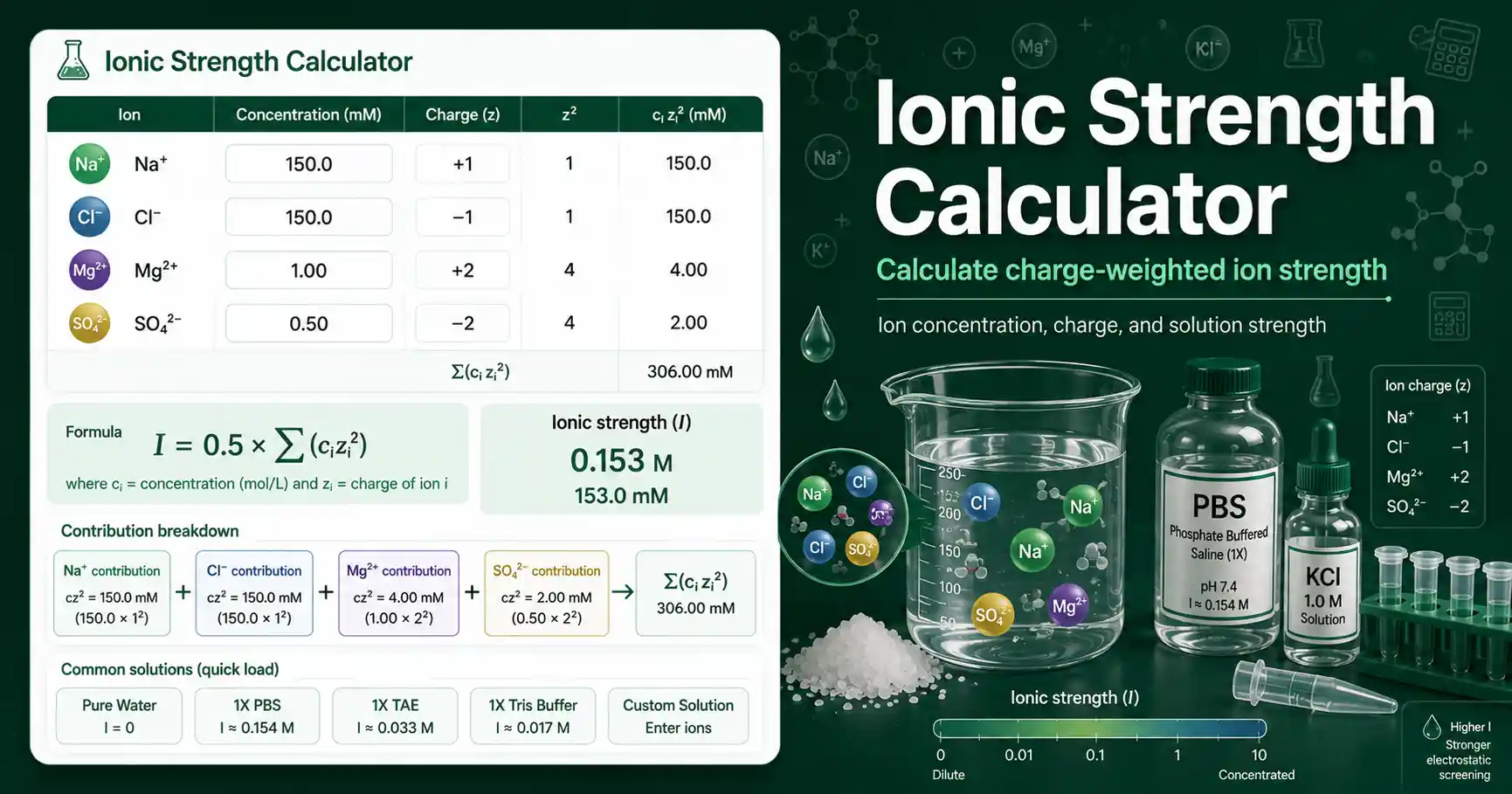
Ionic Strength Calculator formula
Ionic strength describes how much charged material is present in a solution after both concentration and ion charge are considered.
The calculator uses the formula I = 0.5 × Σ(cᵢzᵢ²), where cᵢ is the molar concentration of each ion and zᵢ is the ion charge.
Concentration must be in mol/L inside the equation, so the tool converts mM and µM inputs into M before calculating the result.
The charge term is squared, which means a +2 ion and a −2 ion contribute the same amount at the same concentration.
A 10 mM Mg²⁺ solution contributes more to ionic strength than a 10 mM Na⁺ solution because magnesium has a charge magnitude of 2.
The final 0.5 factor is part of the standard ionic strength definition and keeps the expression consistent for electrolyte solutions.
Chemistry LibreTexts provides a useful background discussion of ionic strength in electrolyte solutions.
How to calculate ionic strength from ions
Enter each charged ion as a separate row.
Add the concentration of the ion, select M, mM, or µM, and enter the formal charge such as 1, −1, 2, or −2.
The calculator multiplies each molar concentration by the square of its charge.
It then adds those terms and multiplies the sum by 0.5.
The result appears in M, mM, and µM so students and lab workers can use the unit that fits their problem.
For simple salts, remember to include both the cation and the anion.
For NaCl, include Na⁺ and Cl⁻ at the same concentration when the salt is fully dissociated.
For MgCl₂, include Mg²⁺ at the salt concentration and Cl⁻ at twice the salt concentration.
For phosphate buffers, include the main charged phosphate forms that are meaningful at the selected pH.
If you are preparing PBS, the PBS Preparation Calculator can help you estimate the salt amounts before checking ionic strength.
Ionic Strength Calculator result interpretation
A low ionic strength means the solution contains little charged material or mostly dilute ions.
A moderate ionic strength is common in many biological buffers and routine aqueous lab solutions.
A high ionic strength means ion-ion interactions may affect activity coefficients, solubility, binding, or assay behavior.
Ionic strength is not the same as osmolarity, even though both depend on dissolved species.
Osmolarity counts dissolved particles, while ionic strength gives extra weight to ions with larger charge magnitude.
For particle-counting questions, use the Osmolarity Calculator instead of ionic strength alone.
The calculator assumes complete dissociation of the ions you enter.
This assumption works well for many simple salts in dilute educational examples.
It may be less accurate for concentrated solutions, partially dissociated weak electrolytes, or mixtures where activity effects are important.
Rounding matters because small differences in divalent ion concentration can produce visible changes in the final value.
Verify critical lab calculations independently before using them in real experiments.