
Chemistry and biology calculator
Lab Unit Converter
Convert common laboratory units for volume, mass, concentration, pressure, temperature, amount, length, and time. Use it to check homework values, prepare calculation notes, and keep lab math consistent.
Lab conversion dashboard
Convert common laboratory units
Choose a category, enter a value, and convert between common lab units with clear rounding and a base-unit check.
Converted value
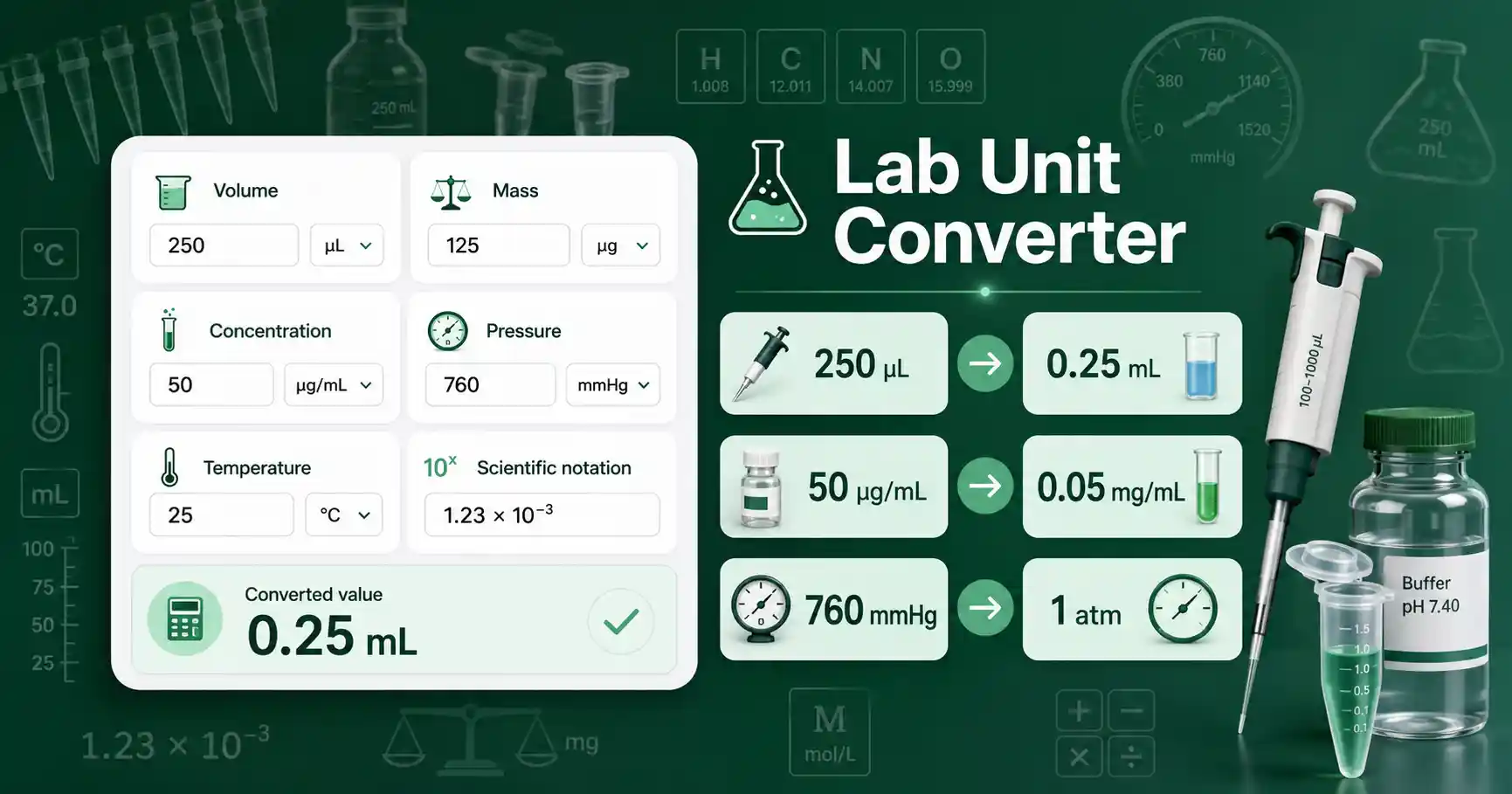
Lab Unit Converter for common scientific units
This Lab Unit Converter changes one laboratory unit into another unit in the same measurement category. It covers volume units such as liters, milliliters, and microliters. It covers mass units such as grams, milligrams, micrograms, and nanograms. It also handles concentration, pressure, amount of substance, length, time, and temperature.
Students can use the converter to check chemistry problems before writing final answers. Teachers can use it to demonstrate how prefixes change a value. Lab workers can use it to keep reagent notes consistent when one protocol uses mL and another uses µL. Researchers can use it as a quick sanity check before moving a value into a spreadsheet or calculation notebook.
The tool is most useful when the measurement is already known and only the unit must change. It does not measure a sample. It does not decide whether a biological procedure is appropriate. It simply keeps the numerical unit conversion clear, readable, and easy to copy.
How to use Lab Unit Converter correctly
Start by choosing the conversion category. Select Volume for L, mL, µL, and nL. Select Mass for g, mg, µg, ng, and pg. Select Mass concentration for values such as mg/mL, µg/mL, and percent weight per volume. Use Advanced mode when you need molarity, pressure, amount, length, or time.
Enter the number exactly as it appears in your lab notes or problem statement. Then choose the starting unit and the target unit. The result card gives the converted value, a base-unit check, and scientific notation. Scientific notation is helpful for very small values such as 0.00000025 L or very large values such as 2500000 ng.
Keep the category consistent. A volume unit cannot convert directly into a mass unit unless you also know density. A mass unit cannot convert directly into molarity unless you also know molar mass and volume. For dilution math, use a dedicated solution dilution calculator after your units are consistent.
Lab Unit Converter method and unit assumptions
Most conversions use a base unit. Volume converts through liters. Mass converts through grams. Pressure converts through pascals. Amount converts through moles. Time converts through seconds. The tool first converts the starting value into the base unit, then converts the base-unit value into the target unit.
For example, 250 µL becomes 0.00025 L because one microliter equals 10⁻⁶ L. The same base value becomes 0.25 mL because one milliliter equals 10⁻³ L. This two-step method makes it easier to catch misplaced decimal points.
Temperature uses a different method because Celsius, Fahrenheit, and Kelvin do not share a simple multiplier. Celsius to Kelvin adds 273.15. Fahrenheit first converts through a 5/9 scale change and then adds the Kelvin offset. The converter rejects temperatures below absolute zero because those values are physically impossible.
Standard unit names and prefixes follow the International System of Units described by the NIST SI units reference. The calculator uses practical lab rounding rather than claiming instrument-level precision.
Lab Unit Converter worked example for microliters to milliliters
Given value: 250 µL. Target unit: mL. Formula: converted value = starting value × starting-unit factor ÷ target-unit factor. Substitution: 250 × 10⁻⁶ L ÷ 10⁻³ L/mL = 0.25 mL. Result: 250 µL equals 0.25 mL.
The interpretation is simple. A quarter of a milliliter is the same volume as 250 microliters. This result is reasonable because 1000 µL equals 1 mL, so 250 µL must be one fourth of a milliliter.
A second useful example is 50 µg/mL to mg/mL. One microgram is 0.001 milligrams, so 50 µg/mL equals 0.05 mg/mL. The volume unit stays the same, and only the mass scale changes. This check helps prevent confusing µg/mL with mg/mL, a thousand-fold error.
Lab Unit Converter results explained
A converted value should preserve the same physical quantity. The number may get bigger when the target unit is smaller. The number may get smaller when the target unit is larger. For example, 1 g equals 1000 mg because milligrams are smaller than grams.
The base-unit check helps users verify the calculation. If a volume result looks wrong, compare the base value in liters. If a pressure result looks wrong, compare the base value in pascals. This method is especially useful when moving between prefixes such as milli, micro, nano, and pico.
Rounding matters because lab values often come from instruments with limited precision. A pipette setting of 2.5 µL should not be reported as if it has ten certain decimal places. Use enough digits to keep the calculation useful, but do not overstate experimental accuracy.
Lab Unit Converter mistakes to avoid
Do not confuse µL with mL. One milliliter is 1000 microliters. A misplaced prefix can create a thousand-fold error in a reaction mix, dilution, or stock note. Always check the prefix before copying a result into a lab sheet.
Do not convert mass concentration into molarity without molar mass. A value such as 10 mg/mL tells you mass per volume. A value such as 10 mM tells you moles per liter. You need the compound molecular weight to connect those two ideas.
Do not treat percent weight per volume as a universal concentration unit. In this tool, 1% w/v means 1 g per 100 mL, which equals 10 g/L. Other percent formats, such as v/v or w/w, use different assumptions. Check the protocol wording before converting.
Do not ignore temperature scale offsets. A temperature change of 1 °C equals a change of 1 K, but a temperature reading of 1 °C is not the same as 1 K. Use the Gas Law Calculator only after converting gas-law temperatures to Kelvin.
Lab Unit Converter use cases in lab work
One common use case is preparing a worksheet for a reaction setup. A protocol may list a reagent volume in milliliters, while a student needs the pipette setting in microliters. The converter quickly changes 0.125 mL into 125 µL.
A second use case is checking concentration labels. An antibiotic stock may be labeled as 50 mg/mL, while a calculation sheet uses µg/mL. The converter shows that 50 mg/mL is 50,000 µg/mL. This prevents scale errors before any separate dilution calculation begins.
A third use case is chemistry homework. Students often need to move between atm, kPa, and mmHg before using the ideal gas law. Pressure conversion keeps the variables in the same unit system before substitution.
A fourth use case is reporting small quantities. Molecular biology notes often include nanograms, picomoles, nanomolar concentrations, and microliter volumes. Scientific notation makes those values easier to compare without losing zeros.
Related tools for unit-based lab calculations
User questions about Lab Unit Converter
Can this Lab Unit Converter convert microliters to milliliters?
Yes. Choose Volume, enter the microliter value, select µL as the starting unit, and select mL as the target unit. The result also shows a liter-based check.
Does the converter handle chemistry concentration units?
Yes. It converts mass concentration units such as g/L, mg/mL, µg/mL, ng/µL, and percent weight per volume. It also converts molar units such as M, mM, µM, nM, and pM.
Why does temperature conversion behave differently?
Temperature scales use offsets. Celsius to Kelvin and Fahrenheit to Kelvin cannot be handled by one multiplier, so the converter applies the correct offset formulas.