
Chemistry math tool
Scientific Notation Calculator
Convert decimals, powers of ten, and e-notation into clean scientific notation. Use the calculator to format lab values, compare very small or very large numbers, and do quick scientific-notation arithmetic without losing the exponent logic.
Scientific notation calculator
Convert, format, and calculate powers of ten
Enter a decimal value or a number such as 6.02 × 10^23. The calculator gives standard notation, scientific notation, engineering notation, and a clear interpretation of the exponent.
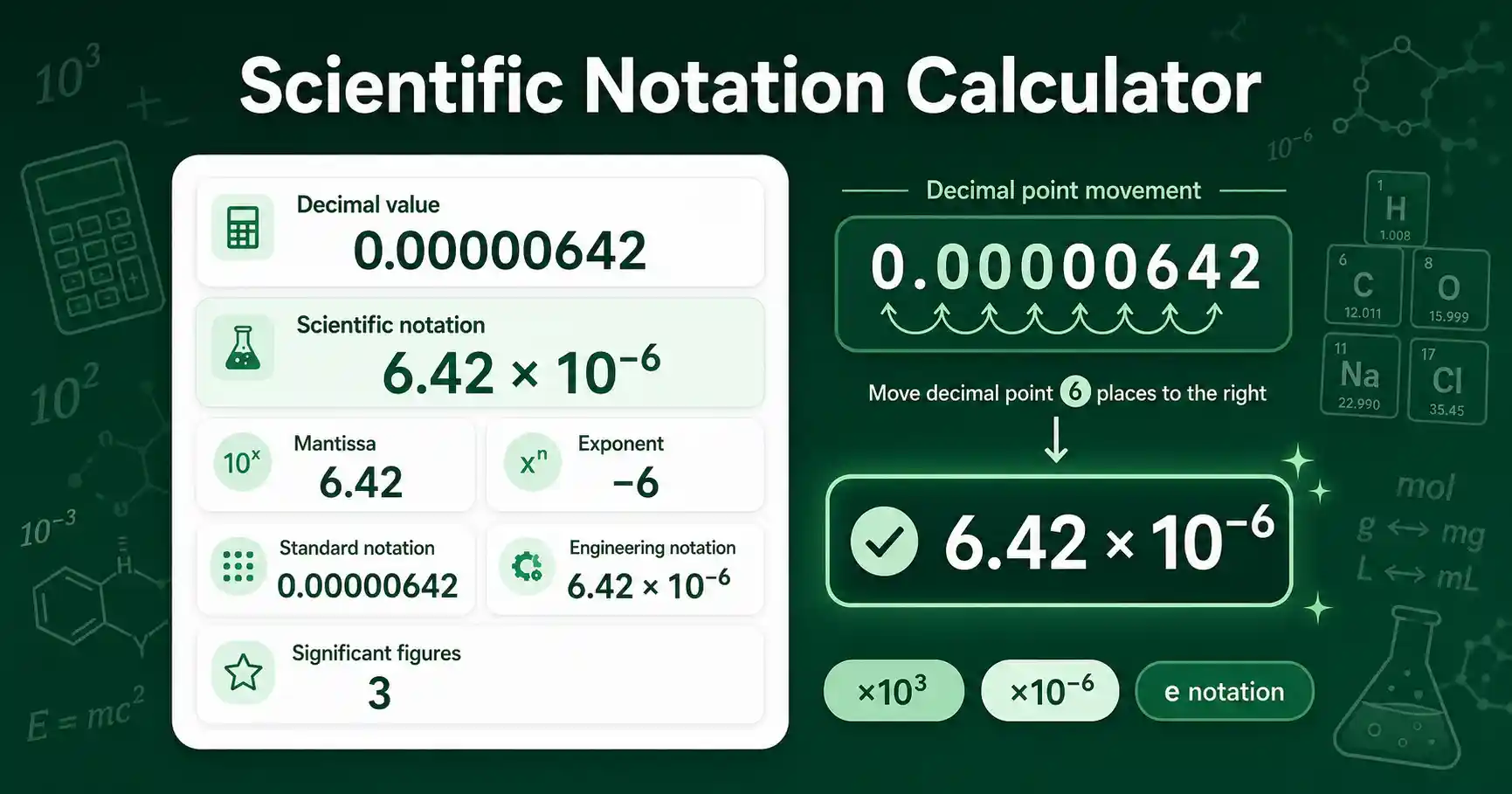
Scientific notation6.42 × 10^-6
Mantissa 6.42, exponent -6.
The coefficient is kept between 1 and 10. The exponent tells how many places the decimal point moves.
Scientific Notation Calculator for powers of ten
This Scientific Notation Calculator changes ordinary decimal numbers into a coefficient multiplied by a power of ten. It also converts scientific notation back into standard notation, so students can see both forms side by side. The calculator accepts values such as 0.00000642, 6.42e-6, and 6.42 × 10^-6. It then reports the mantissa, exponent, standard notation, and engineering notation.
Scientific notation is useful when a number is too small or too large to read comfortably in decimal form. Biology and chemistry classes use it for Avogadro's number, molecular scale distances, cell counts, dilution factors, rate constants, gas-law values, and spectroscopy measurements. A value such as 0.00000038 g is easier to compare as 3.8 × 10^-7 g. A count such as 2500000000 cells is easier to read as 2.5 × 10^9 cells.
The same notation appears throughout molecular lab math. A result from a Lab Unit Convertermay be clearer when written with powers of ten. A gas-law answer from the Gas Law Calculatormay also need consistent significant figures before it goes into a lab report.
How to use Scientific Notation Calculator correctly
Enter the value you want to convert in the number field. You can type a normal decimal, an e-notation value, or a power-of-ten expression. The expression 1.25e6 means the same thing as 1.25 × 10^6. The expression 4.6 × 10^-3 means the decimal point moves three places to the left.
Choose the number of significant figures you want in the result. Two significant figures give a compact answer, while four or five figures preserve more detail for homework, worksheets, or instrument readouts. The calculator rounds only the displayed result. It does not claim that a measured value is more precise than the original data.
Use the calculation mode when you need to multiply, divide, add, or subtract two scientific-notation values. Multiplication and division are especially common because powers of ten combine directly. Addition and subtraction still work, but the values must be considered at the same exponent before the coefficients are combined.
Scientific Notation Calculator method and assumptions
Scientific notation uses the form a × 10^n. The coefficient a must be at least 1 and less than 10 in absolute value. The exponent n is an integer. Positive exponents represent large numbers. Negative exponents represent small numbers between zero and one.
To convert a decimal to scientific notation, move the decimal point until one non-zero digit remains to the left of the decimal point. Count the number of places moved. Moving left gives a positive exponent. Moving right gives a negative exponent. The calculator applies this rule and then rounds the coefficient to the selected significant figures.
For multiplication, the coefficients multiply and the exponents add. For division, the coefficients divide and the exponents subtract. For addition and subtraction, the numbers should first be rewritten with the same exponent. OpenStax gives a helpful foundation for scientific measurements and unit handling in chemistry, including the importance of numerical notation and reported precision.OpenStax Chemistry 2e measurement results
Scientific Notation Calculator worked example
Given values: Convert 0.00000642 to scientific notation with three significant figures.
Method: Move the decimal point until the coefficient is between 1 and 10.
Substitution: 0.00000642 becomes 6.42, and the decimal point moved six places to the right.
Result: 0.00000642 = 6.42 × 10^-6.
Interpretation: The negative exponent shows that the original value is much smaller than one.
A second example uses multiplication. If a sample has 3.2 × 10^5 cells per mL and the volume is 4.0 × 10^-2 mL, multiply 3.2 by 4.0 to get 12.8. Add the exponents 5 and -2 to get 3. The intermediate value is 12.8 × 10^3, which is rewritten as 1.28 × 10^4. The result means the small volume contains about 12,800 cells under the stated concentration.
Scientific Notation Calculator results explained
The mantissa is the front number in scientific notation. In 6.02 × 10^23, the mantissa is 6.02. The exponent is 23. That exponent means the decimal point moves 23 places to the right when the value is written in standard notation.
A negative exponent means the decimal point moves left. A pH-related concentration, a molecular mass in grams, or a microscopic length may use a negative exponent. The value 7.5 × 10^-4 is equal to 0.00075. The exponent gives the scale of the number before you even read every digit.
Engineering notation is slightly different. It uses powers of ten that are multiples of three, such as 10^3, 10^6, or 10^-9. This can match metric prefixes such as kilo, mega, milli, micro, and nano. The calculator reports engineering notation as a helpful comparison, but standard scientific notation remains the usual form for chemistry and biology worksheets.
Scientific Notation Calculator mistakes to avoid
Do not write 64.2 × 10^-7 as final scientific notation because the coefficient is not between 1 and 10. Rewrite it as 6.42 × 10^-6. Do not drop the sign of the exponent. A value with 10^6 is one trillion times larger than a value with 10^-6.
Do not confuse e-notation with natural logarithms. In calculator input, 1.5e4 means 1.5 × 10^4, not e raised to a power. Do not add exponents when you are adding numbers. Exponents add only during multiplication. For addition, align the powers of ten first.
Check rounding before reporting an answer. If your measured value has three significant figures, reporting eight significant figures can create false precision. Verify critical lab calculations independently before using them in real experiments.
Scientific Notation Calculator use cases in lab work
Students can use the calculator to check homework answers that involve Avogadro's number, molar quantities, small masses, or large particle counts. Teachers can use it to demonstrate how moving a decimal point changes the exponent but not the underlying value.
Lab workers can use it to format dilution factors, colony counts, solution concentrations, and instrument readings in a clearer form. Researchers can use it as a quick notation check before moving values into notes, spreadsheets, figures, or manuscript drafts.
The tool is especially helpful when a result contains many zeros. It reduces transcription errors because the scale is separated from the meaningful digits. It also helps users compare values that differ by several orders of magnitude.
Student questions about Scientific Notation Calculator
What is the correct scientific notation format?
Scientific notation writes a value as a coefficient from 1 up to but not including 10, multiplied by a power of ten. The value 4200 becomes 4.2 × 10^3.
Can negative exponents be used for small lab values?
Yes. Negative exponents are used for values smaller than one. The value 0.00042 becomes 4.2 × 10^-4.
Why do significant figures matter in scientific notation?
Significant figures show the precision of a value. The calculator rounds displayed results, but you should match your class rule, instrument precision, or lab reporting requirement.