
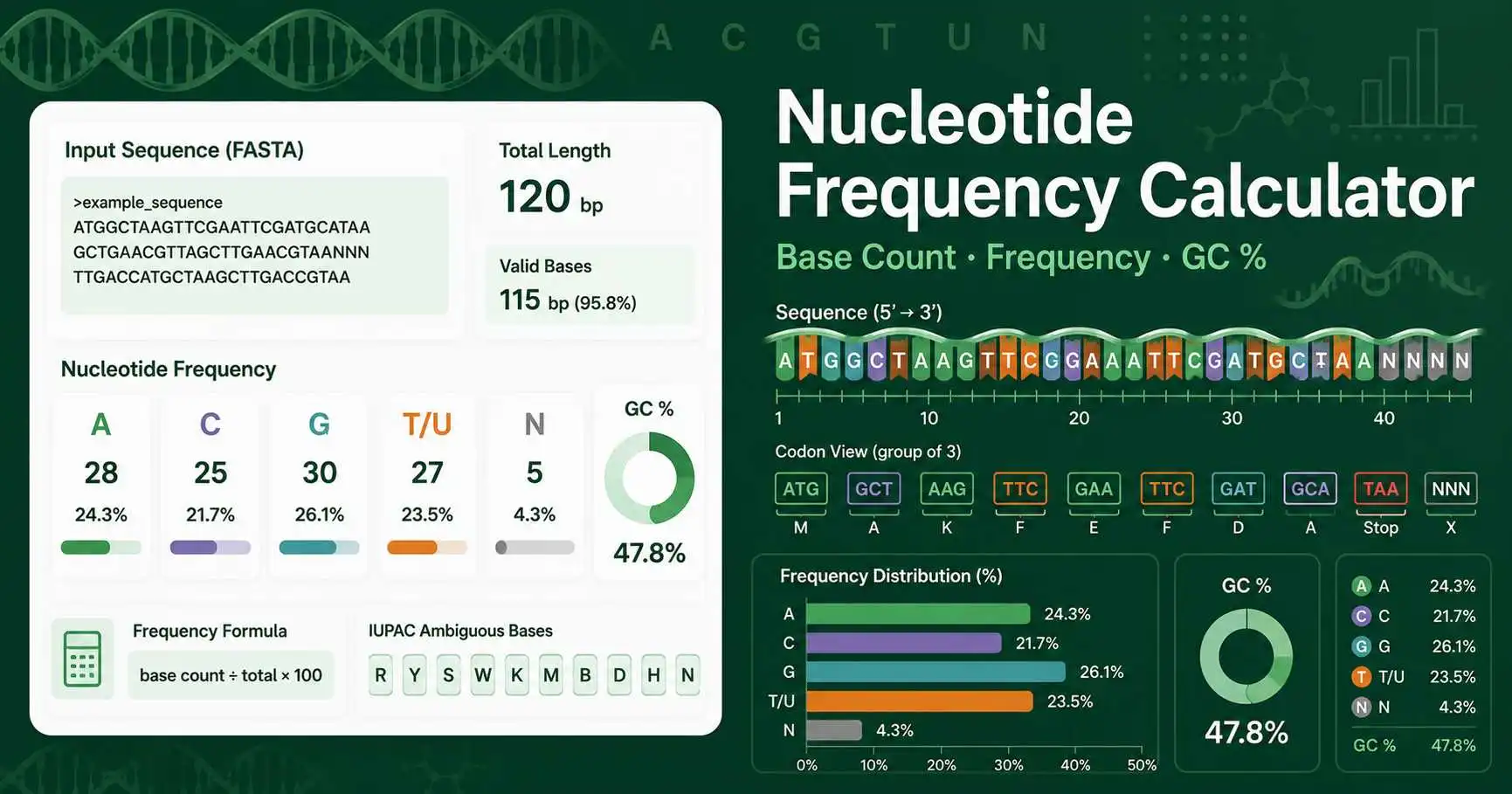
Nucleotide Frequency Calculator for DNA and RNA
A nucleotide frequency calculator counts how many times each base appears in a sequence. It gives the count and percentage for A, C, G, T, U, and N. It also reports GC content and AT or AU content.
Use this tool when you need a fast summary of sequence composition. It is useful for PCR checks, cloning notes, sequencing review, GC-rich template screening, and student lab reports.
How nucleotide frequency is calculated
The calculator removes FASTA headers, spaces, line breaks, and numbers. It then counts each nucleotide symbol. Frequency is calculated as base count divided by total counted symbols, multiplied by 100.
GC content uses the formula G plus C divided by exact bases. AT content uses A plus T for DNA. AU content uses A plus U for RNA. Ambiguous IUPAC bases are listed separately because they do not represent one exact base.
FASTA formatting is common in sequence databases and bioinformatics tools. The NCBI GenBank guide explains the basic FASTA format used for sequence submissions.NCBI FASTA format guide
What the nucleotide frequency result means
Base count tells you the number of each nucleotide in the cleaned sequence. Base percentage tells you how much each nucleotide contributes to the sequence. GC percentage shows the share of guanine and cytosine bases.
A high GC percentage can affect DNA melting behavior, PCR amplification, primer design, and sequencing quality. A low GC percentage may indicate an AT-rich region. These values do not prove whether a sequence is good or bad, but they help you decide what to check next.
If you only need a direct G+C percentage, use the GC Content Calculator. If you want a wider sequence summary with reverse complement and transcript output, use the DNA Sequence Analyzer.
When to use nucleotide frequency analysis
Use nucleotide frequency analysis before comparing DNA fragments, checking RNA sequence composition, reviewing synthetic sequences, or preparing a short sequence statistics table. It helps students explain sequence attributes with clear numbers.
Lab workers can use it during routine checks. For example, a technician may paste a PCR target region to see whether it is GC-rich. A teacher may paste a short DNA sequence and ask students to calculate base percentages by hand, then compare their work with the tool.
Common mistakes in base frequency checks
Do not mix T and U unless you are intentionally working with a converted or mixed sequence. T usually belongs to DNA. U usually belongs to RNA. If both appear together, check the source sequence.
Do not treat ambiguity codes as exact nucleotides. A symbol such as N means the base is unknown. Symbols such as R, Y, S, W, K, and M represent possible base groups. This calculator counts them separately so your exact base percentages stay clear.
Using nucleotide frequency in homework and lab work
Students can use the result to report sequence length, base count, base percentage, GC content, and ambiguous symbols. These are useful values for genetics, molecular biology, bioinformatics, and introductory biotechnology assignments.
In real lab work, verify critical sequence statistics with your original sequence file, supplier record, or analysis pipeline. A simple web calculator is helpful for quick checking, but it should not replace validated laboratory workflows.