
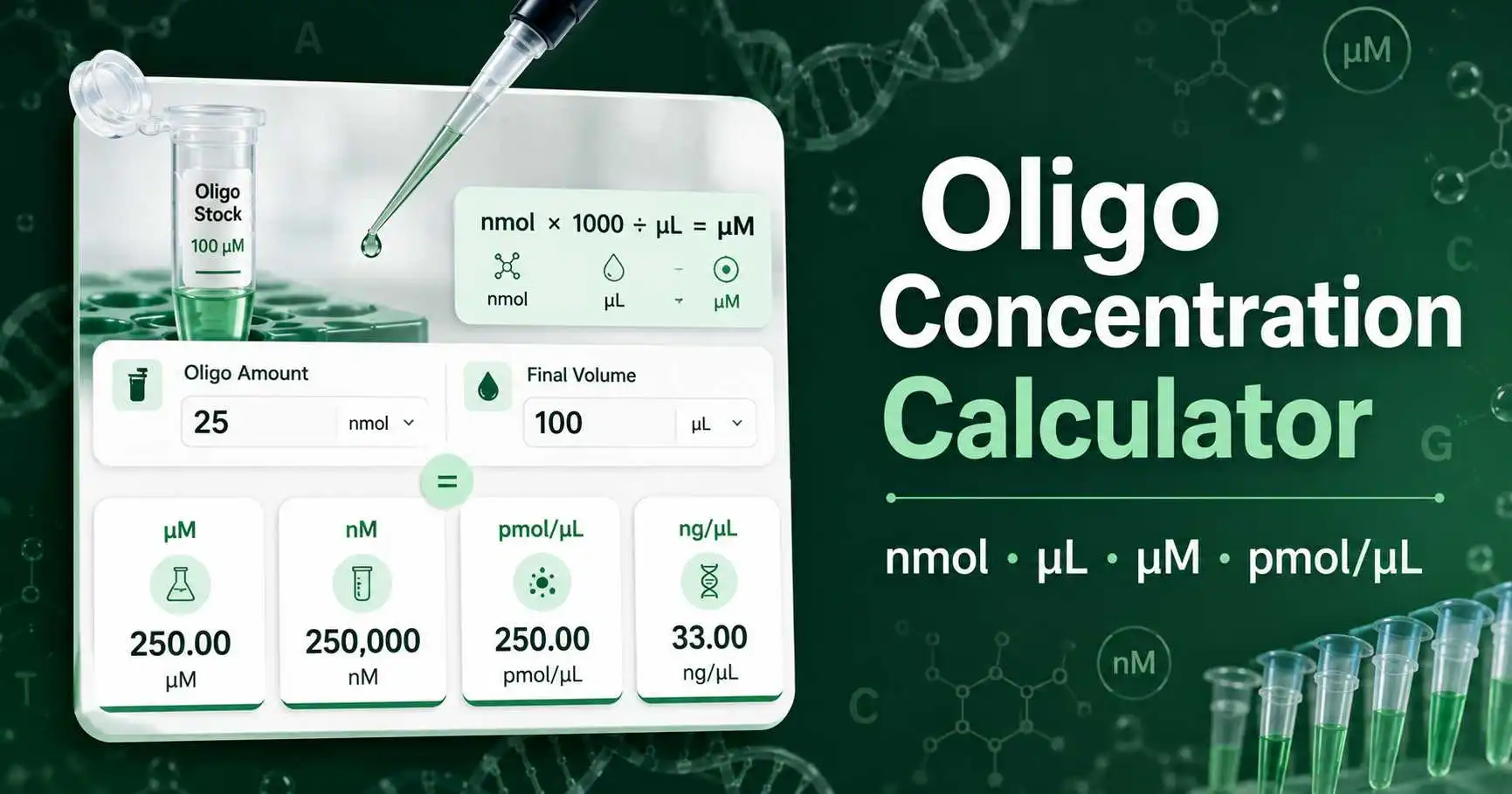
Oligo Concentration Calculator for primer stocks
The Oligo Concentration Calculator converts the amount of a DNA or RNA oligonucleotide and the final solution volume into a practical stock concentration. It is useful when a supplier label gives the dry oligo amount in nmol or pmol and you need to know the final concentration after resuspension.
The tool reports concentration in µM, nM, and pmol/µL. These units are common in PCR, qPCR, sequencing, cloning, and routine primer storage. If you add a sequence or known molecular weight, it also estimates total mass and mass concentration in ng/µL.
How to calculate oligo concentration
Enter the oligo amount from your tube, choose nmol or pmol, and enter the final volume after adding water or buffer. The calculator converts the amount to nmol, converts the volume to µL, and applies a direct molarity conversion.
The formula is simple: concentration in µM equals amount in nmol times 1000 divided by final volume in µL. For oligo solutions, the same value is also pmol/µL. For example, 25 nmol in 250 µL gives 100 µM, or 100 pmol/µL.
This matches the common primer preparation rule described by IDT, where nmol can be used to calculate the volume needed for a 100 µM primer stock.IDT primer dilution guidance
When to use this oligo concentration tool
Use this calculator after resuspending a dry primer, probe, or short oligo. It helps you confirm whether your stock is close to the target concentration, such as 100 µM or 10 µM. It also helps students connect amount, volume, and molarity in a real molecular biology example.
If your main task is deciding how much liquid to add to a dry tube, use the Oligo Resuspension Calculator. If you already have a stock and need a lower working solution, use theOligo Dilution Calculator.
Understanding the concentration results
A result of 100 µM means each microliter contains 100 pmol of oligo. A result of 10 µM means each microliter contains 10 pmol. PCR protocols often describe primer addition in pmol, µM stock concentration, or nM final reaction concentration, so these conversions help prevent unit mistakes.
The optional ng/µL value needs molecular weight. If you enter a known molecular weight from a supplier report, the tool uses that value. If you paste a sequence, the tool estimates molecular weight for an unmodified single-stranded DNA or RNA oligo. Modified oligos, labeled probes, locked nucleic acids, or phosphorothioate bonds may need a supplier-specific molecular weight.
Common oligo concentration mistakes
The most common error is mixing up nmol, pmol, µL, and mL. A thousand pmol equals one nmol, and one mL equals one thousand µL. Another common mistake is assuming ng/µL can be calculated without molecular weight. Mass concentration depends on sequence length and nucleotide composition.
Always check whether your tube label gives amount, concentration, or volume. A dry oligo label may list amount in nmol, while a prepared stock label may list concentration in µM. These values are related, but they are not the same input.
Lab and student use of oligo concentration values
Students can use this tool to learn molarity, stock solutions, unit conversion, and the relationship between amount and volume. Lab workers can use it to label primer stocks, check worksheet calculations, and prepare consistent DNA or RNA oligo solutions for routine experiments.
Before using the result in a real lab, verify the sequence, molecular weight, final volume, diluent, storage condition, and target stock concentration. For critical PCR, qPCR, cloning, or sequencing work, confirm the calculation independently before preparing the final stock.