
Chemistry and acid-base math
pOH Calculator
Calculate pOH from hydroxide ion concentration, convert pOH to pH, and estimate ion concentrations for aqueous chemistry at 25 °C.
Chemistry calculator
Calculate pOH, pH, [OH−], and [H+]
Enter hydroxide ion concentration or a pOH value. The calculator uses pH + pOH = 14 at 25 °C.
Use molar hydroxide concentration for a simple strong-base pOH calculation.
The calculated pH is above neutral because the hydroxide ion concentration is higher than hydrogen ion concentration.
Verify critical lab calculations independently before using them in real experiments.
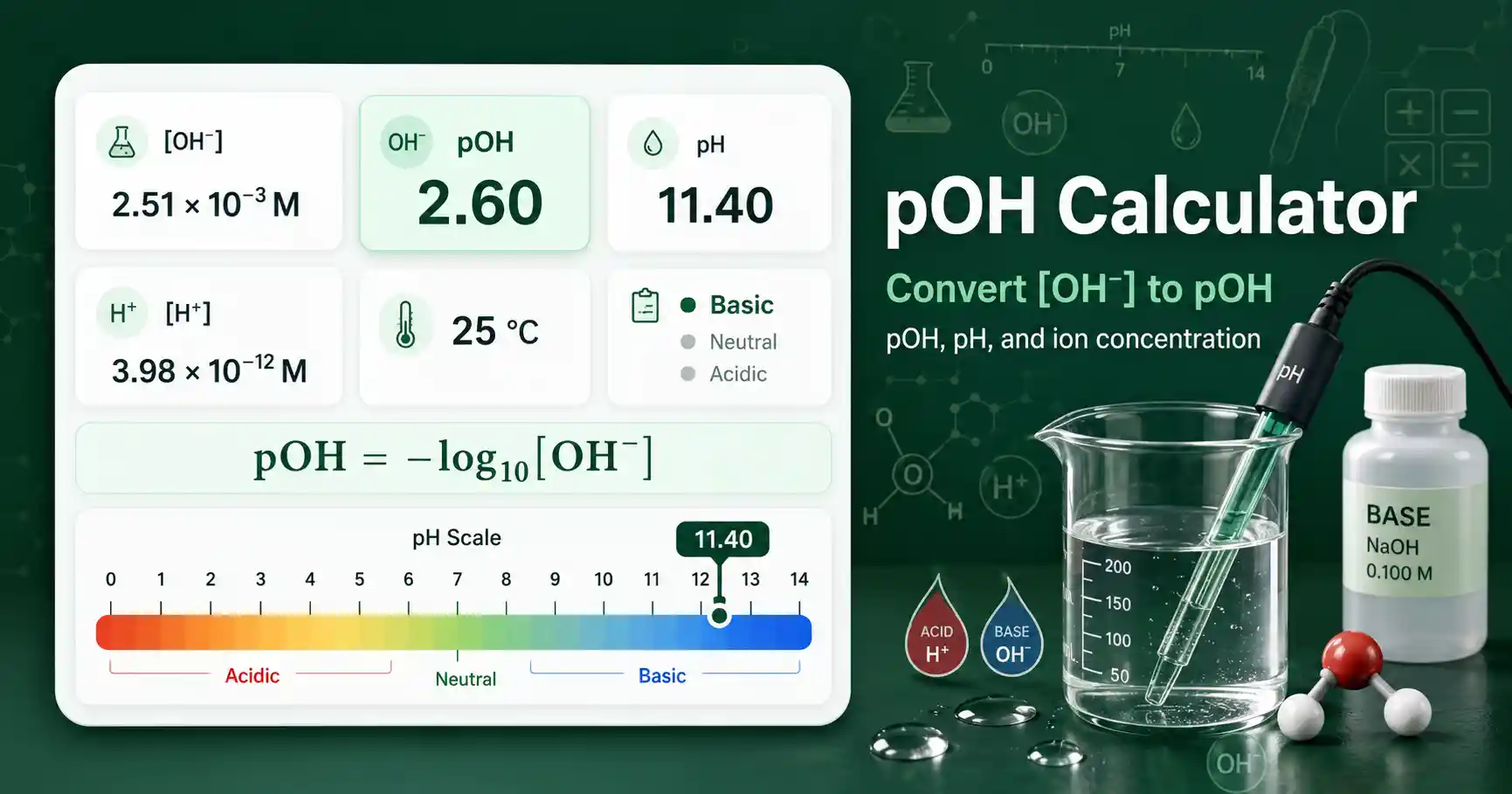
pOH Calculator for hydroxide ion concentration
This pOH Calculator converts hydroxide ion concentration into pOH using a base-10 logarithm. It also calculates pH from pOH using the 25 °C water relationship. The tool is useful when a chemistry problem gives [OH−] instead of [H+]. It is also useful when a lab worksheet asks you to compare basic strength on the pOH scale.
The required input is either hydroxide ion concentration or a direct pOH value. The calculator accepts hydroxide concentration in M, mM, µM, or nM. The output includes pOH, pH, [OH−], [H+], and a simple acidic, neutral, or basic interpretation. The calculation assumes an aqueous solution near 25 °C. It also assumes that the hydroxide concentration represents the free hydroxide ion concentration used in the pOH expression.
pOH is a logarithmic value, so a one-unit decrease in pOH means a tenfold increase in hydroxide ion concentration. A pOH of 3 means [OH−] is 1 × 10^-3 M. A pOH of 4 means [OH−] is 1 × 10^-4 M. The smaller pOH value represents the more basic solution when temperature is 25 °C.
pOH Calculator formula at 25 °C
The main formula is pOH = −log10[OH−]. The hydroxide ion concentration must be expressed in mol/L before the logarithm is applied. If the input is 2.5 mM, the calculator first converts it to 0.0025 M. Then it applies the pOH formula. After pOH is known, the calculator uses pH = 14 − pOH at 25 °C.
This 14 value comes from the ion product of water at 25 °C. In water at this temperature, [H+][OH−] is 1.0 × 10^-14. That relationship makes pH + pOH equal to 14 for many general chemistry calculations. OpenStax explains this relationship in its section on pH and pOH.
Temperature matters because the ion product of water changes with temperature. This calculator uses the common 25 °C convention because that is the standard assumption in most classroom pH and pOH problems. For warm biological systems, heated reactions, or nonstandard solvent conditions, you should check whether pKw is still close to 14. The result should be treated as a calculation aid, not as a substitute for calibrated measurement.
pOH Calculator result interpretation
A low pOH usually indicates a basic solution. A high pOH usually indicates an acidic solution. At 25 °C, neutral water has pOH 7 and pH 7. If pOH is 2.60, the matching pH is 11.40. That result is basic because the pH is above 7.
Students can use the tool to check homework answers after doing the logarithm by hand. Teachers can use it to demonstrate how pOH and pH move in opposite directions. Lab workers can use it for quick educational checks when reviewing strong-base calculations. Researchers can use it as a simple reference for concentration-scale conversions, while still verifying critical values with appropriate lab methods.
Use the pH Calculator when your starting value is hydrogen ion concentration. Use the Acid-Base Calculator when you need a broader acid-base comparison instead of a single pOH conversion. This pOH tool focuses on hydroxide concentration and the pOH scale.
Common pOH calculation mistakes to avoid
Do not take the logarithm of a concentration written in mM, µM, or nM without converting to mol/L first. The logarithmic formula expects molar concentration. Do not enter zero because log10(0) is undefined. Do not enter a negative concentration because concentration cannot be negative. Do not assume pH + pOH equals 14 at every temperature. Do not over-round intermediate values if the final answer is used in a lab report.
Very concentrated acids and bases can produce pH or pOH values outside the familiar 0 to 14 range. That does not automatically mean the math is broken. It means the simple classroom scale is not the full physical range. Still, highly concentrated solutions can show non-ideal behavior, so measured pH and calculated pH may not match perfectly. Always state the assumptions behind the calculation when you report the result.
pOH Calculator worked example
Given values: hydroxide ion concentration = 0.0025 M at 25 °C.
Formula: pOH = −log10[OH−]
Substitution: pOH = −log10(0.0025)
Result: pOH = 2.6021, and pH = 14 − 2.6021 = 11.3979.
Interpretation: The solution is basic because the calculated pH is greater than 7 at 25 °C.
Related chemistry tools
pH Calculator
Convert hydrogen ion concentration to pH and compare the acid side of the same relationship.
Acid-Base Calculator
Work with broader acid-base values when concentration, pH, and neutralization ideas overlap.
Ka pKa Converter
Convert acid dissociation constants when weak-acid and buffer calculations require pKa.
Student Questions About pOH Calculator
What does a low pOH mean?
A low pOH means the hydroxide ion concentration is high, so the solution is basic at 25 °C.
Can pOH be negative?
Yes, very concentrated hydroxide solutions can have negative pOH values, although most classroom examples stay between 0 and 14.
Why does this calculator use pH plus pOH equals 14?
The relationship pH + pOH = 14 applies to aqueous solutions at 25 °C because the ion product of water is 1.0 × 10^-14.