
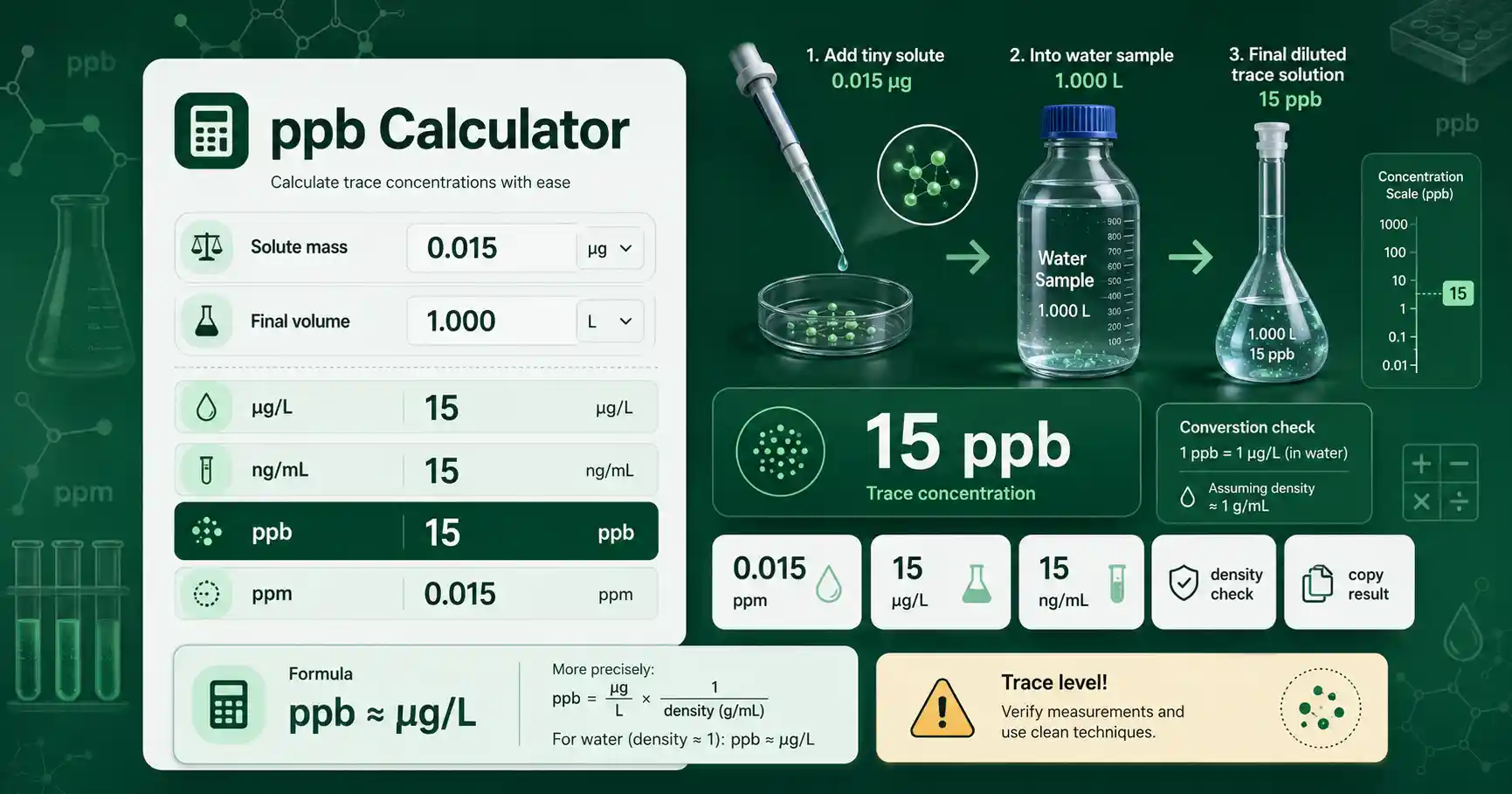
ppb Calculator for trace concentration results
This ppb Calculator helps you report very small solution concentrations as parts per billion. It is useful when a concentration is too small to write clearly as percent or even ppm. Students can use it to practice trace concentration conversions. Lab workers can use it to check sample preparation notes before recording a result. Researchers can use it as a quick sanity check when moving between µg/L, ng/mL, ppm, and ppb.
The tool accepts solute mass and final solution volume in common lab units. It converts ng, µg, mg, and g into micrograms. It converts µL, mL, and L into liters. For dilute water-like solutions, the calculator treats 1 ppb as 1 µg/L. It also treats 1 ppb as 1 ng/mL under the same aqueous assumption.
How the parts per billion calculation works
Parts per billion means one part of solute per one billion parts of total sample. In mass-fraction form, ppb equals the solute mass divided by the solution mass and multiplied by 1,000,000,000. In dilute water-like samples, the shortcut is much simpler. One liter of dilute water has a mass close to one kilogram. Because of that approximation, 1 µg of solute in 1 L of solution is about 1 ppb.
OpenStax describes ppm and ppb as small concentration units used for low solute amounts in solutions. You can review the chemistry background in the OpenStax section on other units for solution concentrations. This calculator follows the common teaching and water-sample convention for dilute aqueous solutions. It also includes a density correction option when the sample is not close to water. Density matters when the solution mass is not approximately equal to the solution volume in kilograms.
ppb formula and unit relationships
The basic aqueous formula is ppb ≈ micrograms of solute divided by liters of final solution. The conversion from ppm to ppb is ppm multiplied by 1,000. The conversion from ppb to ppm is ppb divided by 1,000. The conversion from percent to ppb is percent multiplied by 10,000,000. The conversion from ppb to percent is ppb divided by 10,000,000.
The tool displays the result in ppb, ppm, µg/L, ng/mL, ng/L, and percent. This helps you compare the same concentration in several formats. A value of 15 ppb is the same as 0.015 ppm in a dilute aqueous sample. A value of 15 ppb is also 15 µg/L under the same assumption. The calculator marks high ppb values that may be clearer as ppm or percent.
ppb Calculator worked example
Suppose a water sample contains 2.5 µg of solute in a final volume of 1 L. The given mass is 2.5 µg. The given volume is 1 L. The formula is ppb ≈ µg/L. Substitution gives 2.5 µg ÷ 1 L = 2.5 ppb.
The result means the sample contains about 2.5 parts of solute per billion parts of solution. The same value can be written as 2.5 µg/L. It can also be written as 2.5 ng/mL. If you convert it to ppm, the result is 0.0025 ppm. This is a trace concentration, so blank correction and contamination control are important.
When to use a ppb conversion in the lab
Use ppb when you work with trace analytes in water, dilute buffer, environmental samples, standards, or low-level spike solutions. Use it when ppm is too large and ng/L is too small for the way your result is normally reported. A water testing note may report metals, ions, or contaminants in ppb. A standard solution worksheet may ask you to convert µg/L into ppb. A teaching problem may ask you to compare ppb with ppm, percent, or mg/L.
If you are preparing dilution steps, pair this tool with the ppm Calculator when the reported value crosses between ppm and ppb. Use the Concentration Unit Converter when you need a broader set of concentration units. The ppb result is most reliable when your input mass, volume, and units are correct. It does not correct for recovery, extraction efficiency, instrument calibration, or matrix suppression. It also does not decide whether a measured result is safe or acceptable for a specific regulation.
Common ppb calculation mistakes to avoid
Do not confuse µg/L with mg/L. One mg/L is 1,000 µg/L, so one mg/L is about 1,000 ppb in water-like samples. Do not enter a stock concentration when the calculator asks for the final sample concentration. Do not use the aqueous shortcut for dense acids, organic solvents, oils, or concentrated salt mixtures without checking density. Do not ignore blank values when working near the detection limit.
Always write the unit beside the number in your lab notebook. A value of 10 ppb and a value of 10 ppm differ by a factor of 1,000. Small unit errors can create large preparation errors at trace levels. The calculator helps reduce arithmetic mistakes, but it cannot validate the experimental method. Verify critical lab calculations independently before using them in real experiments.