
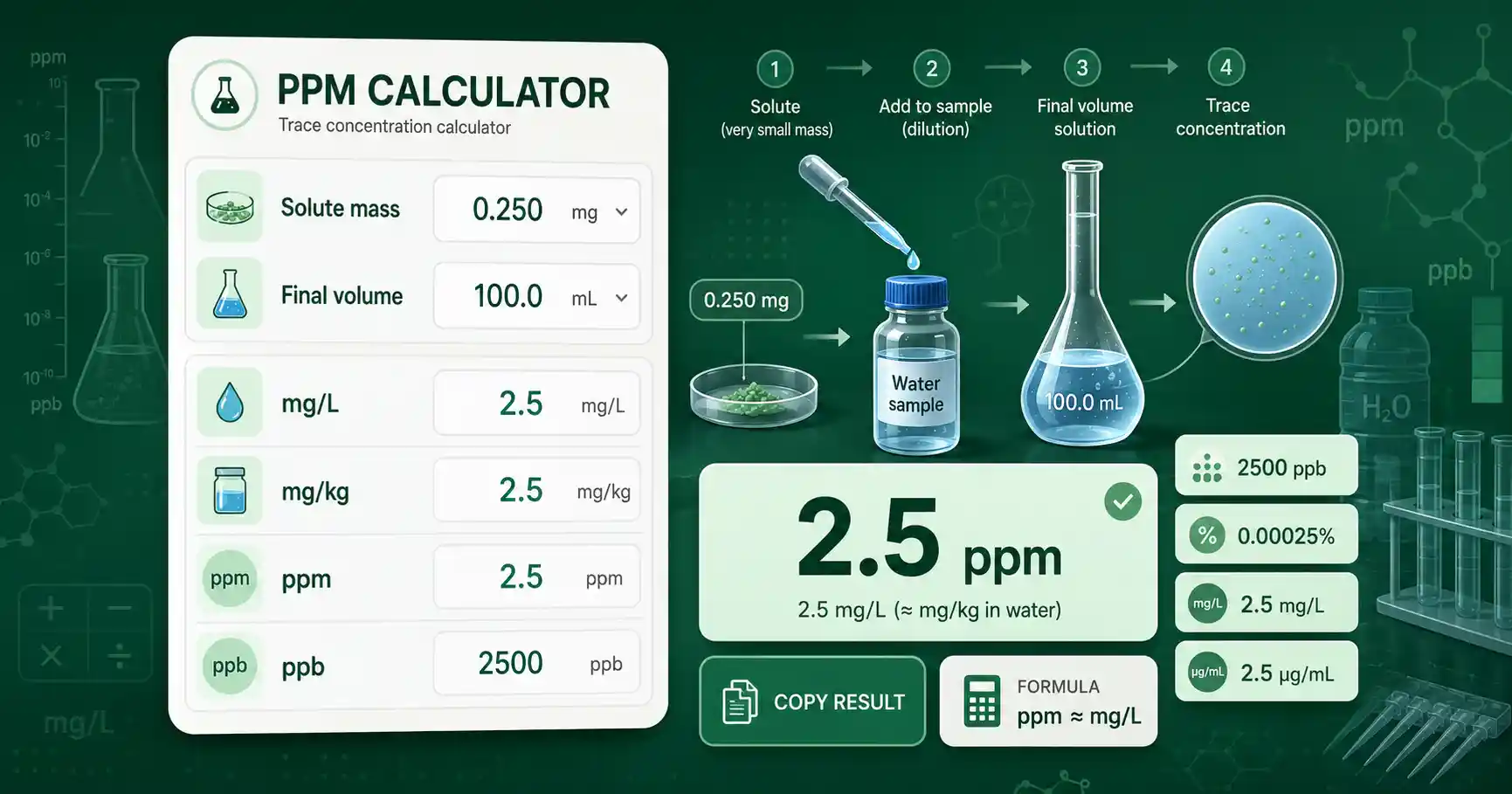
ppm Calculator for parts per million concentration
This ppm Calculator helps you express very dilute concentrations as parts per million. ppm means parts per million, so it describes one part of solute in one million parts of total mixture. It is common in water testing, environmental chemistry, reagent contamination checks, trace-element reporting, and student chemistry problems. The tool calculates ppm from solute mass and final solution volume when the sample behaves like a dilute water solution. It also calculates ppm from solute mass and final solution mass when you need the exact mass-based definition. You can also enter a target ppm value and final volume to estimate how much solute you need.
The calculator reports ppm, ppb, percent, and fraction together. This helps you see the same concentration in different units. A result of 1 ppm equals 1000 ppb. A result of 10,000 ppm equals 1 percent. A result of 1 ppm equals a mass fraction of 0.000001. For dilute aqueous solutions, 1 ppm is usually treated as 1 mg/L, which is also 1 µg/mL.
ppm Calculator formula for mg/L and mg/kg
The aqueous approximation uses ppm ≈ mg/L. The equation is ppm = solute mass in mg ÷ final solution volume in L. This works well for dilute water-like samples because 1 L of water has a mass close to 1 kg. The exact mass-based definition uses ppm = solute mass ÷ solution mass × 1,000,000. OpenStax explains ppm and ppb as useful concentration units for very low solute concentrations in chemistry. OpenStax Chemistry 2e
Use the mg/L mode when your protocol, water sample, or standard solution is reported by final volume. Use the mg/kg mode when a problem asks for a true mass ratio. Use the ppm-to-amount mode when you need to prepare a target trace solution. The density field helps adjust the amount when the solution is not close to 1.00 g/mL. For critical analytical standards, verify the density, purity, solvent compatibility, and official method before preparing the solution.
ppm Calculator worked example for mg/L
Suppose a student dissolves 2.5 mg of solute and brings the final volume to 1.0 L. The given values are solute mass = 2.5 mg and final volume = 1.0 L. The formula is ppm = mg ÷ L. Substitution gives ppm = 2.5 ÷ 1.0. The result is 2.5 ppm. The same value is 2500 ppb, 0.00025 percent, and about 2.5 µg/mL for a dilute water-like solution.
The interpretation is direct. The solution contains 2.5 mg solute per liter of final solution. This is a trace concentration, so ppm is more readable than percent. If the same concentration needs to be expressed as ppb, the ppb Calculator is the related unit workflow. If a lab protocol gives a percent solution instead, the Percent Solution Calculator is usually easier to use.
How to prepare a target ppm solution
To prepare a target ppm solution, enter the desired ppm and the final volume. For a 25 ppm solution in 500 mL water, use the formula solute mg = ppm × liters. The final volume is 0.500 L. Substitution gives solute mg = 25 × 0.500. The result is 12.5 mg solute. You would weigh 12.5 mg, dissolve it, and bring the final volume to 500 mL.
Very small solute masses can be hard to weigh accurately. In that case, prepare a stronger stock solution and dilute it. For example, a 1000 ppm stock can be diluted to 10 ppm by a 1:100 dilution. This approach often improves pipetting and weighing accuracy. The calculator does not replace calibration, blanks, controls, or standard reference materials. It gives the concentration arithmetic that supports the preparation step.
When ppm units are useful in chemistry and biology labs
ppm is useful when the solute concentration is too small for percent notation to feel practical. A 0.0002 percent solution can be easier to read as 2 ppm. Environmental water reports often use ppm for ions, metals, nutrients, and contaminants. Biology labs may use ppm-style thinking when comparing trace additives, disinfectant residues, or low-level impurities. Teaching labs use ppm to connect ratios, mass concentration, and unit conversion in one example.
ppm is not always the best unit for molecular biology reagents. Enzyme assays, oligonucleotides, buffers, and protein samples often need molarity, µM, nM, mg/mL, or activity units. ppm also does not describe molecular amount unless you know the molecular weight. A 10 ppm sodium chloride solution and a 10 ppm protein solution have the same mass concentration but very different molar concentrations. Choose the unit that matches the experimental question.
Common ppm calculation mistakes to avoid
Do not assume ppm and mg/L are exactly identical for every liquid. That shortcut is mainly for dilute water-like solutions. Do not use the solvent volume as the final solution volume unless the protocol says so. Dissolve the solute first, then bring the solution to the final mark when accurate volume matters. Do not forget that ppm is a ratio, not a fixed mass. The same 5 ppm concentration requires different solute masses when the final volume changes.
Watch prefixes carefully. One mg/L equals 1000 µg/L. One µg/mL equals 1 mg/L. One ppm equals 1000 ppb. One percent equals 10,000 ppm. A misplaced prefix can create a 1000-fold error. Verify critical lab calculations independently before using them in real experiments, regulated testing, clinical work, or hazardous chemical preparation.