
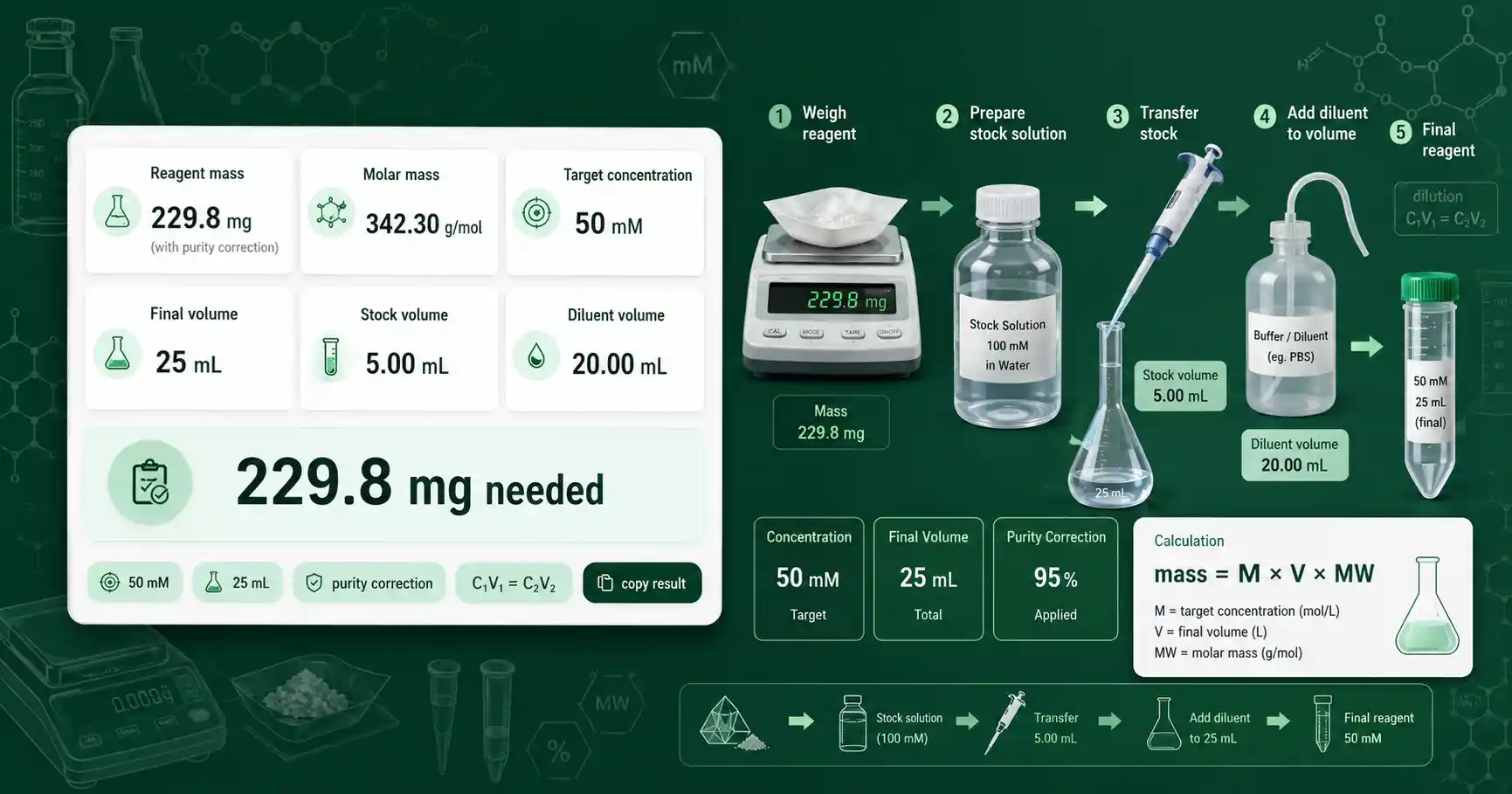
Reagent Preparation Calculator for lab solutions
A reagent preparation calculator helps you turn a written protocol into practical bench volumes and masses. It is useful when a method says to prepare a 100 mM stock, a 1× working reagent, or a fixed-volume solution from a concentrated stock. This calculator covers two common workflows. The solid reagent workflow calculates how much dry compound to weigh. The stock dilution workflow calculates how much stock solution and diluent to mix.
The tool accepts concentration units such as M, mM, µM, and nM. It accepts volume units such as L, mL, and µL. It reports mass in a readable unit such as grams, milligrams, or micrograms. It also reports the final preparation volume after optional overage. Overage is useful when you need extra volume for pipette dead volume, tube loss, replicate wells, or transfer loss. The result should still be checked against your lab protocol before use.
Reagent preparation formula from molarity
For a solid reagent, the main relationship is moles = molarity × volume in liters. The mass is moles × molar mass. If the reagent purity is less than 100%, the weighed mass increases because not all powder is active compound. The calculator applies purity correction as corrected mass = theoretical mass ÷ purity fraction. This is especially helpful for antibiotics, inhibitors, dyes, salts, standards, and small-molecule reagents.
The final volume means the finished solution volume, not the starting solvent volume. You normally dissolve the reagent in less solvent than the final volume, then bring the solution to the final mark. This distinction matters in volumetric flask preparation. It also matters in small tubes when the solute volume is not negligible. OpenStax explains the molarity relationship between moles of solute and liters of solution in its molarity overview.
Reagent Preparation Calculator worked example
Suppose you need 25 mL of a 50 mM reagent stock. The reagent has a molar mass of 180.16 g/mol. First convert 50 mM to 0.050 M. Then convert 25 mL to 0.025 L. Calculate moles as 0.050 mol/L × 0.025 L = 0.00125 mol. Multiply by molar mass: 0.00125 mol × 180.16 g/mol = 0.2252 g. You would weigh about 225.2 mg of pure reagent and bring the final solution to 25 mL.
If the bottle assay says the reagent is 98% pure, the weighed mass changes. The corrected mass is 0.2252 g ÷ 0.98 = 0.2298 g. That equals about 229.8 mg. This small correction can matter when preparing standards, quantitative assay reagents, and inhibitor stocks. It may matter less for rough classroom demonstrations, but recording it is still good practice. Verify critical lab calculations independently before using them in real experiments.
Prepare a working reagent from a stock solution
The stock dilution workflow uses C1V1 = C2V2. C1 is the stock concentration. V1 is the stock volume you need. C2 is the target working concentration. V2 is the final working volume. The calculator rearranges the formula to V1 = C2 × V2 ÷ C1. It then subtracts V1 from the final volume to estimate the diluent volume.
For example, imagine you have a 1 M stock and need 10 mL of a 10 mM working reagent. Convert both concentrations to the same base unit. The dilution factor is 1 M ÷ 0.010 M = 100. The required stock volume is 10 mL ÷ 100 = 0.1 mL. That equals 100 µL of stock plus 9.9 mL of diluent. For a more focused dilution workflow, you can also use the C1V1 C2V2 Calculator.
Inputs needed for accurate reagent preparation
Good calculations start with the correct reagent identity. Use the molar mass for the exact chemical form you are weighing. A free base, hydrochloride salt, sodium salt, hydrate, and anhydrous compound may have different formula weights. If the bottle lists a hydrate, use the hydrate molar mass. If the certificate gives purity or assay percentage, use that value instead of assuming 100%. If the reagent is hygroscopic, old, or poorly stored, the actual active concentration may be lower than the arithmetic estimate.
The calculator does not check solubility, pH compatibility, sterilization needs, storage conditions, or chemical safety. Some reagents require a specific solvent such as water, DMSO, ethanol, or buffer. Some reagents degrade in light or after freeze-thaw cycles. Some reagents need pH adjustment after dissolution. Always check the safety data sheet, supplier note, and lab protocol before preparation. Label the final reagent with name, concentration, solvent, date, preparer, and storage condition.
How students and lab workers can use this tool
Students can use this calculator to learn how mass, moles, molar mass, and volume connect. It shows why a 100 mM solution needs more mass when the final volume increases. It also shows why high molar mass compounds require more grams for the same molarity. Lab workers can use it to reduce transcription mistakes when converting mM to M or mL to L. Researchers can use it for fast planning before writing a reagent preparation note in a lab notebook.
The tool is also useful when preparing multiple related solutions. You can calculate a concentrated stock first, then plan a lower working concentration from that stock. For mass-first calculations, the Mass from Molarity Calculator gives a focused version of the same relationship. For stock preparation workflows, the related stock solution tool helps organize concentration, volume, purity, and weighing details. These linked calculations help keep reagent preparation consistent across protocols.
Common mistakes in reagent preparation calculations
A frequent mistake is mixing concentration units without conversion. A 100 mM target is 0.100 M, not 100 M. Another mistake is confusing µL and mL, which creates a 1000-fold error. A third mistake is entering solvent volume instead of final solution volume. A fourth mistake is using the molar mass of the wrong salt form. A fifth mistake is ignoring purity correction when the reagent is supplied as 90%, 95%, or 98% active material.
Pipetting practicality also matters. If the calculator returns 0.2 µL of stock, prepare an intermediate dilution instead of pipetting an unreliable volume. If the calculated mass is below your balance limit, prepare a larger volume or a more concentrated stock when the reagent allows it. If the diluent volume is negative, the target concentration is higher than the stock concentration and cannot be made by dilution. If the stock is close to the target concentration, the stock volume may take up most of the final volume. The calculator flags these situations so you can revise the preparation plan.