
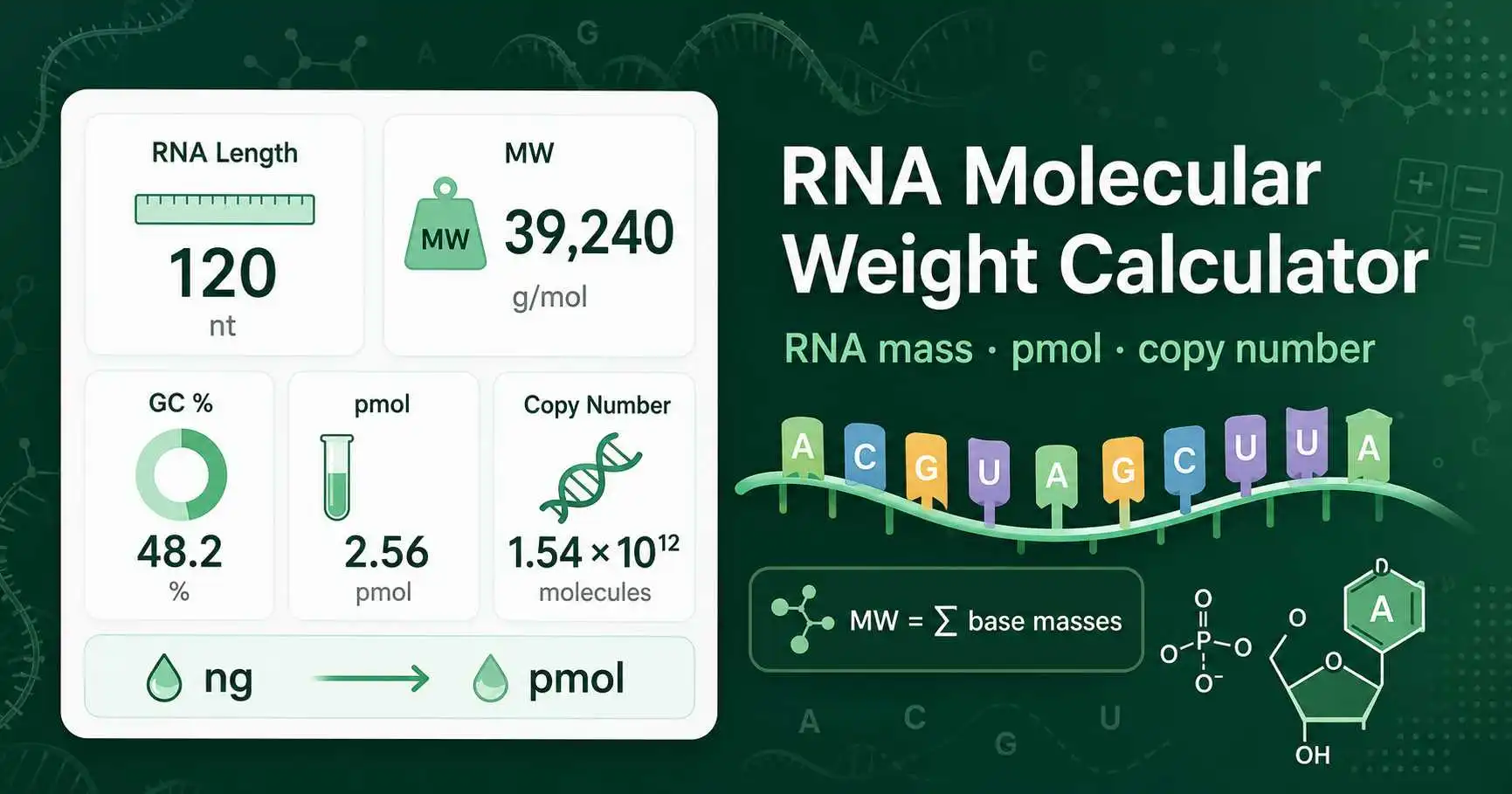
RNA Molecular Weight Calculator use cases
The RNA Molecular Weight Calculator estimates the mass of an RNA strand from its nucleotide sequence or base composition. It is useful for RNA oligos, synthetic guide RNA fragments, short transcripts, teaching examples, and routine lab planning where you need a quick mass-to-mole conversion.
The tool reports RNA length, A, C, G, and U counts, GC content, AU content, molecular weight in g/mol, converted pmol, mass in ng and µg, and an estimated molecule count. These outputs help students connect nucleotide sequence, molecular mass, and amount of substance in one workflow.
How RNA molecular weight is calculated
The calculator adds the standard residue mass for each RNA base and applies a terminal adjustment for an unmodified single-stranded RNA oligonucleotide. The base masses used are A, C, G, and U residue values. If you select the 5′ phosphate option, the tool adds a simple phosphate mass adjustment.
The main conversion is simple: pmol equals ng multiplied by 1000 and divided by molecular weight. When you enter pmol, the calculator can estimate the equivalent ng and µg. Copy number is estimated from pmol using Avogadro's constant.
For broader background on nucleic acid quantification and RNA handling, review the Thermo Fisher educational guide on RNA quantitation.Thermo Fisher RNA quantitation guide
RNA molecular weight results explained
Molecular weight tells you how many grams one mole of that RNA sequence would weigh. Longer RNA sequences have higher molecular weight because each added nucleotide contributes mass. GC-rich RNA can also differ in mass from AU-rich RNA because the base residues have different masses.
GC content is useful because it affects RNA structure and hybridization behavior. A very GC-rich RNA may form stronger secondary structures. For sequence-level checks beyond mass, compare this result with aDNA Molecular Weight Calculatorwhen working with DNA equivalents, or use anRNA to DNA Converter before comparing transcript and coding-strand notation.
When to use RNA mass to pmol conversion
Use RNA mass to pmol conversion when a protocol asks for a molar amount rather than a mass amount. This is common in annealing reactions, guide RNA preparation, hybridization experiments, standard preparation, and classroom exercises that compare molecules rather than grams.
For example, two RNA sequences with the same ng amount may not contain the same number of molecules if their molecular weights are different. Converting to pmol gives a better comparison of molecule amount.
RNA Calculator assumptions and limits
This calculator assumes unmodified single-stranded RNA. It does not automatically include 5′ caps, fluorescent labels, locked nucleic acid bases, 2′-O-methyl bases, phosphorothioate linkages, purification salt, hydration state, or supplier-specific modification masses.
Use supplier certificates for final ordering and resuspension. Use your lab protocol for real experiments. Treat the calculated value as a fast planning estimate, not a replacement for validated product data.