
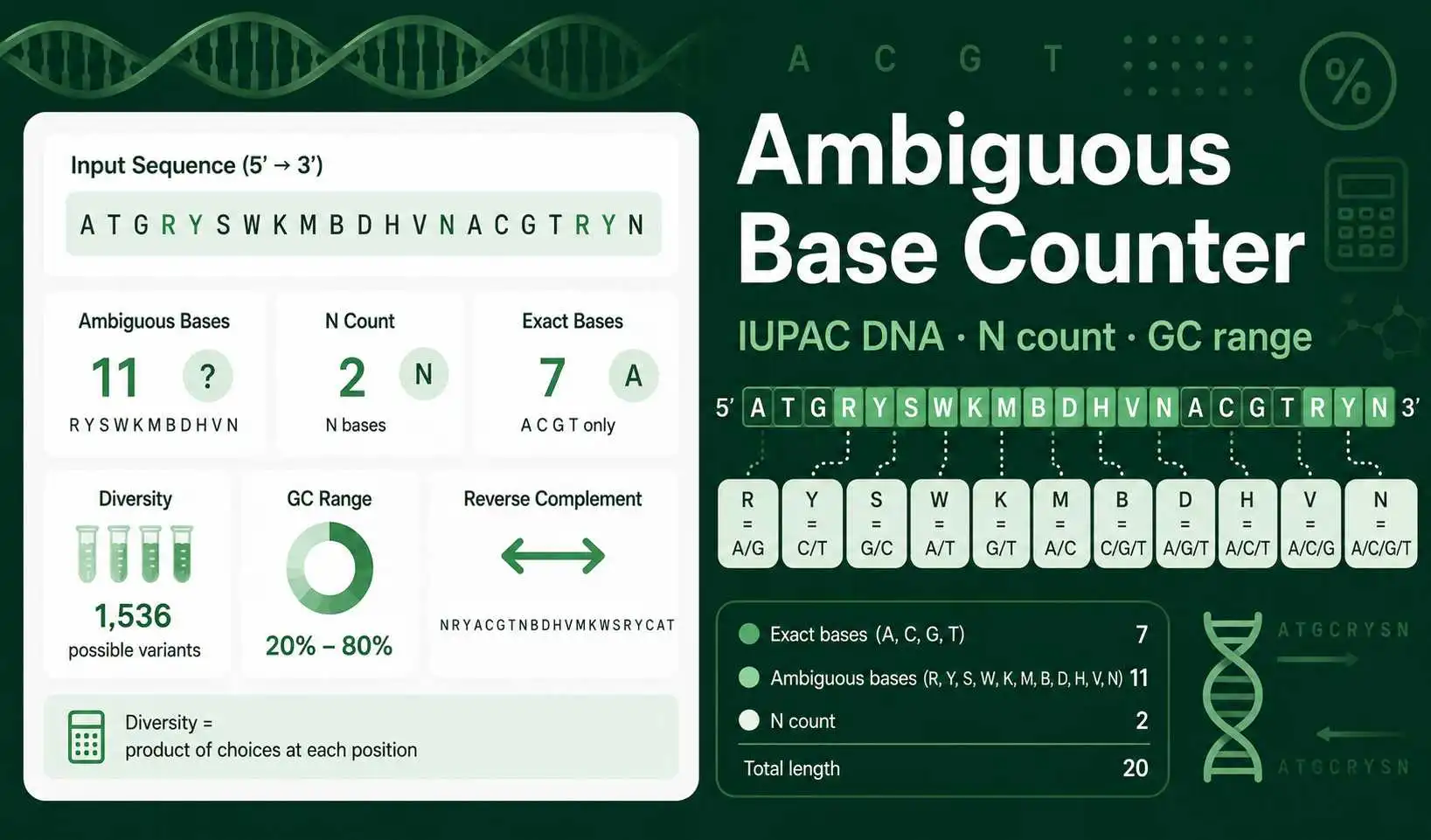
Ambiguous Base Counter for IUPAC DNA symbols
The Ambiguous Base Counter checks DNA sequences that contain IUPAC ambiguity codes. These symbols appear when one position can represent more than one nucleotide. For example, R means A or G, Y means C or T, and N means any DNA base.
The tool gives a direct summary of total length, exact bases, ambiguous bases, N bases, possible variants, GC content range, and reverse complement. This helps students, teachers, and lab workers understand how much uncertainty exists in a primer, sequence read, consensus sequence, or degenerate DNA design.
How to count ambiguous DNA bases
Paste your DNA sequence into the input box. You can paste a plain sequence or a FASTA-style sequence. The calculator removes FASTA headers, spaces, line breaks, and numbers. It accepts A, C, G, T and the IUPAC ambiguity symbols R, Y, S, W, K, M, B, D, H, V, and N.
The output separates exact bases from ambiguous bases. Exact bases have one possible identity. Ambiguous symbols have two, three, or four possible identities. This distinction matters because ambiguity increases sequence diversity and may affect PCR primer specificity.
IUPAC DNA ambiguity symbols explained
IUPAC codes compress several possible bases into one symbol. R represents purines A or G. Y represents pyrimidines C or T. S represents G or C. W represents A or T. K represents G or T. M represents A or C. B, D, H, and V each represent three possible bases. N represents any base.
These codes are useful in degenerate primers, consensus sequences, mixed sequencing peaks, conserved motif searches, and uncertain reference positions. You can compare ambiguous codes with the IUPAC DNA code rules from the Sequence Manipulation Suite reference page.IUPAC DNA code reference
Ambiguous Base Counter formula for diversity
Sequence diversity is the number of possible exact DNA sequences represented by the ambiguous sequence. The formula is simple:
diversity = choices at position 1 × choices at position 2 × choices at position 3 × ...
Exact bases such as A, C, G, and T each add one choice. R, Y, S, W, K, and M each add two choices. B, D, H, and V each add three choices. N adds four choices. A sequence with many N symbols can grow into a very large pool of possible variants.
Worked example for ambiguous DNA sequence diversity
Suppose your sequence is ATGRYN. The exact bases A, T, and G each have one choice. R has two choices, Y has two choices, and N has four choices.
diversity = 1 × 1 × 1 × 2 × 2 × 4 = 16 possible sequences.
This means ATGRYN does not describe one exact molecule. It describes a set of 16 possible DNA sequences. If this is a primer, the ordered primer pool may contain many variants rather than one single primer sequence.
GC range for ambiguous DNA sequences
Ambiguous bases make GC content uncertain. A symbol such as S always counts as G or C, so it contributes to minimum and maximum GC. A symbol such as W always counts as A or T, so it does not contribute to GC. A symbol such as R can be A or G, so it may or may not contribute to GC.
The calculator reports a minimum GC percentage, maximum GC percentage, and expected GC percentage. The expected GC value assumes each possible base under an ambiguous symbol has equal probability. This is useful for quick screening, but real biological sequences may not follow equal probabilities.
Use case: checking a degenerate primer pool
A degenerate primer may use IUPAC symbols to bind related templates. This is common when the exact target sequence varies between species, strains, or gene family members. Use this counter to estimate how many primer variants the sequence represents before ordering it.
If the diversity becomes too high, the effective concentration of each primer variant becomes lower. You may need to reduce degeneracy, design separate primer mixes, or use a more conserved target region. For protein-based primer design, the Degenerate Primer Generator can help convert amino acids into IUPAC codons.
Use case: reviewing sequencing or consensus DNA
Ambiguous symbols also appear in consensus sequences and sequence reads. A few ambiguity symbols may show real variation, low-quality base calls, mixed templates, or unresolved positions. Counting them helps you decide whether the sequence is clean enough for alignment, primer design, cloning, or reporting.
For longer sequence review, pair this tool with the DNA Sequence Analyzer. That tool checks length, base composition, reverse complement, transcript, and codon-level features in one place.
Practical problem: reducing too much ambiguity
Imagine a 22-base primer contains four N symbols. Each N has four choices, so those four positions alone create 4 × 4 × 4 × 4 = 256 sequence variants. If the primer also contains two R symbols, the total diversity becomes 256 × 2 × 2 = 1,024 variants.
That may be too broad for a routine PCR primer. A practical fix is to inspect the alignment, replace unnecessary N symbols with more specific IUPAC symbols, or design separate primers for major sequence groups. The goal is not always zero ambiguity. The goal is controlled ambiguity that still supports efficient and specific amplification.
Common mistakes when reading ambiguous bases
Do not treat N as a missing character. N represents any of A, C, G, or T. Do not treat R and Y as exact bases. They describe alternatives. Also check whether your sequence uses DNA or RNA letters. This tool is designed for DNA and does not accept U.
Always check strand direction before interpreting the reverse complement. Most primers are written 5′ to 3′. If the direction is wrong, the reverse complement and 3′ end interpretation will also be wrong.
What to verify before real lab use
Verify the final sequence, IUPAC symbols, target region, primer direction, supplier rules, and expected degeneracy before ordering primers. If you use the sequence for PCR, also check primer melting temperature, GC clamp, primer-dimer risk, and expected amplicon size.
Treat the result as an educational and planning estimate. For critical experiments, confirm degenerate primer design with your lab protocol, sequence alignment, supplier documentation, or supervisor before placing an order.