
Molecular Lab Tools calculator
Cas12a Target Site Finder
Find Cas12a TTTV PAM sites on both DNA strands and list nearby crRNA spacer candidates. Use it for classroom work, protocol planning, and quick wet-lab checks before you verify final values independently.
Cas12a sites found
GGCTAGCTAGCTAGCTAGCTAGC · GC 56.5%
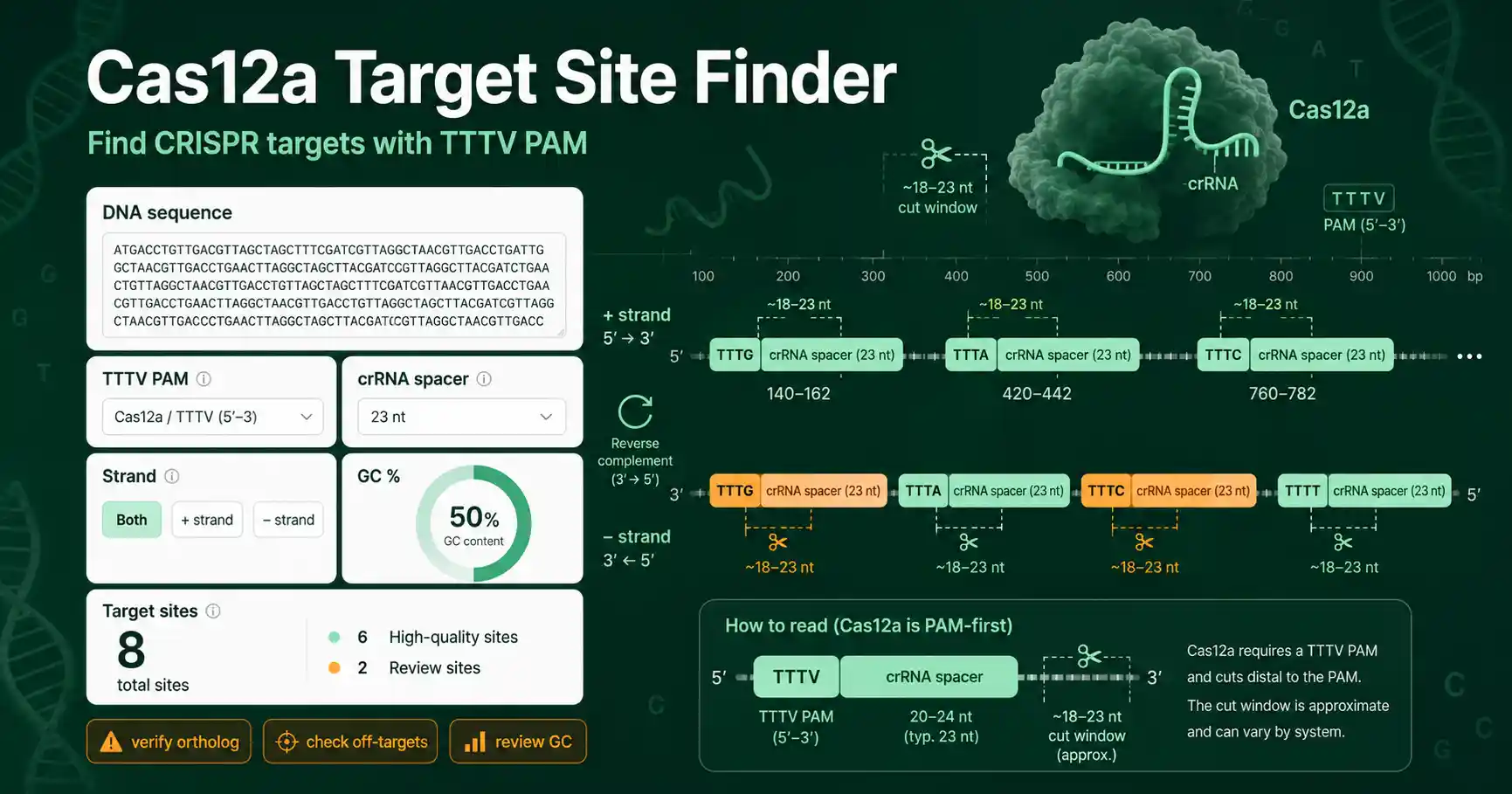
Cas12a Target Site Finder explained
This Cas12a target site finder scans DNA for TTTV PAM motifs and lists adjacent spacer candidates.
Cas12a systems often use a PAM on the 5 prime side of the protospacer, so the tool reports PAM-first target windows.
The tool searches the forward strand and the reverse-complement strand and reports coordinates, spacer sequence, and GC percentage.
The calculator handles empty fields, invalid numbers, and common input formatting mistakes. It gives a clear result and a short interpretation so users can decide what to check next. Students can use the page to learn the calculation logic. Lab workers can use it to reduce manual arithmetic errors. Researchers can use it as a first-pass planning aid before confirming the design with the relevant protocol, reagent datasheet, or analysis software.
For background reading, see this trusted reference: supporting educational source.
Cas12a Target Site Finder worked example
Given a DNA segment containing TTTA followed by a 23 nt spacer, the tool records that PAM and reports the adjacent crRNA candidate.
The result should be treated as a planning estimate. Always verify critical lab calculations independently before using them in real experiments.
For related planning, you may also use the PAM Sequence Finder or compare the next step with the Guide RNA GC Checker.
Related tools
Practical questions about Cas12a Target Site Finder
Can I use this result directly in an experiment?
Use the result as a careful planning estimate. Recheck important values with your protocol, instrument settings, and reagent documentation.
Why does the tool show warnings?
The warnings catch common mistakes such as missing required values, impossible negative values, unsuitable sequence characters, or values outside a typical screening range.
Does the tool replace experimental validation?
No. It supports calculation and screening, but final biological performance depends on the sample, assay, protocol, and experimental controls.