
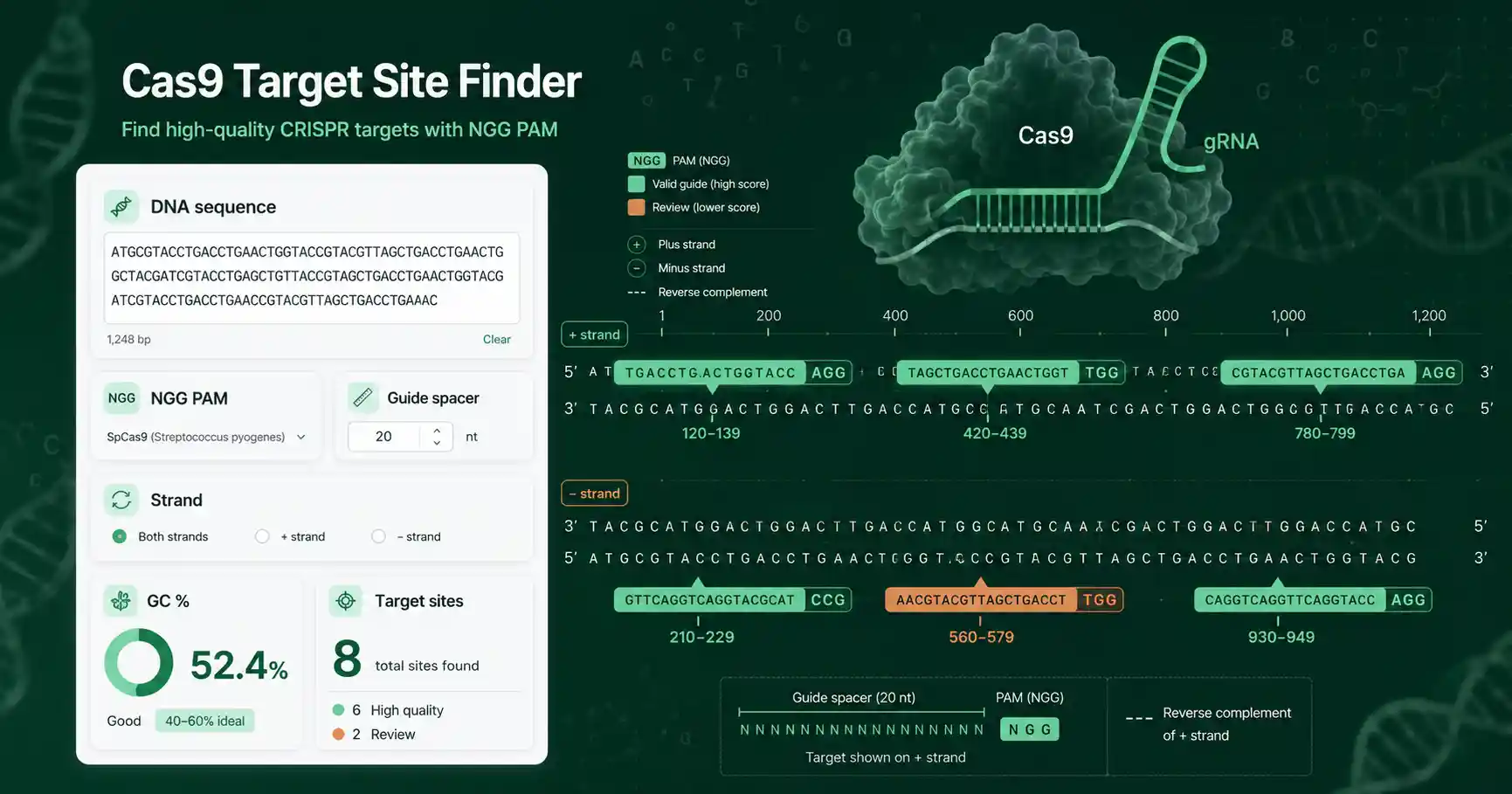
Cas9 Target Site Finder for NGG PAM screening
The Cas9 Target Site Finder scans a DNA sequence for CRISPR target sites that match a chosen Cas9 PAM rule. In the basic setting, it searches for the common Streptococcus pyogenes Cas9 pattern, written as 5′-N20-NGG-3′. The tool returns the 20 nucleotide guide spacer beside each PAM and shows whether the hit lies on the forward or reverse strand. It also calculates GC percentage because guide RNA GC content affects binding strength and practical guide selection. A balanced guide often performs better than a guide with extremely low or extremely high GC content. This page works best as an early screening step before deeper guide ranking and off-target review.
Use this tool when you have a gene region, exon sequence, plasmid insert, amplicon, or short genomic segment and want to see possible SpCas9 targets. You can paste plain DNA, FASTA text, or a copied sequence with line breaks. The calculator removes FASTA headers and whitespace before scanning the sequence. If you paste RNA letters, it converts U to T and reminds you that Cas9 target search uses DNA sequence coordinates. The basic mode uses NGG because SpCas9 commonly needs an NGG PAM next to the protospacer. The advanced mode lets you test wider Cas9-like PAM patterns such as NRG or a custom IUPAC motif.
The guide spacer reported by the calculator does not include the PAM. This distinction matters because the PAM stays in the target DNA and is not ordered as part of the guide RNA spacer. For a forward-strand hit, the guide spacer appears immediately upstream of the PAM in the pasted sequence. For a reverse-strand hit, the calculator scans the reverse complement and reports the guide in its design orientation. The coordinate range helps you locate the target region in your sequence. The seed region field highlights the PAM-proximal part of the spacer, which often receives extra attention during specificity review.
Cas9 target site formula used by this tool
The standard screening pattern is 5′-N20-NGG-3′ for SpCas9. N20 means the guide spacer contains 20 nucleotides. NGG means the PAM has any nucleotide followed by two guanines. The calculator searches every possible PAM position where a full guide spacer can be taken next to it. It searches both strands when reverse-strand scanning is enabled. For each match, it computes GC percentage with this formula: GC% = (G + C) ÷ guide length × 100.
The scoring shown in the result cards is a practical review score, not a biological guarantee. The score favors guides within the selected GC range. It flags poly-T runs because U6-driven guide expression can be affected by repeated thymine bases. It also flags long homopolymer runs because repeated bases can create synthesis, sequencing, or interpretation issues. Always confirm final guide choices with a genome-aware CRISPR design workflow and your lab protocol. The Addgene CRISPR guide gives helpful background on CRISPR components, guide RNA, and PAM-dependent targeting.
Cas9 Target Site Finder worked example
Imagine a pasted DNA segment contains the local pattern 5′-ACTGACCTAGCTAGGTTACC-CGG-3′. The PAM is CGG because it matches NGG. The guide spacer is the 20 nucleotides immediately before the PAM: ACTGACCTAGCTAGGTTACC. The guide has 10 G or C bases out of 20 total bases. The formula is GC% = 10 ÷ 20 × 100. The result is 50% GC. A 50% guide falls inside the common 40% to 60% review window. You would still check genomic specificity, target location, exon structure, and experimental constraints before ordering the guide.
How students and lab workers can use Cas9 results
Students can use the results to learn why PAMs control where Cas9 can bind. The target list shows that the guide sequence and PAM are connected but separate sequence features. Lab workers can use the same list to shortlist guides near a cut site, coding exon, promoter element, or edited base. Researchers can compare candidate guides by GC percentage, seed sequence, strand, and distance from a desired edit location. The tool helps reduce manual scanning errors when a sequence contains many NGG motifs. It also makes reverse-strand candidates easier to inspect because the reverse complement is scanned automatically.
A good first-pass candidate often has a valid PAM, a complete spacer, moderate GC content, and no obvious poly-T warning. A poor first-pass candidate may have very low GC content, very high GC content, long repeated bases, or an inconvenient position. A guide near the beginning or end of a short pasted sequence may be missed if there is not enough flanking sequence to form a full spacer. This is expected because the calculator only reports complete guide-plus-PAM arrangements. If your sequence is very short, paste more upstream and downstream context. If your project needs one final guide, use a genome-wide tool after this first screen.
Common mistakes in Cas9 target site selection
Do not include the NGG PAM in the ordered guide spacer unless your vendor or cloning method specifically asks for extra bases. Do not assume every NGG site is equally useful. Do not choose a guide only because it appears first in the sequence. Do not ignore strand direction when you compare guide coordinates to a gene model. Do not treat a simple GC score as an off-target score. This tool checks sequence features inside the pasted DNA, but it does not search a full genome. Verify critical CRISPR designs independently before using them in real experiments.
If you need a broader guide workflow, start with the CRISPR gRNA Design Helper after finding target sites. If you want to inspect PAM motifs without guide scoring, compare the same sequence in the PAM Sequence Finder. These tools work together because PAM detection, guide quality checks, and specificity review answer different parts of CRISPR design. Cas9 target discovery is the first layer. Guide ranking is the second layer. Experimental validation is the final layer.