
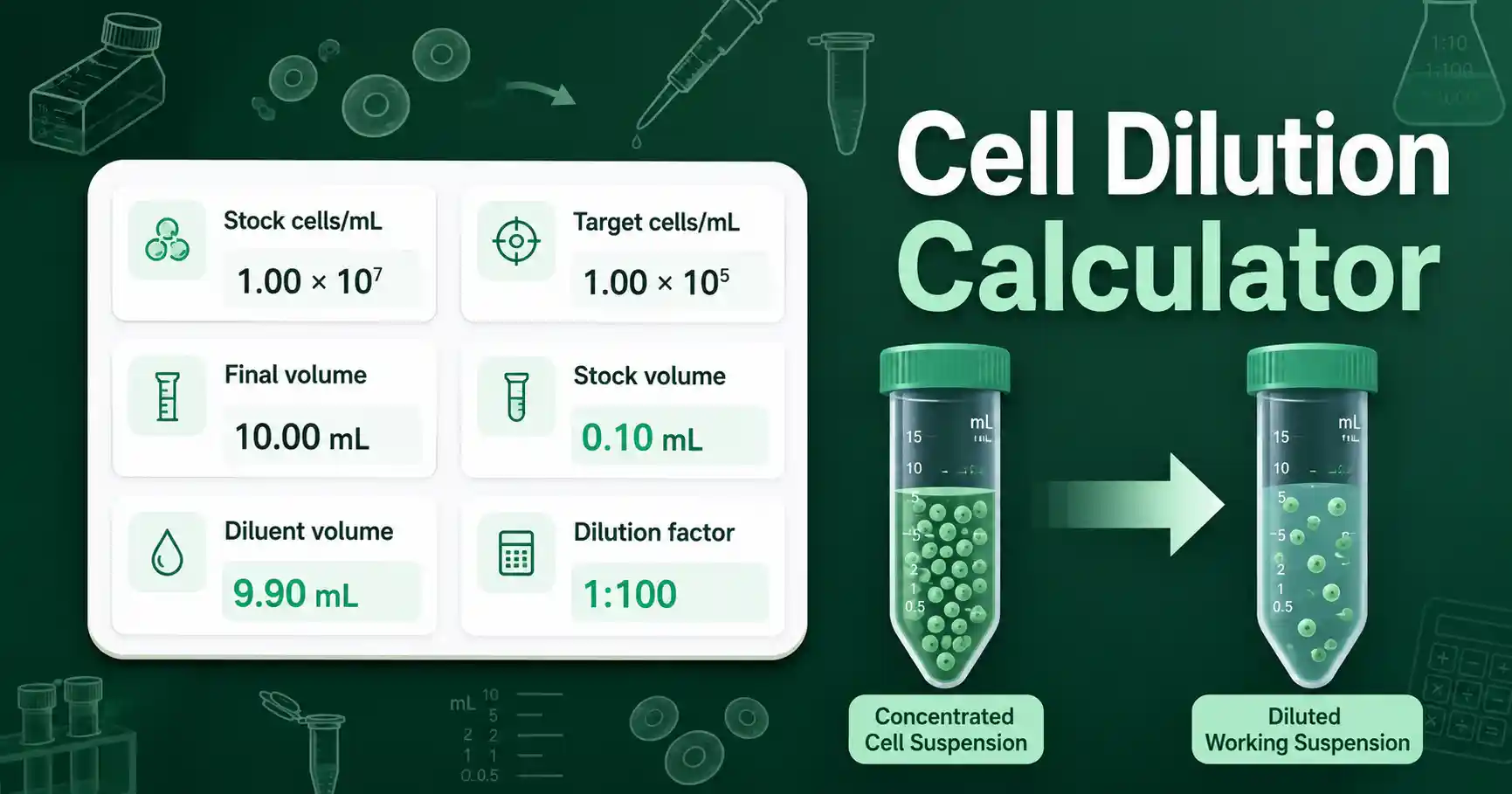
Cell Dilution Calculator for target cell concentration
This Cell Dilution Calculator tells you the stock suspension volume and diluent volume needed to make a final cell suspension at a chosen concentration. It uses the same dilution logic that students learn as C1V1 = C2V2, but it displays the answer in practical cell culture terms.
The calculator works when your stock suspension is more concentrated than your target suspension. It does not create a higher concentration from a lower one, because simple dilution can only reduce concentration.
Use it when a hemocytometer, automated counter, or counting worksheet gives you a stock value such as 1.2 × 10⁶ cells/mL and you need a working suspension such as 2.5 × 10⁵ cells/mL. If you still need to calculate the starting concentration from chamber counts, use a Hemocytometer Calculator first.
The page is educational and non-clinical. Verify critical lab calculations independently before using them in real experiments.
How to use Cell Dilution Calculator correctly
Enter the stock concentration as the current cell concentration of your suspension. This value usually comes from a cell counter, hemocytometer count, or previous worksheet calculation.
Enter the target concentration as the concentration you want after adding diluent. The stock and target concentration fields must use the same selected concentration unit.
Enter the final volume as the volume you want to prepare after dilution. The calculator accepts mL and µL, then returns both stock and diluent volumes in the same selected volume unit.
The advanced viability option adjusts the usable stock concentration when your count is a total-cell concentration but your target is based on viable cells. For example, 1.0 × 10⁶ total cells/mL at 90% viability gives an effective viable stock concentration of 9.0 × 10⁵ viable cells/mL.
Keep units consistent when transferring the result into a lab notebook. A result of 2.08 mL is not the same as 2.08 µL, and this kind of unit error changes the final concentration dramatically.
Cell Dilution Calculator formula and assumptions
The main formula is C1V1 = C2V2. C1 is the stock cell concentration, V1 is the stock volume to add, C2 is the target cell concentration, and V2 is the final prepared volume.
Rearranged for the unknown stock volume, the equation becomes V1 = C2 × V2 ÷ C1. The diluent volume is final volume minus stock volume.
When viability adjustment is on, the calculator replaces C1 with effective viable concentration. Effective viable concentration equals total stock concentration × viability fraction.
The method assumes the cell suspension is evenly mixed before measurement and before transfer. It also assumes the diluent does not change the counted cell number.
Cell culture guides often emphasize accurate counting, viability checks, and good records during subculture. The ATCC Animal Cell Culture Guide gives general educational background on animal cell culture handling and subculturing.
Cell Dilution Calculator worked example
Given values: stock concentration = 1.2 × 10⁶ cells/mL, target concentration = 2.5 × 10⁵ cells/mL, and final volume = 10 mL.
Formula: V1 = C2 × V2 ÷ C1.
Substitution: V1 = 2.5 × 10⁵ cells/mL × 10 mL ÷ 1.2 × 10⁶ cells/mL.
Result: V1 = 2.083 mL of stock cell suspension. Diluent volume = 10 mL − 2.083 mL = 7.917 mL.
Interpretation: add about 2.08 mL of the stock suspension and 7.92 mL of fresh medium or diluent to prepare 10 mL at 2.5 × 10⁵ cells/mL. The final suspension contains 2.5 × 10⁶ total target cells.
Cell Dilution Calculator results explained
A small stock volume means the stock suspension is much more concentrated than the target suspension. A large stock volume means the stock and target concentrations are closer together.
A dilution factor of 4.8× means the effective stock concentration is 4.8 times higher than the target concentration. This number helps you check whether the result feels reasonable.
The diluent volume should never be negative. If a calculation would require a negative diluent volume, the target concentration is too high for the selected stock concentration.
The total target cells result helps connect dilution math with downstream planning. If you are preparing a suspension for plate setup, a Cell Seeding Calculator can help convert that suspension into cells per well.
Cell Dilution Calculator mistakes to avoid
Do not mix cells/mL and cells/µL without converting. One cells/µL equals 1000 cells/mL, so the difference is large.
Do not enter a target concentration higher than the stock concentration. Dilution only lowers concentration.
Do not forget viability when your experiment needs viable cells rather than total counted cells. A sample with 80% viability has fewer usable viable cells than its total-cell count suggests.
Do not round tiny volumes too aggressively. A difference of a few microliters can matter when the final volume is small.
Do not assume every cell line or sample behaves the same after dilution. Cell clumping, poor mixing, and settling can make the measured concentration less representative.
Cell Dilution Calculator use cases in lab work
Students can use the calculator to learn how C1V1 = C2V2 applies to cell suspensions instead of only chemical solutions. It makes the connection between concentration, volume, and total cell number visible.
Teachers can use it for classroom problems where learners compare different stock concentrations and target values. The worked result gives a clear way to check unit setup and substitution.
Lab workers can use it as a quick planning check before preparing a working cell suspension. The calculator is especially useful when moving from a concentrated post-count suspension to a lower working concentration.
Researchers can use it to standardize calculations across repeated assays. Consistent dilution math helps reduce avoidable variation when comparing plates, treatment groups, or passages.
Related cell culture calculators
Practical questions about cell dilution
Can I use this cell dilution calculator with cells per microliter?
Yes. Choose cells/µL as the concentration unit. The calculator converts that value internally so the dilution equation stays consistent.
What should I do if the target cell concentration is higher than the stock concentration?
Dilution cannot increase concentration. Concentrate the suspension first or choose a lower target concentration before calculating the dilution.
Should I adjust for cell viability before dilution?
Use the viability adjustment when the stock concentration represents total cells but your experiment requires a target viable-cell concentration.