
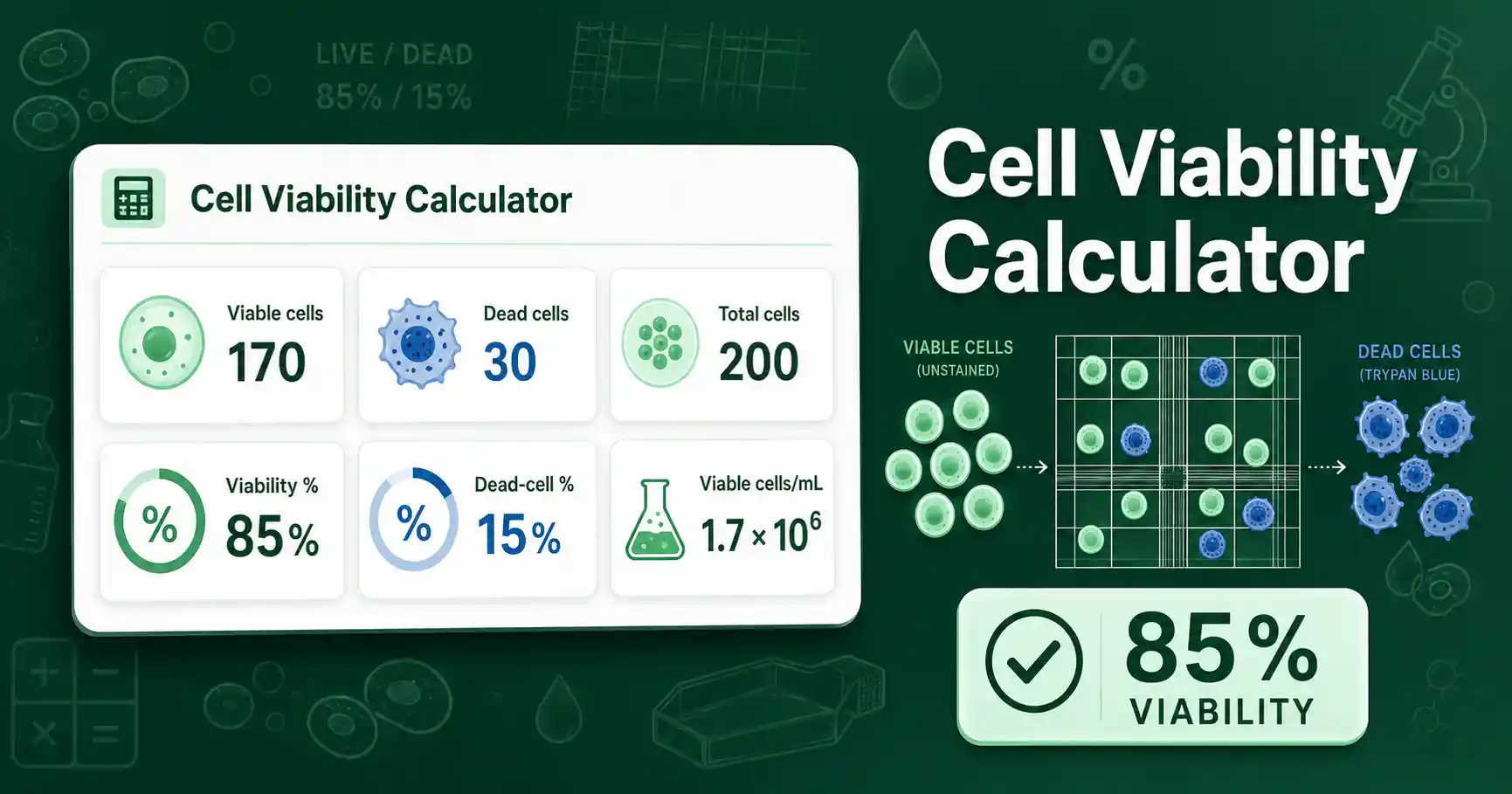
Cell Viability Calculator for live and dead cell counts
The Cell Viability Calculator converts live and dead cell counts into a clear viability percentage. It also reports the dead-cell percentage, live-to-dead ratio, and estimated cells per mL when hemocytometer details are entered.
This tool is useful after a manual viability count, a trypan blue count, a teaching practical, or a cell culture quality check. It helps users see whether a suspension contains mostly viable cells or whether dead cells form a large fraction of the sample.
The calculator uses raw counts rather than a precomputed concentration. Enter the viable cells you counted and the dead cells you counted from the same sample.
If your count came from a chamber, the optional dilution factor and large-square count estimate total cells/mL. A separate Hemocytometer Calculator can help when you need a more detailed chamber concentration workflow.
How to use Cell Viability Calculator correctly
Start by entering the number of viable cells counted. In a dye exclusion count, these are usually the cells that do not take up the exclusion dye.
Enter the number of dead cells counted from the same counting area. The dead count should come from the same mixture, dilution, microscope field strategy, and counting rule as the viable count.
Enter the dilution factor when you want a cells/mL estimate. Use 2 for a 1:1 mixture of cell suspension and stain, and use 1 when the sample was not diluted.
Enter the number of large hemocytometer squares counted if you want the concentration estimate. The calculator uses the common large-square conversion where cells/mL equals average cells per large square multiplied by dilution factor and 10,000.
The percentage result does not need square count or dilution factor. Viability depends only on the fraction of viable cells among all counted cells.
Use the result with the Cell Seeding Calculator when your next step is planning viable cells per well. This avoids treating dead cells as useful seeded cells.
Cell Viability Calculator formula and assumptions
The calculator first adds viable cells and dead cells to find the total counted cells. It then divides viable cells by total counted cells and multiplies by 100.
Cell viability (%) = viable cells ÷ (viable cells + dead cells) × 100
Dead-cell percentage (%) = dead cells ÷ total counted cells × 100
Cells/mL = average cells per large square × dilution factor × 10,000
The method assumes that the counted area represents the whole cell suspension. Mix the suspension gently and consistently before counting because cells can settle quickly.
The cells/mL estimate assumes a standard hemocytometer large square with a chamber depth of 0.1 mm. If your counting chamber uses a different volume, use the conversion rule supplied with that chamber.
The calculator does not identify why viability is high or low. Sample age, cell type, passage condition, staining time, temperature, centrifugation, and handling can all affect the count.
Verify critical lab calculations independently before using them in real experiments. For educational background on dye exclusion cell viability, the Thermo Fisher trypan blue exclusion overview explains the basic principle.
Cell Viability Calculator worked example
Suppose a student counts 85 viable cells and 15 dead cells after mixing a cell suspension 1:1 with trypan blue. The count was collected across four large hemocytometer squares.
Given values
- Viable cells = 85
- Dead cells = 15
- Total counted cells = 100
- Dilution factor = 2
- Large squares counted = 4
Substitution
Cell viability = 85 ÷ 100 × 100 = 85%.
Dead-cell percentage = 15 ÷ 100 × 100 = 15%.
Average total cells per square = 100 ÷ 4 = 25.
Total cells/mL = 25 × 2 × 10,000 = 500,000 cells/mL.
The result means the sample has 85% viable cells under the counting method used. The estimated total concentration is 5.0 × 10⁵ cells/mL, and the estimated viable concentration is 4.25 × 10⁵ viable cells/mL.
The interpretation depends on the purpose of the count. A teaching exercise may only need the calculation, while a sensitive assay may require a higher viability threshold or a repeated count.
Cell Viability Calculator results explained
A high viability percentage means most counted cells were classified as viable. This usually supports better confidence when using the count for routine dilution, seeding, or growth calculations.
A moderate viability percentage means the sample includes a meaningful dead-cell fraction. In that situation, decide whether your downstream calculation needs total cells or viable cells.
A low viability percentage means dead cells strongly affect the sample. Rechecking the count and reviewing the sample handling steps can prevent a misleading seeding or concentration calculation.
The live-to-dead ratio gives a quick comparison between counted live cells and counted dead cells. A 9:1 ratio means about nine viable cells were counted for every dead cell.
The viable cells/mL estimate is often more useful than total cells/mL when planning assays that depend on living cells. The total cells/mL value can still help describe the complete counted suspension.
Cell Viability Calculator mistakes to avoid
Do not enter percent values as cell counts. The calculator needs raw viable and dead counts to calculate the percentage correctly.
Do not use counts from different samples for the viable and dead fields. Both numbers must describe the same suspension and the same counting session.
Do not forget the dilution factor when estimating cells/mL. A stain mixture or buffer dilution changes the concentration calculation even though the viability percentage stays the same.
Do not count only the clearest fields if the suspension is uneven. Select counting areas consistently so the result represents the sample.
Do not compare viability results without noting the method. Manual dye exclusion, automated counters, fluorescence assays, and metabolic assays can report different values for the same sample.
Cell Viability Calculator use cases in lab work
A biology student can use this calculator to learn the difference between viable cells, dead cells, total cells, and cell viability percentage. The worked calculation makes the formula easy to show in a lab report.
A teacher can use the tool to create practice problems with different live and dead counts. Students can predict how the percentage changes when dead cells increase.
A lab worker can use the viable cells/mL estimate before preparing a cell suspension for routine culture setup. This helps avoid overestimating usable cells when many dead cells are present.
A researcher can use the calculator during assay planning to decide whether a sample count is suitable for replicate wells, treatment comparisons, or pilot experiments. The result should be recorded with the count method and dilution factor.
Cell Viability Calculator quality checklist
- Confirm that viable and dead counts came from the same mixed sample.
- Record the dilution factor used during staining or sample preparation.
- Count enough cells to make the percentage meaningful for the exercise.
- Mix the suspension before loading the chamber because cells settle over time.
- Check whether the downstream calculation needs total cells or viable cells.
- Repeat critical counts when results look unexpected or inconsistent.
User Queries About Cell Viability Calculator
What does a Cell Viability Calculator calculate?
It calculates the percentage of viable cells from live and dead cell counts. It can also estimate viable cells/mL, dead cells/mL, and total cells/mL when a dilution factor and counted square number are provided.
What is the basic cell viability formula?
Cell viability percentage equals viable cells divided by total counted cells multiplied by 100. Total counted cells means viable cells plus dead cells.
Should I enter cells/mL as the viable count?
No. Enter raw counted viable cells and raw counted dead cells. The calculator uses those counts to calculate the percentage and then estimates cells/mL separately.
Why does dilution factor matter in viability counting?
Dilution factor does not change the viability percentage, but it changes the cells/mL estimate. A 1:1 mix of cells and stain has a dilution factor of 2.