
DNA Molarity Calculator
Convert DNA mass concentration in ng/µL into nM, pM, and fmol/µL using fragment or oligonucleotide length. Choose dsDNA or ssDNA so the calculator applies the matching average mass-per-base assumption.
DNA Molarity Calculator explained in one minute
DNA molarity depends on both mass concentration and fragment length. The same ng/µL contains more molecules when DNA fragments are shorter and fewer molecules when they are longer, because each longer molecule has a greater molecular weight.
Convert DNA concentration to molarity
Convert ng/µL into nM or pM from DNA length using the conventional average molecular weight per base pair or nucleotide.
Enter your values
Your result
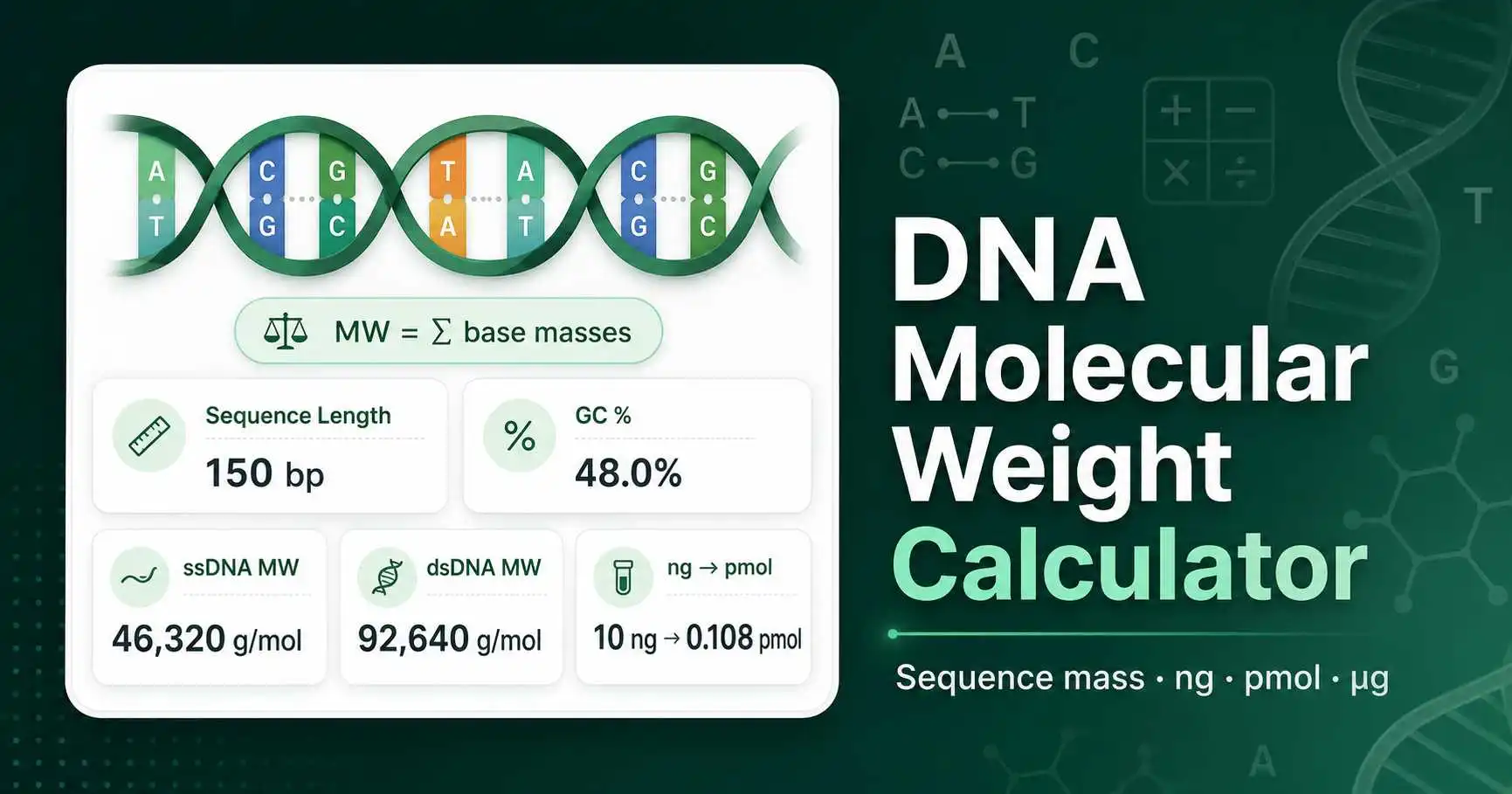
How to use the DNA Molarity Calculator
Enter the values from your protocol, reagent label, spectrophotometer, or experiment, then use the result together with the formula and assumptions shown on this page.
- 1
Choose dsDNA for double-stranded fragments or ssDNA for single-stranded oligonucleotides.
- 2
Enter the DNA mass concentration in ng/µL.
- 3
Enter fragment length in base pairs for dsDNA or nucleotides for ssDNA.
- 4
Read the calculated nM, pM, fmol/µL, and estimated molecular weight.
- 5
For sequencing libraries, use the representative fragment length required by your library-normalization workflow rather than assuming the insert length alone always equals the full library molecule length.
- 6
For short synthetic oligos or work requiring higher precision, use exact sequence-based molecular weight when available instead of the average-per-base approximation.
How do you convert DNA ng/µL to nM?
Estimate DNA molecular weight from sequence length, convert ng/µL to a molar amount, and report the result in nM or pM.
For routine dsDNA calculations, this page uses an average molecular weight of 660 g/mol per base pair. For ssDNA it uses 330 g/mol per nucleotide. The estimated molecular weight is therefore length × 660 for dsDNA or length × 330 for ssDNA.
Because 1 ng/µL equals 1 mg/L, the conversion can be condensed to nM = ng/µL × 1,000,000 ÷ molecular weight in g/mol. The tool performs that unit conversion automatically.
| DNA type | Average molecular-weight assumption | Length unit |
|---|---|---|
| dsDNA | 660 g/mol per base pair | bp |
| ssDNA | 330 g/mol per nucleotide | nt |
| Exact oligo sequence | Sequence-specific molecular weight preferred | nt and base composition |
Why DNA fragment length changes molarity
At the same mass concentration, shorter DNA fragments produce a higher molar concentration because each molecule has less mass.
A 100 bp dsDNA fragment and a 1,000 bp dsDNA fragment differ by roughly tenfold in molecular weight. If both samples are 10 ng/µL, the 100 bp sample contains about ten times as many DNA molecules per unit volume and therefore has about ten times the molarity.
This distinction is important in cloning, ligation, amplicon pooling, sequencing-library normalization, and any experiment that depends on molecule counts or molar ratios rather than only total DNA mass.
DNA molarity for NGS libraries and amplicon pools
Library molarity calculations use mass concentration together with an appropriate average library fragment length, but the value is still an estimate unless concentration and size measurements accurately represent the library population.
For an NGS library, the relevant length may include adapters as well as the insert depending on the platform and normalization method. Use the fragment-size definition specified by the library kit or sequencing workflow.
A broad fragment-size distribution makes a single average length less exact. Likewise, UV-based DNA concentration can overestimate amplifiable library molecules if contaminants or non-library nucleic acids contribute to the mass measurement. Fluorescence and qPCR-based library quantification can provide more application-specific information.
- Use an average or modal library fragment length that matches your validated workflow.
- Confirm whether adapter length is already included in the reported fragment size.
- Use an appropriate DNA concentration measurement for low-concentration libraries.
- Treat calculated molarity as a planning value when the library is heterogeneous or contains non-amplifiable material.
Why some references use 650 instead of 660 g/mol per bp
Average dsDNA molecular-weight conventions vary slightly by reference, so 650 and 660 g/mol per base pair are both seen in laboratory calculations.
Promega commonly uses 660 as an average molecular weight for a nucleotide pair in practical conversion formulas. NEB lists an average dsDNA molecular-weight approximation of 650 daltons per base pair in its nucleic-acid data guidance while also listing more exact base-pair mass information.
For long DNA fragments, the difference between 650 and 660 is usually small relative to other experimental uncertainties. For short oligos or high-precision work, exact sequence composition, terminal groups, and chemical modifications matter more, so sequence-specific molecular weight is preferable.
Common DNA molarity calculation mistakes
The most common errors are using the wrong DNA type, confusing bp with nt, using insert length instead of full library length, or assuming a mass concentration method counts only functional DNA molecules.
- Use bp for dsDNA length and nt for ssDNA length.
- Do not use 330 g/mol per nucleotide for a dsDNA fragment unless you explicitly account for both strands.
- Do not confuse nM with pM; 1 nM equals 1,000 pM.
- For NGS libraries, follow the kit's fragment-length convention and normalization method.
- For modified oligos, use the supplier's exact molecular weight when available.
- Remember that the output can only be as accurate as the input concentration and length estimate.
Convert 10 ng/µL of 500 bp dsDNA to nM
A 500 bp double-stranded DNA fragment has a measured concentration of 10 ng/µL. Using the common 660 g/mol per bp approximation gives a quick molarity estimate.
dsDNA, so use 660 g/mol per base pair.
500 bp × 660 g/mol per bp = 330,000 g/mol.
nM = 10 ng/µL × 1,000,000 ÷ 330,000.
≈ 30.3 nM.
30.3 nM × 1,000 ≈ 30,300 pM.
30.3 nM is numerically equal to about 30.3 fmol/µL.
Interpretation: The sample is about 30.3 nM under the 660 g/mol per bp approximation. If the DNA is a heterogeneous sequencing library, use the fragment-length and quantification method recommended by that workflow.
Calculations and terms covered on this page
These are the closely related lab calculations and concepts this tool is designed to answer without forcing you to translate between several separate calculators.
Scientific references and source checks
The equations, constants, and interpretation notes on this page are checked against established chemistry or molecular-biology references. Always follow your own validated protocol when exact experimental conditions matter.
- Promega BioMath CalculatorsUses an average molecular weight of 660 pg/pmol per nucleotide pair in dsDNA conversion formulas.
- New England Biolabs: Nucleic Acid DataReference data for nucleic-acid absorbance, average molecular weight, DNA mass, and molar conversions.
DNA Molarity Calculator FAQs
What molecular weight per base pair does this DNA molarity calculator use?
It uses the common planning approximation of 660 g/mol per base pair for dsDNA.
What value is used for ssDNA?
The calculator uses 330 g/mol per nucleotide for ssDNA as an average approximation.
How do I convert ng/µL to nM for DNA?
Estimate molecular weight from DNA length, then calculate nM = ng/µL × 1,000,000 ÷ molecular weight in g/mol.
Why does shorter DNA have higher molarity at the same ng/µL?
Shorter DNA molecules weigh less, so the same total mass contains more molecules and therefore a higher molar concentration.
Is 1 nM equal to 1 fmol/µL?
Yes. A concentration of 1 nanomole per liter is numerically equivalent to 1 femtomole per microliter.
Can I use this as an NGS library molarity calculator?
Yes as a planning estimate when you have an appropriate DNA concentration and representative library fragment length. Follow the library kit's recommended quantification and normalization procedure for final use.
Should I use 650 or 660 g/mol per bp?
Both approximations appear in molecular-biology references. This calculator uses 660 for consistency with common BioMath-style conversions. For higher precision, use exact sequence-based molecular weight.
Can I use this for modified oligos?
Only as a rough estimate. Chemical modifications and terminal groups change molecular weight, so use the exact molecular weight supplied by the oligo manufacturer when available.