
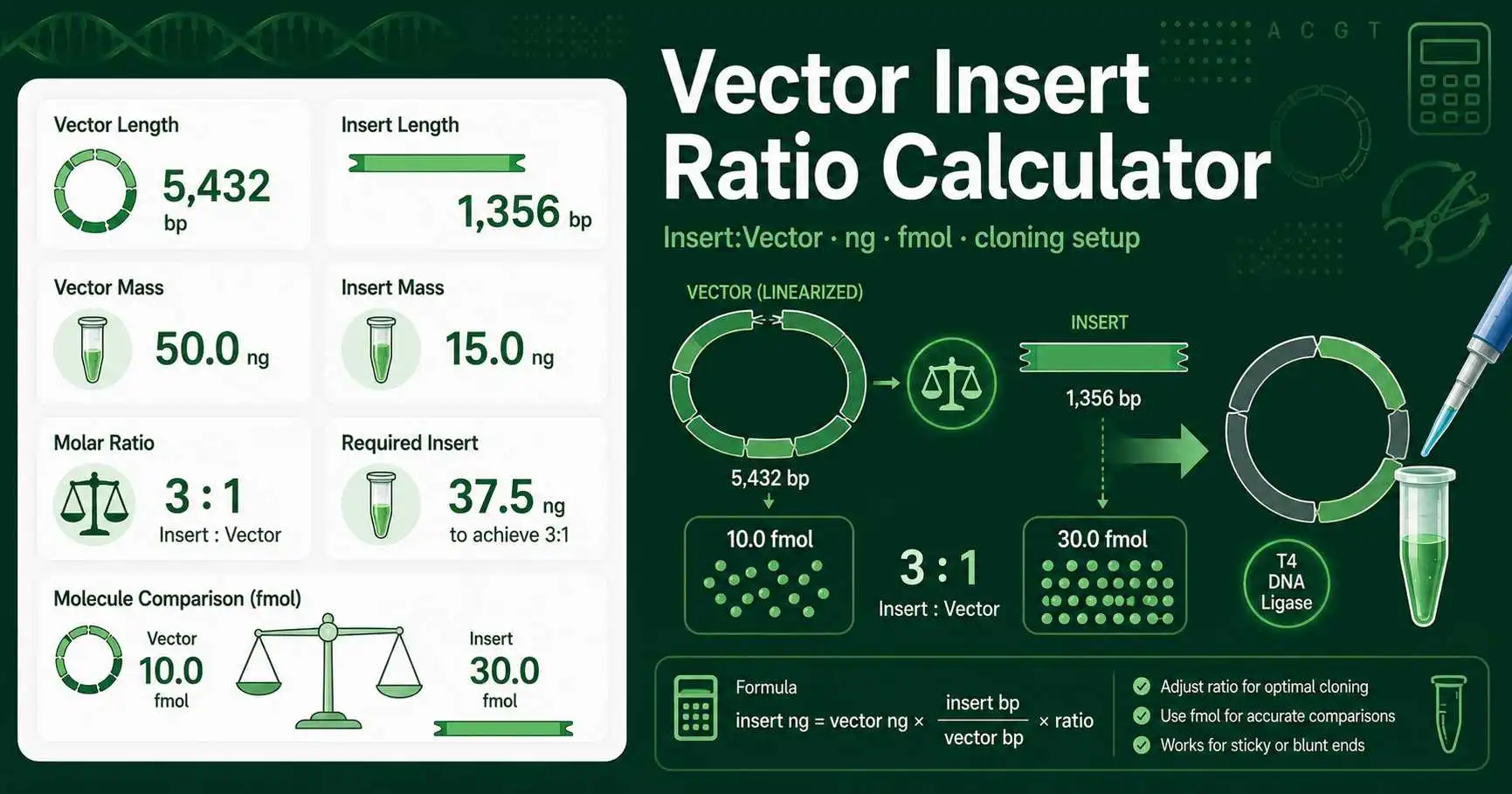
Vector Insert Ratio Calculator for cloning setup
The Vector Insert Ratio Calculator helps you compare the number of insert molecules to the number of vector molecules in a cloning reaction. It is useful for sticky-end ligation, blunt-end ligation, restriction enzyme cloning, and other vector-insert planning tasks.
The tool does not only compare DNA mass. It converts nanograms into femtomoles using fragment length. That matters because a 500 bp insert and a 2,000 bp insert do not contain the same number of molecules at the same nanogram mass.
How to calculate insert-to-vector molar ratio
Enter the vector length in base pairs, insert length in base pairs, vector DNA mass in nanograms, and insert DNA mass in nanograms. The calculator converts both DNA fragments into femtomoles and reports the current insert:vector ratio.
Use the target ratio field when you want to know how much insert DNA to use. A 3:1 insert:vector molar ratio is a common starting point for many single-insert ligations, but your best ratio can change with end type, fragment size, vector background, and DNA quality.
Vector insert ratio formula
The practical insert-mass equation is simple when both fragments are double-stranded DNA:
Insert ng = vector ng × insert length bp ÷ vector length bp × target insert:vector ratio
The calculator also uses a molecule-based check. Double-stranded DNA femtomoles are estimated from mass and length:
fmol = ng × 1,000,000 ÷ (base pairs × 660)
The average molecular weight of one double-stranded DNA base pair is treated as about 660 g/mol. This assumption is suitable for routine cloning estimates, but you should verify critical work with your lab protocol or supplier calculator. NEB provides a useful calculator for ligation-related DNA mass and molar-ratio planning. NEBioCalculator ligation tool
Worked example for a 3:1 vector insert ratio
Suppose your vector is 3,000 bp, your insert is 1,000 bp, and you want to ligate 50 ng of vector at a 3:1 insert:vector molar ratio.
Required insert ng = 50 × 1,000 ÷ 3,000 × 3. The result is 50 ng of insert. In this example, the insert is one-third the vector length, so 50 ng of insert gives about three times as many insert molecules as vector molecules.
If the insert were 2,000 bp instead, the required insert mass would increase. Required insert ng = 50 × 2,000 ÷ 3,000 × 3 = 100 ng. The molecule ratio stays 3:1, but the required mass changes because the insert is longer.
Use case 1: planning a restriction cloning ligation
A student cuts a plasmid vector and a PCR insert with compatible restriction enzymes. The gel-purified vector is 4,200 bp, and the insert is 850 bp. The student wants to use 40 ng vector and a 3:1 insert:vector ratio.
This calculator estimates the insert mass needed before the ligation reaction is assembled. The student can then use the concentration fields to convert the DNA mass into microliters. This reduces pipetting guesswork and helps keep the total reaction volume realistic.
Use case 2: comparing 1:1, 3:1, and 5:1 reactions
A researcher may set up three ligation reactions with the same vector mass but different insert ratios. This helps test whether too little insert or too much insert affects colony number and insert-positive clones.
The tool makes this comparison faster. Keep the vector length, insert length, and vector mass fixed. Then change the target ratio from 1 to 3 to 5. Record the required insert mass for each reaction and prepare the ligation tubes accordingly.
Practical problem before using the result
Imagine you need 75 ng insert for a target ratio, but your insert stock is only 5 ng/µL. You would need 15 µL of insert. That volume may be too large for a 20 µL ligation reaction after buffer, vector, ligase, and water are added.
The best fix is not always to force the reaction. You can concentrate the insert, reduce vector mass, increase final reaction volume if your protocol allows it, or test a lower molar ratio. The calculator flags volume problems so you can adjust the setup before wasting DNA.
When vector insert ratio is not enough
A good insert:vector ratio does not guarantee successful cloning. You still need compatible ends, clean DNA, complete vector digestion, low background, active ligase, and a suitable transformation protocol.
Use this page for molar-ratio planning. Use the Ligation Calculator when you want a fuller reaction setup with buffer, ligase, and water. Use the Plasmid Size Calculator when you need to check final construct size before mapping or screening.
Common mistakes in vector insert ratio calculations
Do not use equal nanograms and assume the molecule ratio is equal. Molecule count depends on fragment length. A short insert has more molecules per nanogram than a long insert.
Do not ignore DNA concentration. A mathematically correct insert mass may require an impractical pipetting volume. Also avoid using unverified gel bands, partially digested vector, or inaccurate Nanodrop values without checking the quality of the DNA.