
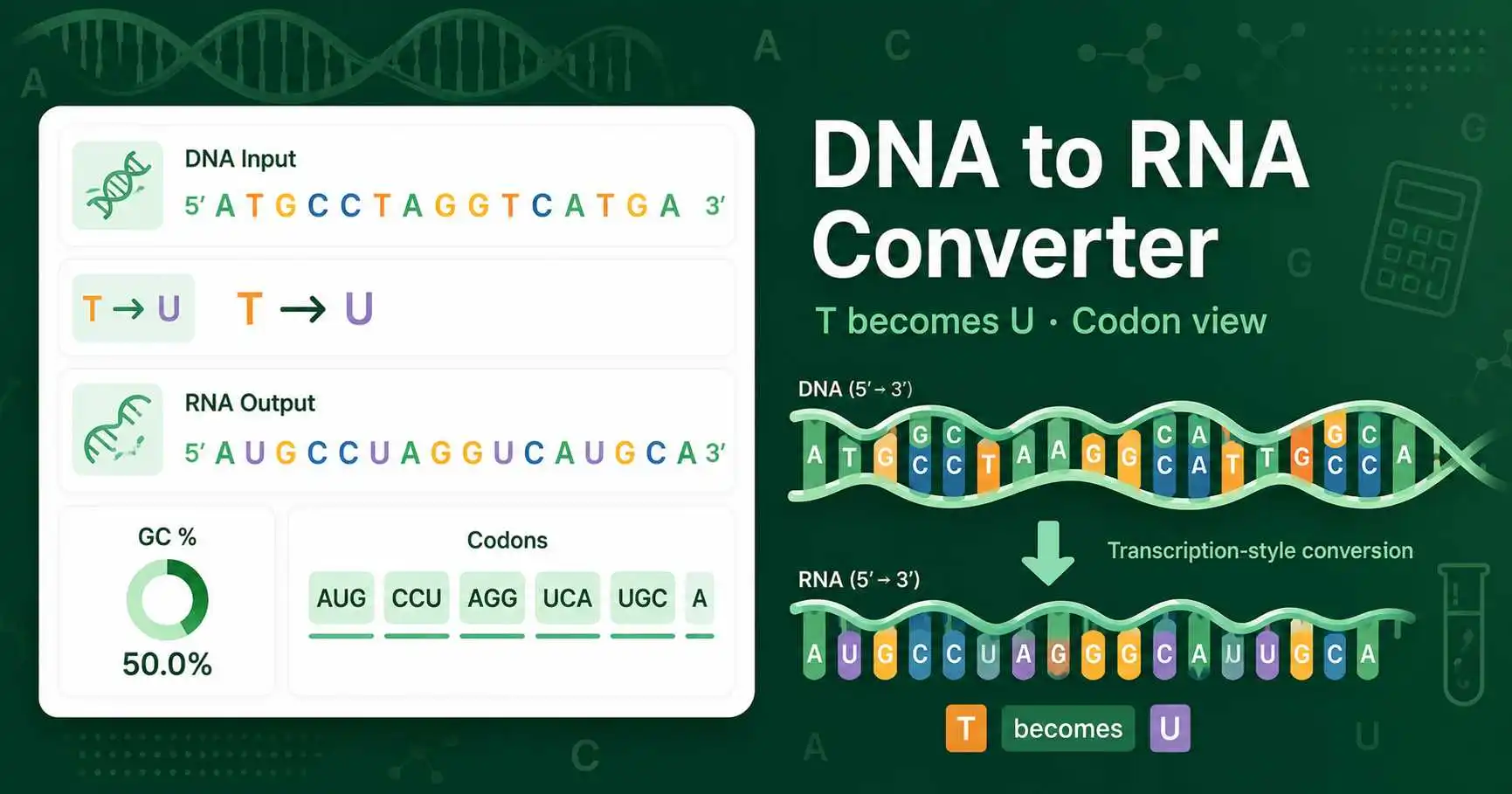
DNA to RNA Converter for transcription practice
A DNA to RNA Converter changes a DNA nucleotide sequence into an RNA sequence. The conversion is simple: A stays A, C stays C, G stays G, and T becomes U. This mirrors the letter change students see when they learn transcription.
The tool also gives sequence length, GC content, base counts, and codon grouping. These extra results help biology students, teachers, and lab workers check the converted sequence before using it in a worksheet, lab report, or downstream sequence tool.
How DNA to RNA conversion works
RNA uses uracil instead of thymine. If the DNA coding strand is ATG GCT TAA, the RNA-style sequence is AUG GCU UAA. This converter performs that letter replacement and keeps the sequence in the same order.
The converter does not automatically infer whether your DNA is a coding strand or a template strand. If your input is the template strand, first make sure you understand whether you need a complementary RNA sequence. For a quick strand check, use the Reverse Complement Generator before interpreting the result.
DNA to RNA Converter inputs and output
Paste a DNA sequence using A, C, G, and T. FASTA headers, spaces, line breaks, and numbers are ignored. The output uses A, C, G, and U. The tool flags invalid symbols so you do not accidentally convert labels, ambiguity codes, or non-sequence text.
You can also switch direction and convert RNA back to DNA notation by replacing U with T. This is useful when you want to move an RNA-style sequence into a DNA-based calculator or compare it with a genomic DNA sequence.
Reading codons after DNA to RNA conversion
The codon view groups the converted sequence into sets of three bases. Codons are important because translation reads mRNA in triplets. If the sequence length is not divisible by three, the last codon is incomplete, and the tool shows a warning.
This converter does not translate codons into amino acids. Use a separate DNA to Protein Translator when you need amino acid output, stop codon detection, or open reading frame checks.
Common mistakes in DNA and RNA conversion
The most common mistake is using the wrong strand. A coding-strand DNA sequence converts to an RNA-like sequence by changing T to U. A template-strand DNA sequence must be read with complementarity in mind. Strand labels matter.
Another mistake is treating conversion as translation. DNA to RNA conversion changes nucleotide letters only. It does not produce a protein sequence. It also does not confirm whether the reading frame begins at a start codon or ends at a stop codon.
For a student exercise, write the DNA sequence, convert T to U, group the RNA into codons, and then explain what each step means. For lab planning, verify the biological context before using the converted sequence in primer design, cloning, qPCR, or expression analysis.
What to verify before using the RNA output
Check the input strand, sequence orientation, reading frame, start codon, stop codon, and whether the sequence represents genomic DNA, coding DNA, cDNA, mRNA, or a synthetic oligo. These details change how you should interpret the output.
The National Human Genome Research Institute explains transcription as the process of making an RNA copy from a DNA sequence, which is the biological idea behind this classroom-style conversion step.NHGRI transcription glossary