
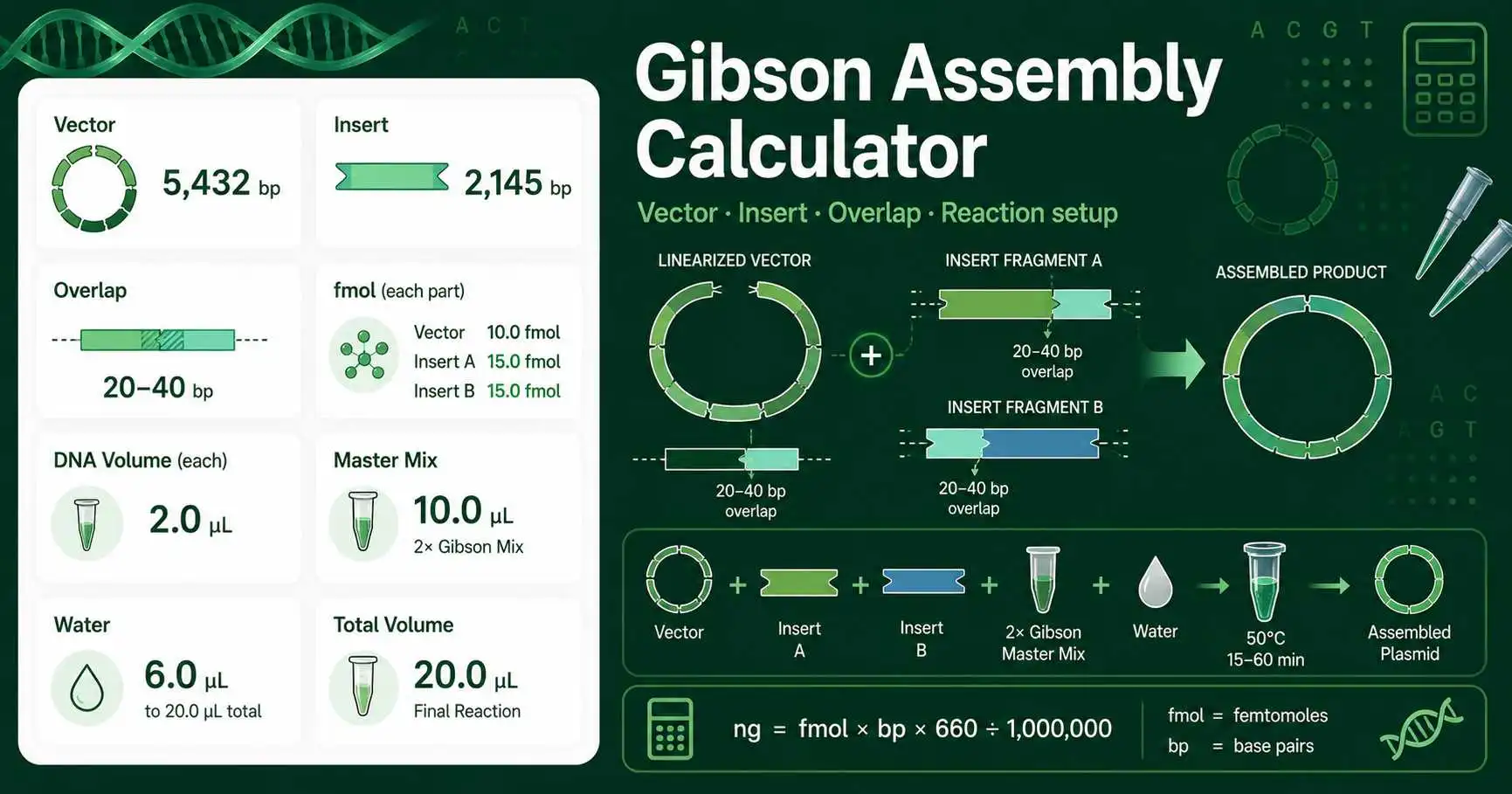
Gibson Assembly Calculator for cloning setup
A Gibson Assembly Calculator helps you plan how much vector and insert DNA to add to an isothermal assembly reaction. It uses fragment length, DNA concentration, target molar amount, and reaction volume to estimate pipetting volumes.
The tool is useful for linearized plasmids, PCR inserts, synthetic gene fragments, and multi-fragment DNA assembly. It does not design the overlap sequence. It helps you balance the physical amount of DNA after you already know the vector and insert sizes.
What this Gibson assembly calculator measures
The calculator reports required DNA mass in ng, DNA volume in µL, total assembly size in bp, total DNA volume, 2X master mix volume, and water volume. It also flags common setup risks such as low overlap length, too many fragments, high DNA volume, or negative water volume.
Gibson-style assembly joins overlapping double-stranded DNA fragments in one reaction. NEB describes Gibson Assembly as a method that efficiently joins multiple overlapping DNA fragments and provides protocol guidance for reaction setup and fragment volume limits. NEB Gibson Assembly Protocol
Gibson Assembly Calculator formula
The main calculation converts a target molar amount into a DNA mass. The calculator assumes average double-stranded DNA mass of about 660 g/mol per base pair.
Formula: DNA ng = target fmol × fragment length bp × 660 ÷ 1,000,000. Then the tool converts mass into volume using this equation: DNA volume µL = DNA ng ÷ DNA concentration ng/µL.
Water volume is calculated after DNA and master mix are assigned. Formula: water µL = final reaction volume − 2X master mix volume − total DNA volume. In a 20 µL reaction with 2X master mix, the tool uses 10 µL master mix by default.
Worked example for Gibson assembly reaction setup
Suppose your vector is 3,200 bp at 45 ng/µL. You have two inserts: 850 bp at 28 ng/µL and 1,200 bp at 32 ng/µL. You want 0.04 fmol of each fragment in a 20 µL assembly reaction.
Vector mass = 0.04 × 3,200 × 660 ÷ 1,000,000 = 0.08448 ng. Vector volume = 0.08448 ÷ 45 = 0.0019 µL. Insert 1 mass = 0.02244 ng. Insert 2 mass = 0.03168 ng. These tiny values show why many real protocols use kit-specific DNA amount ranges and practical minimum pipetting volumes.
A practical setup may need a higher target fmol, diluted DNA stocks, or a kit-recommended DNA mass range. The calculator gives the math, but you should adjust the reaction to match real pipetting limits and your assembly kit instructions.
Use case 1: planning a vector plus one insert assembly
A common cloning task uses one linear vector and one PCR insert. The goal is to add a balanced number of vector molecules and insert molecules. This matters because a 700 bp insert has many more molecules per ng than a 5,000 bp vector.
Use the calculator to compare vector fmol and insert fmol before setup. If the insert volume is too small to pipette, dilute the vector or insert stock, change the target fmol, or prepare a larger intermediate mix.
Use case 2: checking a multi-fragment Gibson assembly
Multi-fragment assembly needs more careful balance. A vector, promoter, coding sequence, and tag fragment may all have different lengths and concentrations. Equal ng amounts would not give equal molecule numbers.
Enter each insert length and concentration on a separate line. The calculator estimates equal-fmol input for each fragment. It also reports the total number of fragments and warns when the assembly becomes more complex.
Gibson assembly overlap length and primer design notes
Overlap length controls how adjacent DNA fragments recognize each other. Many beginner Gibson primer designs start near 20 to 40 bp of overlap. Short overlaps may reduce assembly success. Very long overlaps can make primers expensive and harder to order.
This page does not replace primer design. Use it after you already know the overlap sequence. For primer design checks, compare overlap primers with the Primer Tm Calculator. For fragment sizing before cloning, use the PCR Product Size Calculator.
Common Gibson assembly calculation mistakes
Do not balance fragments by ng alone when fragment lengths differ. Do not ignore the concentration unit. Use ng/µL, not µg/µL or ng/mL. Do not paste a total plasmid size where the tool asks for linear vector length.
Also check the water result. A negative water value means your DNA and master mix already exceed the reaction volume. Concentrate or dilute DNA stocks, lower the target fmol, or change reaction volume based on the kit protocol.
What to verify before real Gibson assembly
Verify fragment purity, gel band size, overlap orientation, overlap sequence, DNA concentration method, reaction temperature, incubation time, competent cell quality, and antibiotic selection. If the assembly fails, check primer design, PCR cleanup, fragment ratio, and transformation control first.
Treat this calculator as a planning tool for students and lab workers. Always confirm critical cloning reactions with the enzyme mix manual, your lab protocol, and supervisor guidance.