
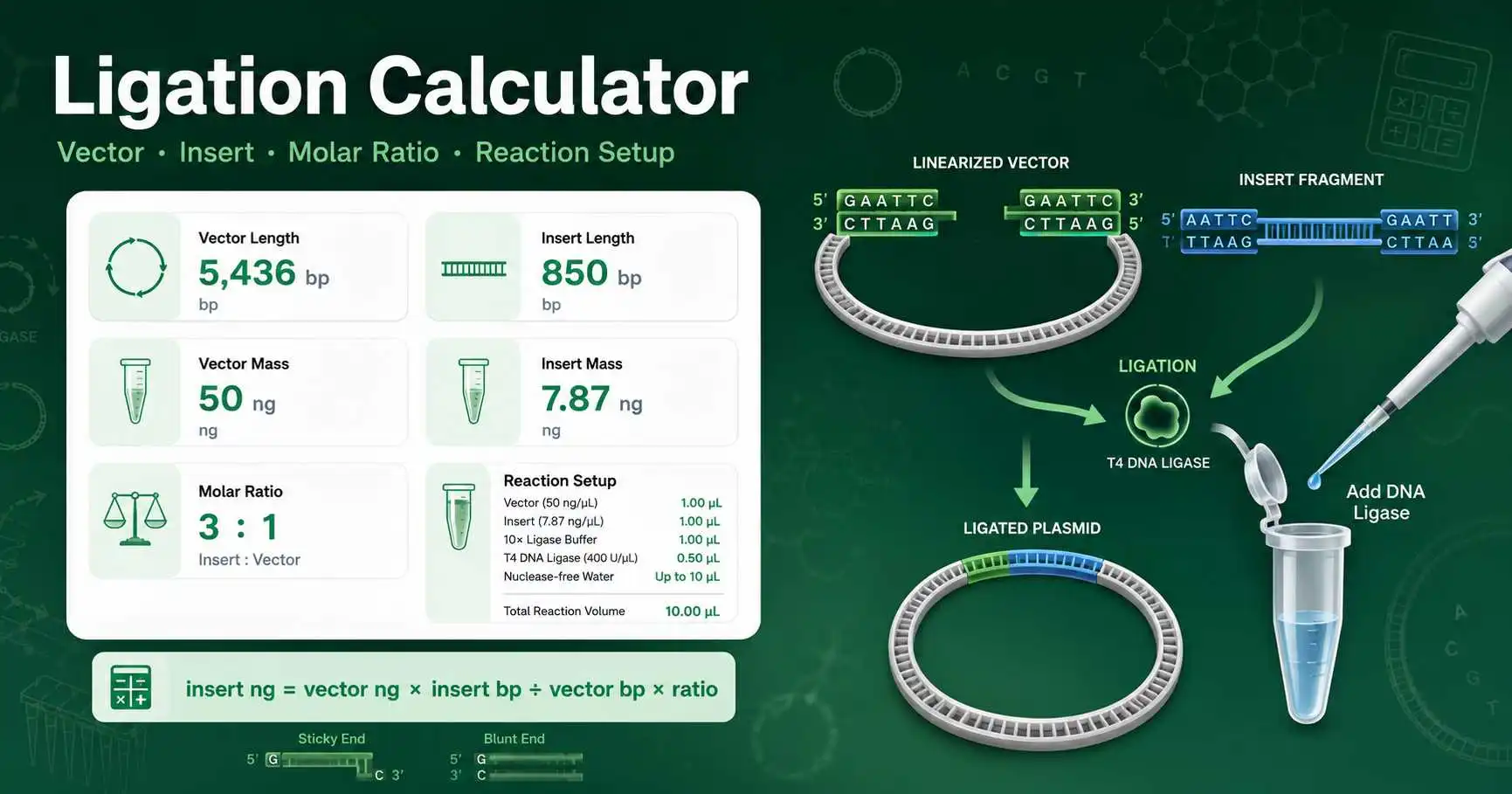
Ligation Calculator for vector and insert DNA
A Ligation Calculator helps you choose the correct amount of insert DNA for a cloning reaction. It uses vector length, insert length, vector mass, and desired insert:vector molar ratio. The output gives the required insert mass in nanograms and the estimated molar amount of each DNA fragment.
This matters because ligation works with DNA molecules and DNA ends, not only with total mass. A 500 bp insert and a 2,000 bp insert do not need the same ng amount to give the same number of molecules. The calculator converts fragment length and DNA mass into femtomoles, then balances the insert amount against the vector.
Ligation formula for insert mass
The common educational formula is: required insert mass = vector mass × insert length ÷ vector length × insert:vector molar ratio. Length values must use the same unit, usually base pairs or kilobases. DNA mass is usually entered in ng.
For a 3:1 insert:vector ratio, a 1,000 bp insert, a 3,000 bp vector, and 50 ng vector, the calculation is 50 × 1,000 ÷ 3,000 × 3 = 50 ng insert. The vector and insert have different sizes, but this setup gives three insert molecules for each vector molecule.
The tool also uses the double-stranded DNA approximation of 660 g/mol per base pair. This lets it estimate femtomoles from ng and bp. NEB describes ligation calculators as tools for calculating insert mass at several insert:vector molar ratios for typical ligation reactions. NEBioCalculator
How to use this Ligation Calculator
Enter the vector length after digestion or linearization. Enter the insert length as the purified insert fragment size. Add the vector DNA mass you plan to use in the reaction. Then choose the insert:vector molar ratio. A 3:1 ratio is a common first test for many single-insert sticky-end ligations.
Add vector and insert concentrations in ng/µL when you want pipetting volumes. The calculator then estimates vector volume, insert volume, 10X buffer volume, ligase volume, and water volume. If the water volume becomes negative, your DNA solutions are too dilute for the selected final reaction volume.
Worked example for a cloning ligation
Suppose your vector is 3,000 bp and your insert is 1,000 bp. You want to use 50 ng vector in a 20 µL ligation. You choose a 3:1 insert:vector molar ratio. The calculator returns 50 ng insert because the insert is one-third the vector size, and the 3:1 ratio cancels that size difference.
If the vector concentration is 25 ng/µL, you need 2 µL vector. If the insert concentration is 15 ng/µL, you need about 3.33 µL insert. In a 20 µL reaction with 10X buffer and 1 µL ligase, the water volume is about 11.67 µL. This gives a complete reaction plan, not only a mass result.
Use case 1: planning sticky-end restriction cloning
In sticky-end cloning, a 3:1 insert:vector ratio often works as a starting point. The insert and vector have compatible overhangs, so the insert can ligate into the linearized plasmid. This calculator helps you avoid adding too little insert, which can reduce colony number, or too much insert, which can increase unwanted ligation products.
You can pair this page with the Restriction Digest Predictor when you first need to confirm cut sites and fragment sizes. After gel extraction or purification, return here and calculate the actual insert amount from measured DNA concentration.
Use case 2: comparing several molar ratios
Cloning sometimes improves when you test more than one ratio. You may run 1:1, 3:1, and 5:1 reactions side by side. This helps when the insert is large, the vector background is high, or the DNA concentration measurement is uncertain.
For blunt-end ligation, you may need more optimization than sticky-end ligation. Blunt ends lack complementary overhangs, so ligation can be less efficient. Keep your protocol, ligase recommendation, DNA-end concentration, and control reactions in mind before changing the ratio too aggressively.
Practical ligation setup checks
Check whether your vector was fully digested. Confirm that the insert and vector have compatible ends. Use fresh ligase buffer because ATP can degrade after repeated freeze-thaw cycles. Include a vector-only control so you can estimate background colonies from self-ligated vector.
Also check whether the DNA solution volumes are reasonable. If the insert volume is too high, the reaction may contain too much salt or elution buffer. Concentrating the insert or increasing reaction volume may help. For downstream planning, use the Vector Insert Ratio Calculator when the main question is molar ratio rather than full reaction setup.
Common mistakes in ligation calculations
Do not use plasmid backbone length before digestion if a large fragment was removed. Use the actual linear vector fragment that will receive the insert. Do not use total PCR product volume as if it were purified insert mass. Measure DNA concentration after purification when possible.
Do not confuse vector:insert and insert:vector notation. This calculator uses insert:vector ratio. A 3:1 value means three insert molecules for each vector molecule. If your protocol writes vector:insert as 1:3, that is the same practical ratio.
What to verify before real lab work
Verify critical ligation calculations independently. Confirm enzyme compatibility, buffer, incubation time, DNA purification, phosphorylation status, vector dephosphorylation, insert orientation strategy, antibiotic marker, competent-cell efficiency, and colony-screening plan.
This calculator gives a useful planning estimate for molecular biology students, teachers, lab workers, and cloning researchers. It does not guarantee successful ligation. Real outcomes depend on DNA quality, fragment ends, ligase activity, transformation conditions, and screening design.