
Plasmid Size Calculator for cloning maps
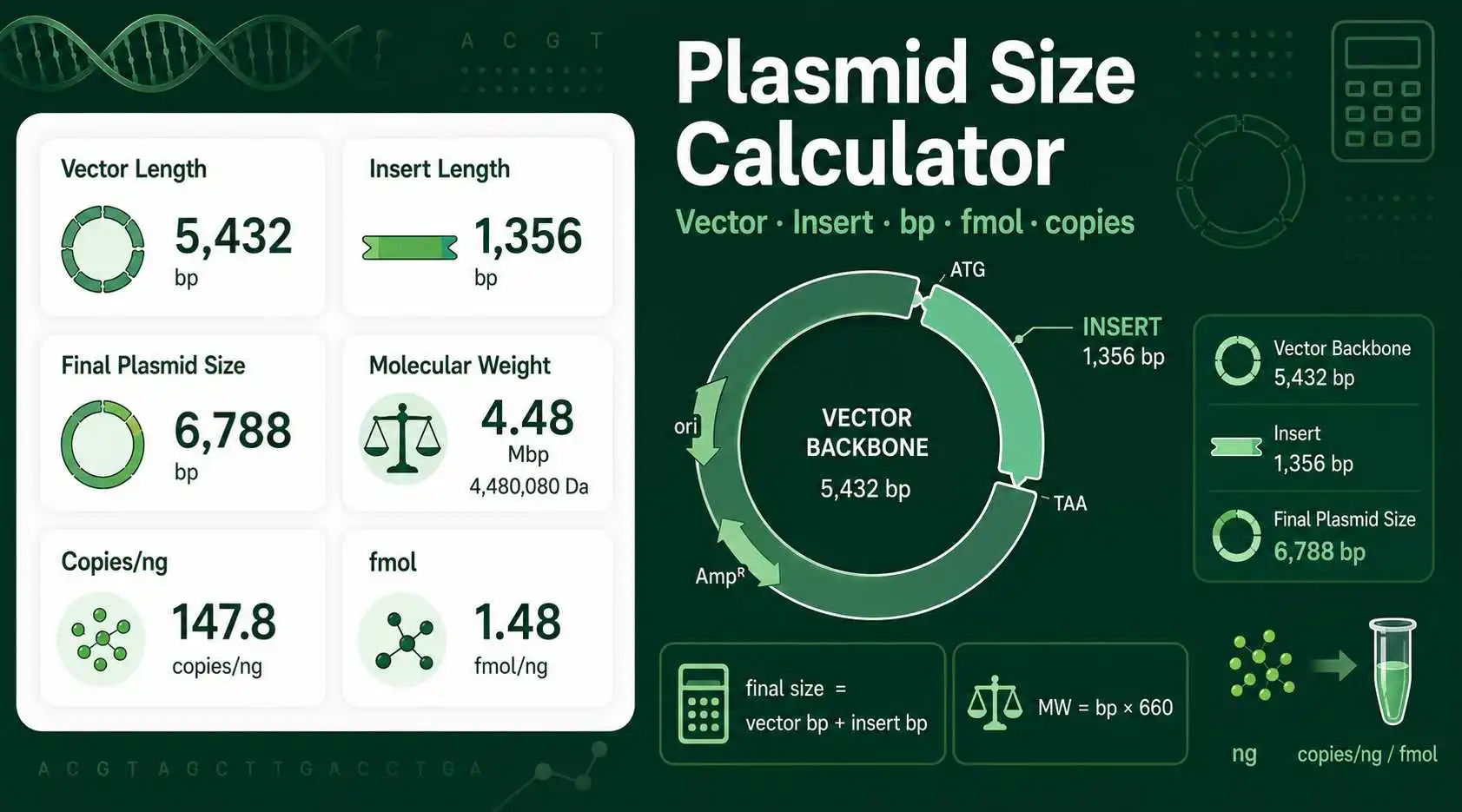
The Plasmid Size Calculator adds the vector backbone length and insert fragment lengths to estimate the final recombinant plasmid size. It is useful when you build a new construct from a linearized vector, PCR insert, synthetic gene block, restriction fragment, Gibson Assembly fragment, or Golden Gate Assembly part.
The result helps you plan cloning reactions, estimate DNA copy number, compare expected colony plasmids with a map, and prepare values for lab notes. You only need the vector length in base pairs and the length of each insert fragment.
How to calculate final plasmid size
Enter the empty vector or backbone size in base pairs. Then enter each insert length in base pairs. The tool adds all positive insert lengths and reports the total construct size in bp and kb.
The main equation is simple: final plasmid size = vector backbone length + total insert length. If a 5,369 bp vector receives an 873 bp coding sequence and a 72 bp tag, the plasmid size is 5,369 + 873 + 72 = 6,314 bp, or 6.314 kb.
Addgene describes common plasmid features such as the origin of replication, antibiotic resistance gene, and multiple cloning site. Those features are part of the vector map, so their lengths are usually already included in the backbone size you enter.Addgene Plasmids 101
Plasmid molecular weight and copy number
The calculator estimates double-stranded DNA molecular weight with the common approximation 660 g/mol per base pair. The formula is molecular weight = plasmid bp × 660 g/mol. This works well for routine planning, but it does not replace exact sequence-based mass if modified bases or unusual chemistry are involved.
Copy number per ng is estimated from mass, molecular weight, and Avogadro’s number. The practical equation is copies per ng = (1 × 10⁻⁹ g ÷ molecular weight) × 6.022 × 10²³. Smaller plasmids give more molecule copies per ng than larger plasmids because each molecule weighs less.
Worked example for plasmid size and fmol
Suppose your vector backbone is 5,369 bp. Your insert is 945 bp after adding a small tag. The final plasmid size is 6,314 bp. The estimated molecular weight is 6,314 × 660 = 4,167,240 g/mol.
If you have 50 ng of this plasmid, the fmol amount is calculated as ng × 1,000,000 ÷ molecular weight. So 50 × 1,000,000 ÷ 4,167,240 = about 12.0 fmol. If you want 20 fmol instead, you need about 83.3 ng of this plasmid.
Use case: checking a recombinant plasmid map
Students and lab workers often need to confirm that a new plasmid map has the expected size. If the vector is 4.8 kb and the insert is 1.2 kb, the recombinant plasmid should be about 6.0 kb. This value can guide restriction digest interpretation, colony PCR planning, and sequencing coverage checks.
If your expected plasmid size does not match the map, check whether the promoter, tag, linker, terminator, origin, selection marker, and cloning scar were already included in the vector backbone. Also check whether you entered bp rather than kb.
Use case: planning DNA amount for cloning
A cloning reaction depends on molecule number, not only DNA mass. For example, 50 ng of a 3 kb plasmid contains more molecules than 50 ng of a 10 kb plasmid. This matters when you prepare ligation, Gibson Assembly, Golden Gate Assembly, or transformation controls.
Use this page to estimate fmol from ng before you move into a reaction-specific setup. For ligation ratios, use the Ligation Calculator. For multi-fragment assembly planning, compare the total construct size with the Gibson Assembly Calculator.
Common plasmid size mistakes to avoid
Do not add the insert length twice. Some plasmid maps already show the final recombinant size, while others show the empty vector size. Use the empty backbone size only when you want the calculator to add inserts for you.
Do not ignore small elements if precision matters. Tags, linkers, restriction sites, scars, promoters, terminators, selectable markers, and origins of replication all contribute to total plasmid size. Small elements may not matter for a rough estimate, but they matter for a final map.
What to verify before lab use
Verify the plasmid map, insert orientation, junction sequence, reading frame, restriction sites, overhangs, and final sequence file before using the size for real experiments. For transformation or transfection, also consider plasmid purity, supercoiled fraction, host strain, selection marker, and construct toxicity.
Treat this calculator as a planning and education tool. For critical cloning, confirm the construct with sequencing, diagnostic digest, colony PCR, or another validated method from your lab workflow.