
Chemistry calculator
Kb pKb Converter
Convert Kb to pKb or pKb to Kb for weak-base equilibrium problems, buffer comparisons, and acid-base chemistry reports.
Base dissociation converter
Convert Kb and pKb
Enter a base dissociation constant or pKb value. The calculator returns the matching value, a simple strength interpretation, and the conjugate acid pKa estimate at 25 °C.
Choose the value you already know.
Kb must be positive. Scientific notation such as 1.8e-5 is accepted.
Converted result
Formula: pKb = −log10(Kb)
Substitution: pKb = −log10(1.8000 × 10^-5)
Relatively stronger weak base
This pKb range indicates a larger Kb than many weak bases, so the base produces more OH− at comparable concentration.
Lower pKb values indicate stronger bases. Higher Kb values indicate stronger proton-accepting behavior in the stated equilibrium model.
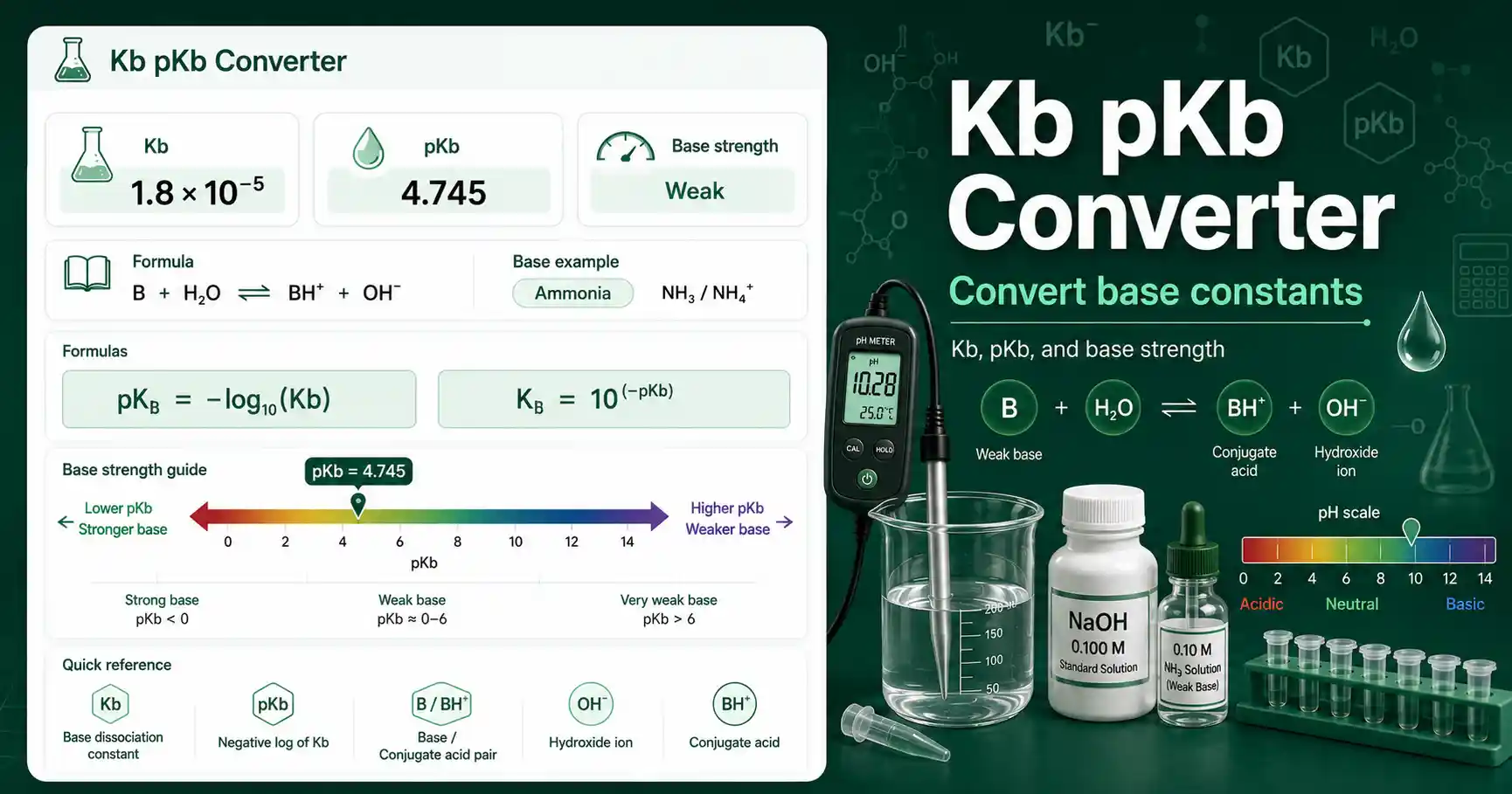
Kb pKb Converter for base dissociation constants
The Kb pKb Converter changes a base dissociation constant into pKb, or changes pKb back into Kb. Kb describes how far a base reacts with water to form its conjugate acid and hydroxide ion. pKb is the negative base-10 logarithm of Kb. The logarithmic form makes very small equilibrium constants easier to compare. A larger Kb means stronger basic behavior under the same assumptions. A smaller pKb means stronger basic behavior under the same assumptions.
This converter is useful for chemistry students, biochemistry students, teachers, and lab workers who need a quick acid-base equilibrium check. It accepts ordinary decimal notation and scientific notation. A value such as 1.8e-5 is read as 1.8 × 10⁻⁵. The result card shows Kb, pKb, and the estimated pKa of the conjugate acid at 25 °C. The conjugate acid estimate uses the common water relationship pKa + pKb = 14 at 25 °C. For a broader acid-side conversion, use the Ka pKa Converter.
The converter does not measure a base constant from experimental data. It only transforms values that you already have from a textbook, dataset, lab handout, or equilibrium problem. The calculation assumes dilute aqueous chemistry and a temperature near 25 °C when it reports the conjugate acid pKa. Temperature, ionic strength, solvent composition, and activity effects can change real equilibrium values. Use the result as an educational calculation, not as a substitute for measured constants in critical work.
Kb values often span many powers of ten. This is why pKb is easier to read in tables and homework solutions. For example, Kb = 1.8 × 10⁻⁵ becomes pKb about 4.745. That single pKb value is easier to compare with another base that has pKb 8.90 or pKb 3.30. A one-unit decrease in pKb means a tenfold increase in Kb. Rounding matters because logarithms compress large changes into smaller numbers.
Kb pKb Converter formula
The main formula is pKb = −log10(Kb). The reverse formula is Kb = 10^(−pKb). These formulas use the same logarithm rule used for pH, pOH, pKa, and many other chemistry scales. If Kb is positive, pKb can be calculated directly. If pKb is known, Kb can be recovered with a power of ten. The pOH Calculator is useful next when hydroxide concentration is known instead of Kb.
The calculator rejects zero and negative Kb values because the logarithm of those values is not valid in this context. It also prevents impossible numeric outputs such as NaN and Infinity. The interpretation label is qualitative. It helps users compare base strength, but it does not replace a full equilibrium table or experimental method.
What the result means
Kb is the equilibrium constant for base ionization.
pKb is a compact logarithmic version of Kb.
Lower pKb points to stronger basic behavior.
Higher pKb points to weaker basic behavior.
Kb pKb Converter worked example
Given values: Kb = 1.8 × 10⁻⁵ for a weak base.
Formula: pKb = −log10(Kb).
Substitution: pKb = −log10(1.8 × 10⁻⁵).
Result: pKb = 4.745.
Interpretation: The base has a moderate weak-base constant in this simplified comparison. At 25 °C, the estimated pKa of its conjugate acid is 14 − 4.745 = 9.255.
Students can use this example to check calculator entries and homework solutions. Teachers can use the same values to show how logarithms turn small equilibrium constants into readable pKb values. Lab workers can use the result as a quick reference when comparing weak bases used in buffer systems. Researchers should check the original source for the constant, temperature, solvent, and ionic strength before using the value in a report. For background on Ka, Kb, pKa, and pKb relationships, see this Chemistry LibreTexts explanation of calculating Ka and Kb.
Student Questions About Kb and pKb
What does a lower pKb mean?
A lower pKb means a larger Kb, so the base has a stronger tendency to accept a proton in the equilibrium model.
Can pKb be negative?
Yes. A negative pKb is possible when Kb is greater than 1, although many introductory chemistry examples use weak bases with positive pKb values.
Why does the calculator show conjugate acid pKa?
The conjugate acid pKa helps compare an acid-base pair. At 25 °C in water, pKa plus pKb is commonly treated as 14.
Use the converter when a problem gives a base dissociation constant but asks for pKb. Use it in reverse when a table lists pKb but you need Kb for an equilibrium expression. Check that you copied exponents correctly because 1.8e-5 and 1.8e-6 differ by a factor of ten. Always report enough significant figures for your class, lab, or data table.