
Potassium Phosphate Buffer Calculator
Calculate starting amounts of anhydrous potassium phosphate monobasic (KH₂PO₄) and potassium phosphate dibasic (K₂HPO₄) for a target pH, total phosphate concentration, and final volume.
Potassium Phosphate Buffer Calculator explained in one minute
A near-neutral potassium phosphate buffer uses the H₂PO₄⁻/HPO₄²⁻ conjugate pair. The calculator converts target pH and pKa into a base-to-acid ratio, splits the total phosphate between KH₂PO₄ and K₂HPO₄, and reports the corresponding anhydrous masses.
Calculate potassium phosphate dry-salt amounts
Estimate anhydrous KH₂PO₄ and K₂HPO₄ amounts from target pH, total phosphate concentration, and final volume.
Enter your values
Your result
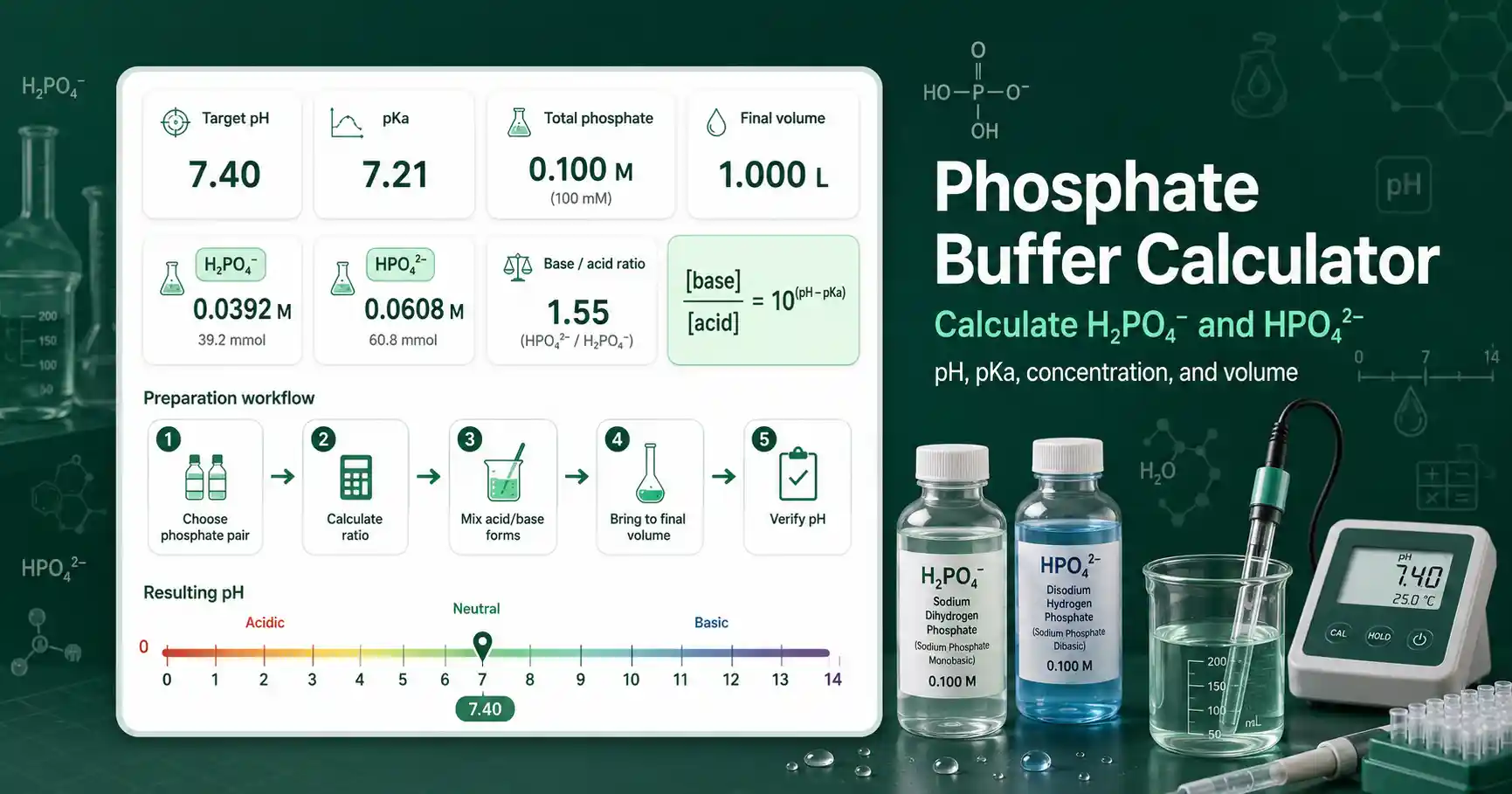
How to use the Potassium Phosphate Buffer Calculator
Enter the values from your protocol, reagent label, spectrophotometer, or experiment, then use the result together with the formula and assumptions shown on this page.
- 1
Enter the target pH for the potassium phosphate buffer.
- 2
Enter the pKa for the relevant phosphate transition. The calculator starts at 7.21 for near-neutral planning.
- 3
Enter total phosphate concentration in mM, meaning the combined analytical concentration of KH₂PO₄ and K₂HPO₄ forms.
- 4
Enter the final buffer volume in mL.
- 5
Use the calculated anhydrous KH₂PO₄ and K₂HPO₄ masses as starting amounts and note the reported base-to-acid ratio.
- 6
Dissolve below final volume, check pH under your actual experimental conditions, and bring to final volume only after the solution is fully mixed and verified.
What does the potassium phosphate buffer calculator calculate?
It calculates the molar split and dry-salt masses of KH₂PO₄ and K₂HPO₄ needed to approximate a target near-neutral phosphate buffer.
Potassium phosphate buffers are useful when potassium, rather than sodium, is the desired counterion. The acid-base chemistry is controlled by phosphate protonation states, while the salt identity determines the mass that must be weighed and the ionic composition of the final solution.
Near pH 7, the relevant pair is H₂PO₄⁻/HPO₄²⁻. KH₂PO₄ supplies the more protonated acid form and K₂HPO₄ supplies the less protonated base form. The calculator keeps the requested total phosphate concentration fixed while changing the ratio of those two forms to match the target pH mathematically.
Potassium phosphate buffer formula and salt masses
The tool uses [HPO₄²⁻]/[H₂PO₄⁻] = 10^(pH − pKa), then converts the required acid and base moles into grams with the anhydrous KH₂PO₄ and K₂HPO₄ formula weights.
Total phosphate moles equal concentration in mol/L multiplied by final volume in liters. Once the base-to-acid ratio is known, acid moles are total moles divided by 1 + ratio, and base moles are the difference between total and acid moles.
The page uses PubChem formula weights of about 136.086 g/mol for KH₂PO₄ and 174.176 g/mol for K₂HPO₄. If your reagent is supplied as a hydrate, the required mass changes and must be recalculated with the hydrate's molecular weight.
| Component | Formula | Formula weight used | Buffer role |
|---|---|---|---|
| Potassium phosphate monobasic | KH₂PO₄ | 136.086 g/mol | H₂PO₄⁻ acid form |
| Potassium phosphate dibasic | K₂HPO₄ | 174.176 g/mol | HPO₄²⁻ base form |
| Phosphate transition | H₂PO₄⁻ ⇌ H⁺ + HPO₄²⁻ | pKa entered by user | Controls the near-neutral ratio |
When should potassium phosphate be used instead of sodium phosphate?
Potassium phosphate can be preferable when the protocol requires potassium as the major counterion, while sodium phosphate is more appropriate when sodium composition is desired or already specified by a validated formulation.
The pH calculation is similar because it is driven mainly by phosphate protonation, but sodium and potassium buffers are not compositionally identical. Counterions can matter in biological assays, enzyme systems, chromatography, ionic-strength control, and compatibility with other salts.
Do not substitute potassium and sodium phosphate automatically in a validated protocol. Even when the pH is similar, changing the counterion changes the ionic composition and can affect experimental performance.
- Use the counterion specified by the method whenever a validated protocol exists.
- Check compatibility with proteins, enzymes, metals, membranes, and downstream analytical methods.
- If you need a mixed sodium/potassium phosphate system, use the exact formulation rather than treating one page as a direct substitute for the other.
How to make potassium phosphate buffer accurately
Accurate preparation requires the correct reagent form, final concentration, temperature-aware pH measurement, complete dissolution, and final-volume adjustment after pH verification.
- Confirm that your KH₂PO₄ and K₂HPO₄ bottles match the anhydrous forms assumed by the calculator.
- Weigh the salts with a balance appropriate for the required precision.
- Dissolve the calculated masses in less than the final volume so pH or composition can still be adjusted if the protocol permits.
- Measure pH after the salts are fully dissolved and the solution is well mixed.
- Bring to final volume at the end rather than starting with the exact final water volume.
- Record final pH, temperature, reagent lot/form, and any adjustment made so the preparation is reproducible.
Common potassium phosphate buffer mistakes
Most errors come from hydrate mismatches, incorrect unit conversion, using the wrong pKa, or assuming ideal Henderson–Hasselbalch behavior is an exact recipe under every condition.
- Do not confuse mM with M; this calculator's concentration input is explicitly millimolar.
- Do not use anhydrous K₂HPO₄ mass for a hydrated K₂HPO₄ reagent.
- Do not use the near-neutral phosphate pKa for a target pH where a different phosphoric-acid transition dominates.
- Do not assume equal masses when pH = pKa. Equal molar amounts are required, but KH₂PO₄ and K₂HPO₄ have different molecular weights.
- Do not use potassium phosphate in a protocol where phosphate precipitation, metal binding, or counterion sensitivity is a known concern without checking compatibility.
50 mM potassium phosphate buffer at pH 7.4: worked example
For 100 mL of 50 mM potassium phosphate at pH 7.40 with pKa 7.21, total phosphate is 5.00 mmol and the base form is favored over the acid form.
0.050 mol/L × 0.100 L = 5.00 mmol total phosphate.
10^(7.40 − 7.21) ≈ 1.55.
About 1.96 mmol × 136.086 g/mol ≈ 0.267 g.
About 3.04 mmol × 174.176 g/mol ≈ 0.529 g.
Dissolve below 100 mL, mix fully, and check pH.
If the pH is acceptable for the protocol, bring the solution to 100 mL final volume.
Interpretation: The calculated dry-salt masses give a chemically reasonable starting composition for the selected pH and concentration. Use the exact hydrate state on your reagent bottle and verify the measured pH before experimental use.
Calculations and terms covered on this page
These are the closely related lab calculations and concepts this tool is designed to answer without forcing you to translate between several separate calculators.
Scientific references and source checks
The equations, constants, and interpretation notes on this page are checked against established chemistry or molecular-biology references. Always follow your own validated protocol when exact experimental conditions matter.
- PubChem: Potassium phosphate monobasicFormula and molecular weight for KH₂PO₄.
- PubChem: Potassium phosphate dibasicFormula and molecular weight for K₂HPO₄.
- Sigma-Aldrich: Phosphate Buffer Formulation GuideExample potassium phosphate mixtures across near-neutral pH values.
Potassium Phosphate Buffer Calculator FAQs
Which salts are used in this potassium phosphate calculator?
The calculator uses anhydrous KH₂PO₄ as the acid-form salt and anhydrous K₂HPO₄ as the base-form salt.
What molecular weights are used?
It uses about 136.086 g/mol for anhydrous KH₂PO₄ and 174.176 g/mol for anhydrous K₂HPO₄.
Can I use a K₂HPO₄ hydrate with these masses?
No. A hydrate contains crystal water and has a different formula weight. Convert the calculated moles using the molecular weight of the exact hydrate on your reagent label.
What pKa should I use near pH 7.4?
A value around 7.2 is commonly used for the H₂PO₄⁻/HPO₄²⁻ transition at room-temperature planning conditions. Use a protocol-specific value when accuracy requirements are tighter.
Why is K₂HPO₄ higher than KH₂PO₄ at pH 7.4?
Because pH 7.4 is above a pKa near 7.21, the equilibrium favors the more deprotonated HPO₄²⁻ form.
Can I replace sodium phosphate with potassium phosphate?
Not automatically. The acid-base calculation is similar, but the counterion changes the composition and may affect experimental compatibility.
Do I need to check pH after mixing?
Yes. The calculator uses an ideal concentration model. Temperature, ionic strength, reagent form, and other solution components can shift the measured pH.
Can I scale the recipe to any volume?
Yes. Enter the desired final volume in mL. Salt moles and masses scale linearly with volume at the same concentration and pH.