
Sodium Phosphate Buffer Calculator
Calculate starting amounts of anhydrous sodium phosphate monobasic (NaH₂PO₄) and sodium phosphate dibasic (Na₂HPO₄) for a target pH, total phosphate concentration, and final volume.
Sodium Phosphate Buffer Calculator explained in one minute
Near neutral pH, sodium phosphate buffer is commonly modeled with the H₂PO₄⁻/HPO₄²⁻ pair. This calculator uses the Henderson–Hasselbalch ratio to divide total phosphate between NaH₂PO₄ and Na₂HPO₄, then converts those moles to grams using anhydrous formula weights.
Calculate sodium phosphate dry-salt amounts
Estimate anhydrous NaH₂PO₄ and Na₂HPO₄ amounts from target pH, total phosphate concentration, and final volume.
Enter your values
Your result
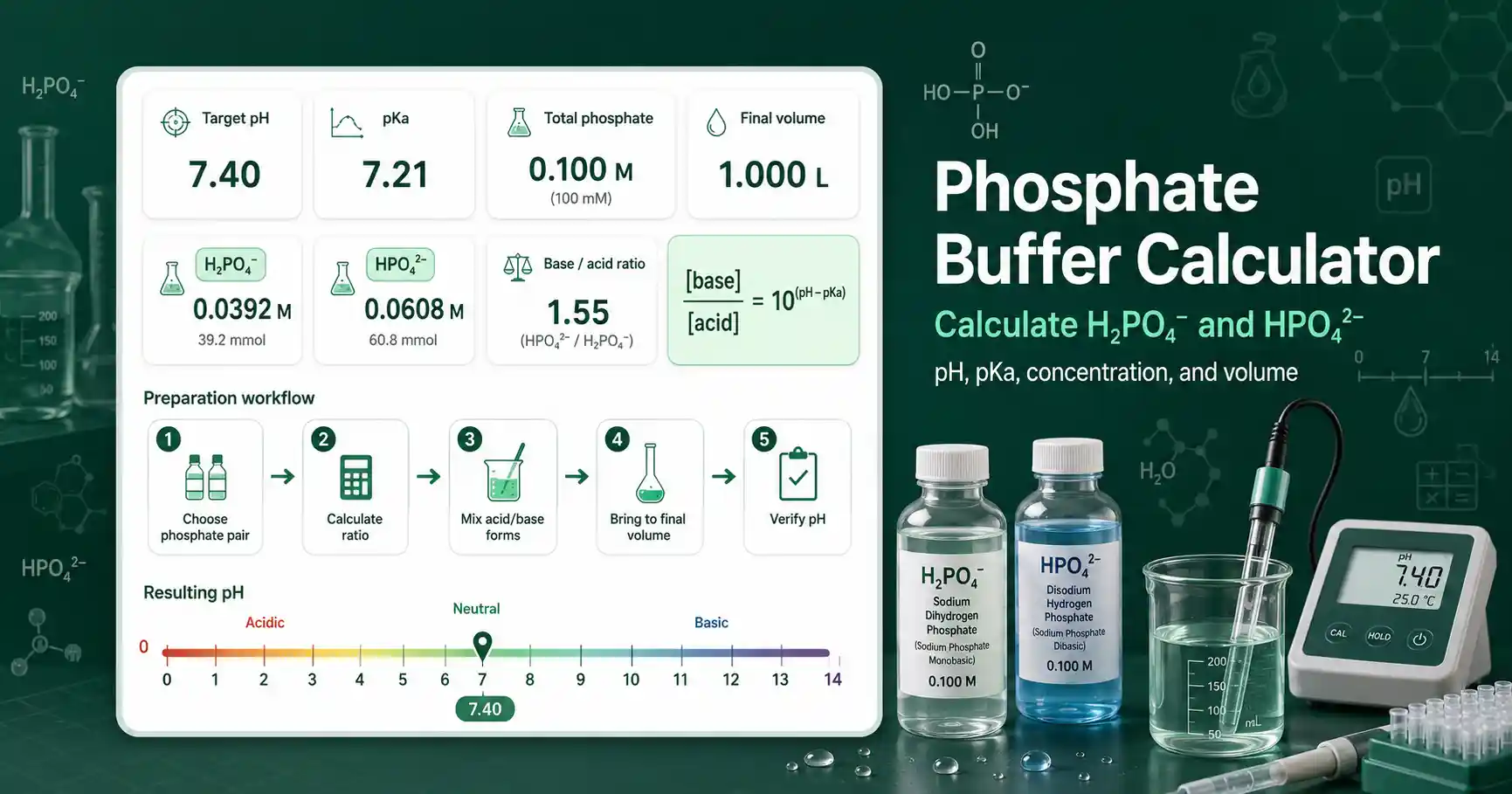
How to use the Sodium Phosphate Buffer Calculator
Enter the values from your protocol, reagent label, spectrophotometer, or experiment, then use the result together with the formula and assumptions shown on this page.
- 1
Enter the target pH for the sodium phosphate buffer.
- 2
Use the pKa appropriate to your temperature and conditions. The calculator starts with 7.21 as a common planning value for the second phosphoric-acid dissociation.
- 3
Enter the final total phosphate concentration in mM. This is the sum of the acid and base phosphate forms.
- 4
Enter the final solution volume in mL.
- 5
Read the calculated anhydrous NaH₂PO₄ and Na₂HPO₄ masses, the acid/base mmol split, and the Henderson–Hasselbalch ratio.
- 6
Dissolve the salts in less than the final volume, check the pH with a calibrated meter, adjust if your validated protocol allows it, and then bring the solution to final volume.
How does a sodium phosphate buffer calculator work?
The calculator first finds the HPO₄²⁻ to H₂PO₄⁻ ratio from pH and pKa, then splits the total phosphate moles between the monobasic and dibasic sodium salts.
Phosphoric acid is polyprotic, but near biological and near-neutral pH the second dissociation is usually the dominant buffering transition. That pair is H₂PO₄⁻ as the acid form and HPO₄²⁻ as the conjugate base form.
When sodium is the counterion, those species are commonly supplied as sodium phosphate monobasic and sodium phosphate dibasic. The calculator converts the required moles into grams for the anhydrous salts, which makes the result useful as a starting formulation rather than only an abstract acid/base ratio.
- If target pH rises above pKa, the calculator requires a larger fraction of Na₂HPO₄.
- If target pH falls below pKa, the calculator requires a larger fraction of NaH₂PO₄.
- At pH = pKa, the acid and base forms are present in a 1:1 molar ratio.
- The total phosphate concentration stays fixed while the acid/base split changes with pH.
Sodium phosphate buffer formula and molecular weights
The ratio is calculated as [HPO₄²⁻]/[H₂PO₄⁻] = 10^(pH − pKa), and total phosphate moles are concentration × final volume.
After the ratio is known, acid moles are total moles ÷ (1 + ratio), and base moles are the remaining total moles. The calculator then multiplies each amount by the selected formula weight.
This page deliberately uses anhydrous formula weights. Sodium phosphate reagents are also sold as hydrates, and their molecular weights are higher because crystal water is part of the weighed material. Using an anhydrous molecular weight for a hydrate gives the wrong mass.
| Component | Formula | Formula weight used | Role near neutral pH |
|---|---|---|---|
| Sodium phosphate monobasic | NaH₂PO₄ | 119.977 g/mol | Acid form, H₂PO₄⁻ |
| Sodium phosphate dibasic | Na₂HPO₄ | 141.959 g/mol | Base form, HPO₄²⁻ |
| Phosphate pair | H₂PO₄⁻ / HPO₄²⁻ | pKa entered by user | Main buffer pair around neutral pH |
How to prepare sodium phosphate buffer from the calculated masses
Use the calculated salt masses as starting amounts, dissolve below final volume, verify pH under your actual conditions, and only then bring the buffer to its final volume.
- Confirm whether each bottle is anhydrous, monohydrate, dihydrate, heptahydrate, dodecahydrate, or another form before weighing.
- Use suitable-quality water and clean glassware for the intended application.
- Dissolve both phosphate salts in roughly 70–90% of the intended final volume so there is room for adjustment.
- Measure pH at the temperature relevant to your protocol whenever practical.
- If your validated method allows pH adjustment, use small additions and mix thoroughly before re-reading.
- Bring to final volume only after dissolution and pH verification, because dilution changes concentration and can slightly affect pH.
Sodium phosphate buffer at pH 7.4
At pH 7.4 with pKa 7.21, the Henderson–Hasselbalch ratio is about 1.55, so the dibasic HPO₄²⁻ form is more abundant than the monobasic H₂PO₄⁻ form.
This is why a pH 7.4 phosphate recipe contains more dibasic phosphate than monobasic phosphate on a molar basis. The exact measured pH can still differ from the ideal calculation because temperature, ionic strength, other salts, and activity effects change real solution behavior.
A sodium phosphate buffer is not automatically the same as phosphate-buffered saline (PBS). PBS also contains sodium chloride and may include potassium salts depending on the formulation. Use a PBS-specific calculator when the complete saline composition matters.
Common sodium phosphate preparation mistakes
The biggest errors come from using the wrong hydrate, confusing total phosphate with one salt concentration, and assuming the calculated pH will exactly match the measured pH.
- Do not weigh a hydrate using the anhydrous mass shown here without converting to the hydrate's formula weight.
- Do not enter 50 for 50 M; this field is explicitly in mM, so 50 means 50 mM.
- Do not treat NaH₂PO₄ concentration alone as the total phosphate concentration.
- Do not use this near pH regions where another phosphoric-acid dissociation dominates without choosing the appropriate equilibrium model.
- Do not assume phosphate is compatible with every experiment; phosphate can interact with some metals, proteins, surfaces, or assays.
- For reproducible work, record reagent form, temperature, pH meter calibration, water quality, and final volume in the protocol.
50 mM sodium phosphate buffer at pH 7.4: worked example
Suppose you need 100 mL of 50 mM sodium phosphate buffer at pH 7.40 and use pKa 7.21 with anhydrous NaH₂PO₄ and Na₂HPO₄.
0.050 mol/L × 0.100 L = 0.005 mol = 5.00 mmol.
10^(7.40 − 7.21) ≈ 1.55.
About 1.96 mmol, which is about 0.235 g anhydrous NaH₂PO₄.
About 3.04 mmol, which is about 0.431 g anhydrous Na₂HPO₄.
Dissolve both salts below 100 mL, mix thoroughly, check pH, and then bring to 100 mL.
If either reagent is hydrated, recalculate the mass with the molecular weight printed on that exact reagent.
Interpretation: The calculated composition is a rational starting recipe for a 50 mM near-neutral sodium phosphate buffer. Measured pH remains the final check because ideal Henderson–Hasselbalch calculations do not capture every solution effect.
Calculations and terms covered on this page
These are the closely related lab calculations and concepts this tool is designed to answer without forcing you to translate between several separate calculators.
Scientific references and source checks
The equations, constants, and interpretation notes on this page are checked against established chemistry or molecular-biology references. Always follow your own validated protocol when exact experimental conditions matter.
- PubChem: Sodium phosphate monobasicFormula and molecular weight for anhydrous NaH₂PO₄.
- PubChem: Sodium phosphate dibasicFormula and molecular weight for anhydrous Na₂HPO₄.
- Sigma-Aldrich: Phosphate Buffer Formulation GuideExample phosphate buffer mixtures across near-neutral pH values and a reminder to confirm final pH.
Sodium Phosphate Buffer Calculator FAQs
Which sodium phosphate salts does this calculator use?
It uses anhydrous sodium phosphate monobasic, NaH₂PO₄, and anhydrous sodium phosphate dibasic, Na₂HPO₄.
What pKa should I use for phosphate buffer near pH 7?
A value around 7.2 is commonly used as a room-temperature planning value for the H₂PO₄⁻/HPO₄²⁻ pair. Use a condition-specific value when your protocol requires tighter accuracy.
Can I use sodium phosphate monohydrate or dihydrate with these masses?
Not directly. Hydrates have different formula weights. Convert the required moles to grams using the molecular weight of the exact hydrate listed on your reagent label.
Is sodium phosphate buffer the same as PBS?
No. Sodium phosphate buffer contains the phosphate pair, while PBS also contains saline components such as sodium chloride and may include potassium salts.
Why is there more Na₂HPO₄ at pH 7.4?
Because pH 7.4 is above a pKa near 7.21, the Henderson–Hasselbalch ratio favors the deprotonated HPO₄²⁻ form, supplied here by Na₂HPO₄.
Should I adjust the pH after mixing?
For experimental work, measure the final pH with a calibrated meter. If your validated protocol allows adjustment, make small changes, mix thoroughly, and then bring the solution to final volume.
Can I make 1 L instead of 100 mL?
Yes. Enter 1000 mL as the final volume. The calculated mmol and gram amounts scale directly with volume at the same concentration and pH.
Why can the measured pH differ from the calculated pH?
Temperature, ionic strength, reagent form, additional salts, activity coefficients, water quality, and pH-meter calibration can all shift a real solution away from the ideal concentration-based calculation.