
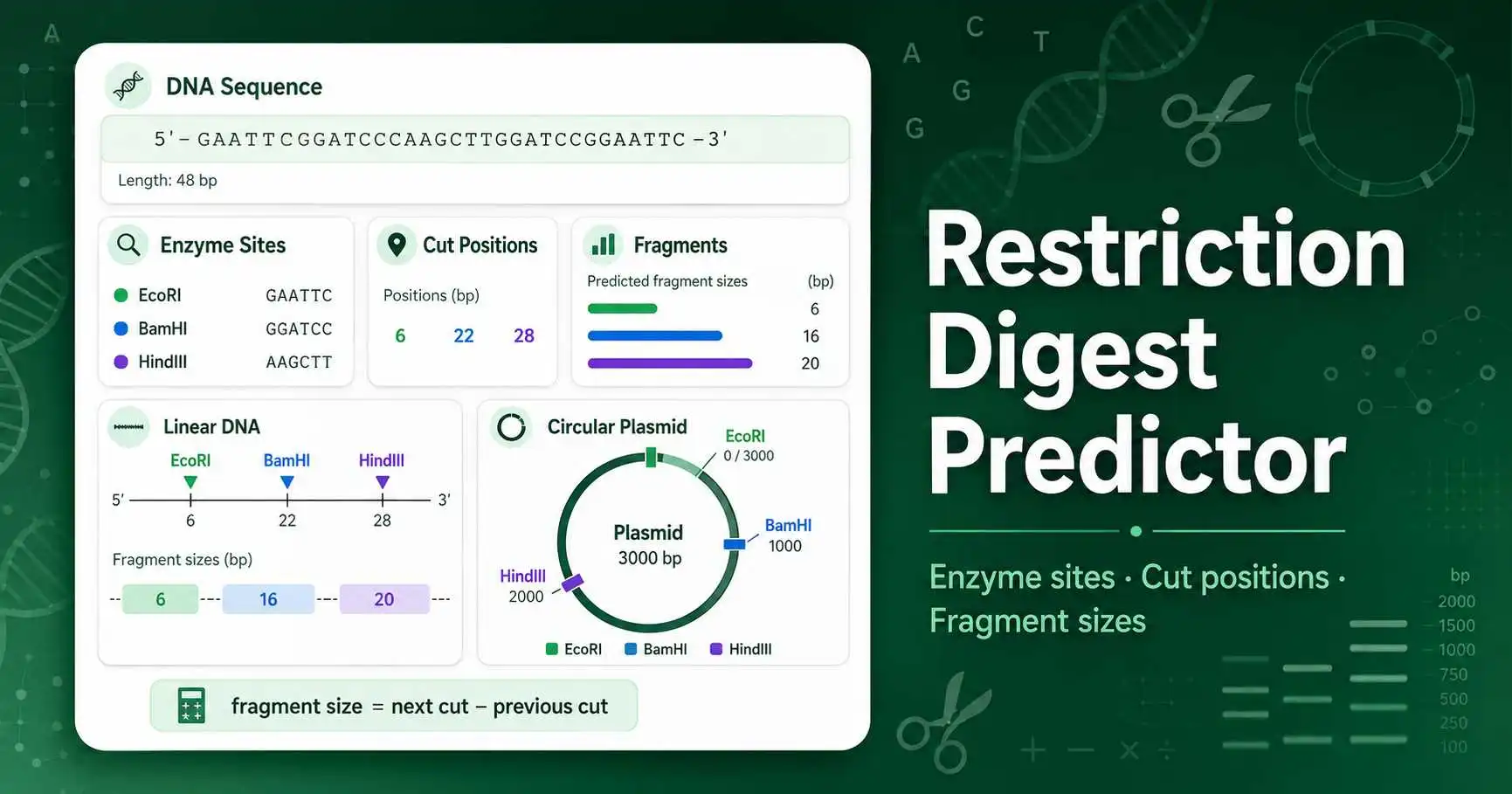
Restriction Digest Predictor for DNA cut sites
A Restriction Digest Predictor scans a DNA sequence for restriction enzyme recognition sites. It reports where each selected enzyme binds, where the cut is predicted to occur, and what fragment sizes you should expect after digestion.
Use it when you want a quick digest map for a plasmid, PCR product, insert, synthetic DNA fragment, or classroom cloning problem. The tool works with exact DNA bases: A, C, G, and T. It ignores FASTA headers, spaces, line breaks, and numbers.
How to use Restriction Digest Predictor results
Paste the DNA sequence into the tool. Choose linear DNA for PCR products, inserts, or genomic fragments. Choose circular plasmid for vector maps. Then select one or more restriction enzymes from the common cloning enzyme list.
The result shows total DNA length, GC content, total cut sites, single cutters, enzyme-specific site counts, cut positions, and predicted fragment sizes. A single cutter is often useful for plasmid linearization. A pair of cutters can help release an insert or screen a recombinant plasmid.
Restriction digest fragment size formula
For linear DNA, fragment sizes come from the distance between the start of the sequence, each cut position, and the end of the sequence. The basic formula is simple:
fragment size = next cut position − previous cut position
For circular DNA, the sequence has no physical start or end. The tool measures the distance between adjacent cut positions around the circle. If a circular plasmid has only one cut site, the digest produces one linear fragment equal to the full plasmid size.
Worked example for a restriction digest
Imagine a 5,000 bp circular plasmid with an EcoRI cut at 1,200 bp and a BamHI cut at 3,700 bp. The first fragment is the distance from 1,200 to 3,700 bp, which is 2,500 bp. The second fragment wraps around the plasmid: 5,000 − 3,700 + 1,200 = 2,500 bp.
On an agarose gel, you would expect two bands near 2.5 kb if both enzymes cut efficiently. If you see one 5 kb band instead, the digest may be incomplete, one enzyme may not have cut, or the plasmid may have lost one restriction site.
Use case 1: checking a cloning vector
Before cloning, you can paste a vector sequence and look for enzymes that cut once in the multiple cloning site. A single cutter can linearize the plasmid. Two different enzymes can create directional cloning ends if their sites flank the insert position.
If you need to inspect a specific recognition sequence rather than a preset enzyme list, use the Restriction Site Finder. It helps when you want to search for one site, compare target regions, or check whether a primer adds a new restriction site.
Use case 2: planning an insert release digest
A double digest can confirm whether an insert is present and roughly the expected size. For example, if EcoRI and XhoI flank a 900 bp insert inside a 3,200 bp vector, a complete digest should give bands near 900 bp and 3,200 bp.
For enzyme-pair planning, compare this page with the Double Digest Calculator. That type of workflow focuses more on paired enzyme setup, reaction planning, and practical digest conditions.
Common interpretation notes for digest maps
A no-cutter result means the selected enzyme recognition site was not found in the pasted sequence. A one-cutter result means a circular plasmid should linearize. A multi-cutter result means the enzyme can produce several fragments and may not be suitable for simple linearization.
Small fragments can be hard to see on a standard agarose gel. Very similar fragment sizes may appear as one thick band. Star activity, incomplete digestion, methylation sensitivity, wrong buffer, low enzyme activity, or poor DNA quality can also change real gel results.
What this digest predictor assumes
This tool assumes the sequence is exact, unmethylated DNA and that each selected enzyme can access and cut its recognition sequence. It does not model enzyme kinetics, buffer compatibility, star activity, methylation blocking, supercoiling effects, incubation time, or supplier-specific activity data.
For real lab work, check current supplier documentation for each enzyme. New England Biolabs explains that restriction enzymes identify specific recognition sequences in DNA and generate double-stranded breaks that create sticky or blunt ends.NEB cloning with restriction enzymes
Practical problem before running a digest
Suppose your plasmid is 4,800 bp. HindIII cuts once at 600 bp. XhoI cuts once at 2,100 bp. For circular DNA, the fragments are 1,500 bp and 3,300 bp. If your gel shows a strong 4,800 bp band and weak smaller bands, you may have partial digestion.
Before repeating the experiment, verify enzyme storage, incubation temperature, compatible buffer, DNA purity, methylation sensitivity, and total glycerol concentration. A correct in-silico prediction is useful, but the reaction still depends on real wet-lab conditions.