
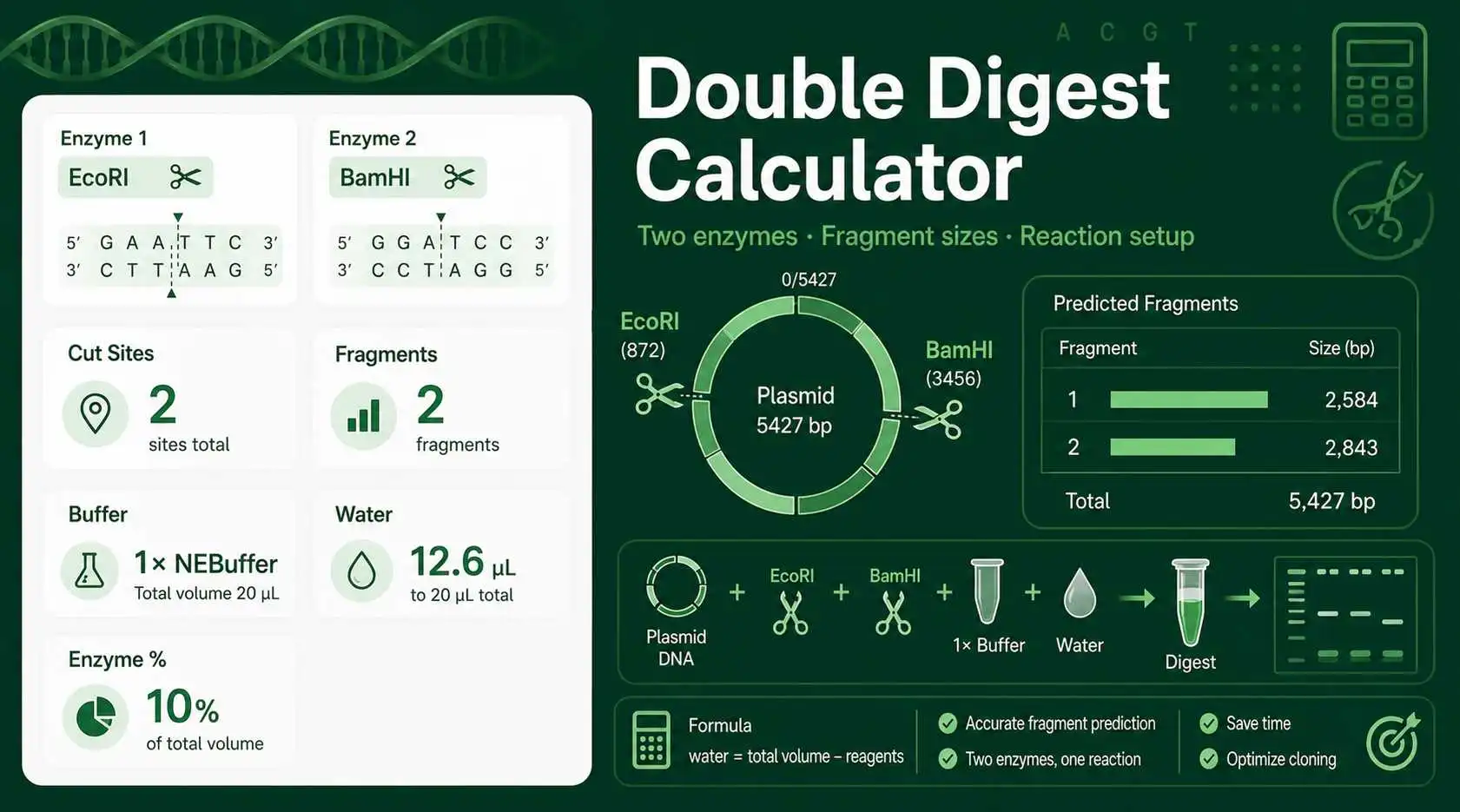
Double Digest Calculator for restriction cloning
A double digest uses two restriction enzymes in one DNA digestion plan. Molecular biologists use it to cut a plasmid, release an insert, verify a clone, or prepare compatible DNA ends for ligation. This calculator helps you check the sequence map and prepare a reaction table before you go to the bench.
The tool accepts a DNA sequence, two restriction enzymes, DNA form, DNA amount, DNA concentration, reaction volume, buffer stock, and enzyme unit settings. It then calculates exact recognition sites, cut positions, predicted fragment sizes, DNA volume, buffer volume, enzyme volumes, water volume, and the percentage of the reaction made from enzyme stock.
How to use the Double Digest Calculator
Paste your DNA sequence in 5′ to 3′ format. Select linear DNA for a PCR product, synthetic fragment, or linear insert. Select circular plasmid for a plasmid map. Then choose enzyme 1 and enzyme 2 from the list.
Enter the DNA amount in nanograms and the DNA concentration in ng/µL. The calculator uses these values to find the DNA sample volume. Enter the total reaction volume and buffer stock concentration. A 10X buffer in a 50 µL reaction gives 5 µL of buffer for a final 1X reaction.
The enzyme settings let you plan a common educational setup such as 10 units of each enzyme per microgram of DNA. If your enzyme stock is 10 U/µL and you digest 1 µg DNA with 10 U enzyme, the enzyme volume is 1 µL.
Double digest formulas used by the tool
The DNA volume formula is simple:
DNA volume = DNA amount ÷ DNA concentration
For example, 1000 ng DNA at 50 ng/µL needs 20 µL of DNA sample. The buffer volume formula is also direct:
Buffer volume = final reaction volume ÷ buffer stock concentration
For a 50 µL reaction with 10X buffer, buffer volume = 50 ÷ 10 = 5 µL. The enzyme volume is calculated from units needed and enzyme stock strength:
Enzyme volume = required units ÷ enzyme concentration
Water volume is the remaining volume after DNA, buffer, and both enzymes are added. If water becomes negative, the reaction volume is too small for the selected inputs.
Worked example for a 50 µL double digest
Suppose you want to digest 1 µg plasmid DNA in a 50 µL reaction. Your plasmid stock is 50 ng/µL. You use a 10X buffer and two enzymes at 10 U/µL. You want 10 U of each enzyme per µg DNA.
DNA volume = 1000 ng ÷ 50 ng/µL = 20 µL. Buffer volume = 50 µL ÷ 10 = 5 µL. EcoRI volume = 10 U ÷ 10 U/µL = 1 µL. BamHI volume = 10 U ÷ 10 U/µL = 1 µL. Water volume = 50 − 20 − 5 − 1 − 1 = 23 µL.
The final setup is 20 µL DNA, 5 µL 10X buffer, 1 µL EcoRI, 1 µL BamHI, and 23 µL nuclease-free water. The total enzyme volume is 2 µL, which is 4% of the reaction. That is below the common 10% caution threshold.
Fragment size calculation for linear and circular DNA
Fragment size depends on DNA form. For linear DNA, the calculator includes the left end and right end of the sequence as boundaries. If a 1000 bp linear DNA molecule is cut at positions 200 and 700, the predicted fragments are 200 bp, 500 bp, and 300 bp.
For circular plasmid DNA, there are no natural ends. Fragment sizes are the distances between consecutive cut positions around the circle. If a 3000 bp plasmid has cuts at 500 and 2000, the fragments are 1500 bp and 1500 bp. If a circular plasmid has only one cut, it becomes one linear fragment equal to the full plasmid length.
Use case 1: cloning an insert into a vector
Double digestion is common in restriction enzyme cloning. You may cut a vector with two enzymes to create directional sticky ends. You may cut the insert with the same pair of enzymes so it can ligate in the correct orientation.
Use this calculator to check whether both enzymes cut once in the vector and once at the expected insert ends. If one enzyme cuts inside the insert, the insert may break into unwanted fragments. In that case, review your cloning strategy with a restriction site finderor choose different enzymes.
Use case 2: confirming a plasmid by diagnostic digest
A diagnostic digest checks whether a plasmid has the expected construct. You choose enzymes that produce a clear band pattern on an agarose gel. The best digest often gives fragments that are easy to separate, not tiny fragments that disappear near the dye front.
Use the predicted fragment sizes to plan the gel percentage and ladder. If two bands are very close in size, they may appear as one band. If the expected insert band is small, load enough DNA and choose a gel condition that can resolve it.
Buffer compatibility and sequential digest decisions
A double digest works best when both enzymes have strong activity in the same reaction buffer and incubation condition. If the enzymes do not share a good buffer, you may need a sequential digest. In a sequential digest, you cut with one enzyme, adjust buffer conditions or purify the DNA, and then cut with the second enzyme.
NEB describes double digestion as digesting a DNA substrate with two restriction enzymes at the same time and provides protocol guidance for setting up double digests with standard restriction enzymes.NEB double digest protocol
Common double digest mistakes to avoid
Do not assume that two enzymes work well together just because both cut at 37°C. Check buffer compatibility, methylation sensitivity, heat inactivation, star activity notes, and supplier instructions. Also check whether the DNA sequence has extra internal recognition sites.
Keep total enzyme volume reasonable. Many enzyme stocks contain glycerol. A high enzyme-stock fraction can increase nonspecific cutting risk. This tool flags total enzyme volume above 10% of the reaction so you can increase reaction volume or reduce enzyme volume when appropriate.
What to verify before a real digest
Verify the recognition sequence, cut position, DNA form, expected fragment sizes, reaction buffer, incubation temperature, incubation time, enzyme units, total enzyme volume, and DNA purity. For cloning, also verify insert-vector compatibility, dephosphorylation needs, gel purification plan, and ligation ratio. A related ligation calculatorcan help after the digest is complete.
Treat this tool as a planning and education calculator. Always confirm critical lab calculations with your enzyme supplier documentation, supervisor, or local lab protocol before preparing DNA for cloning or sequencing.